- Proposed
- 2Under Assessment
- 3Preliminary Assessed
- 4Assessed
- 5Published
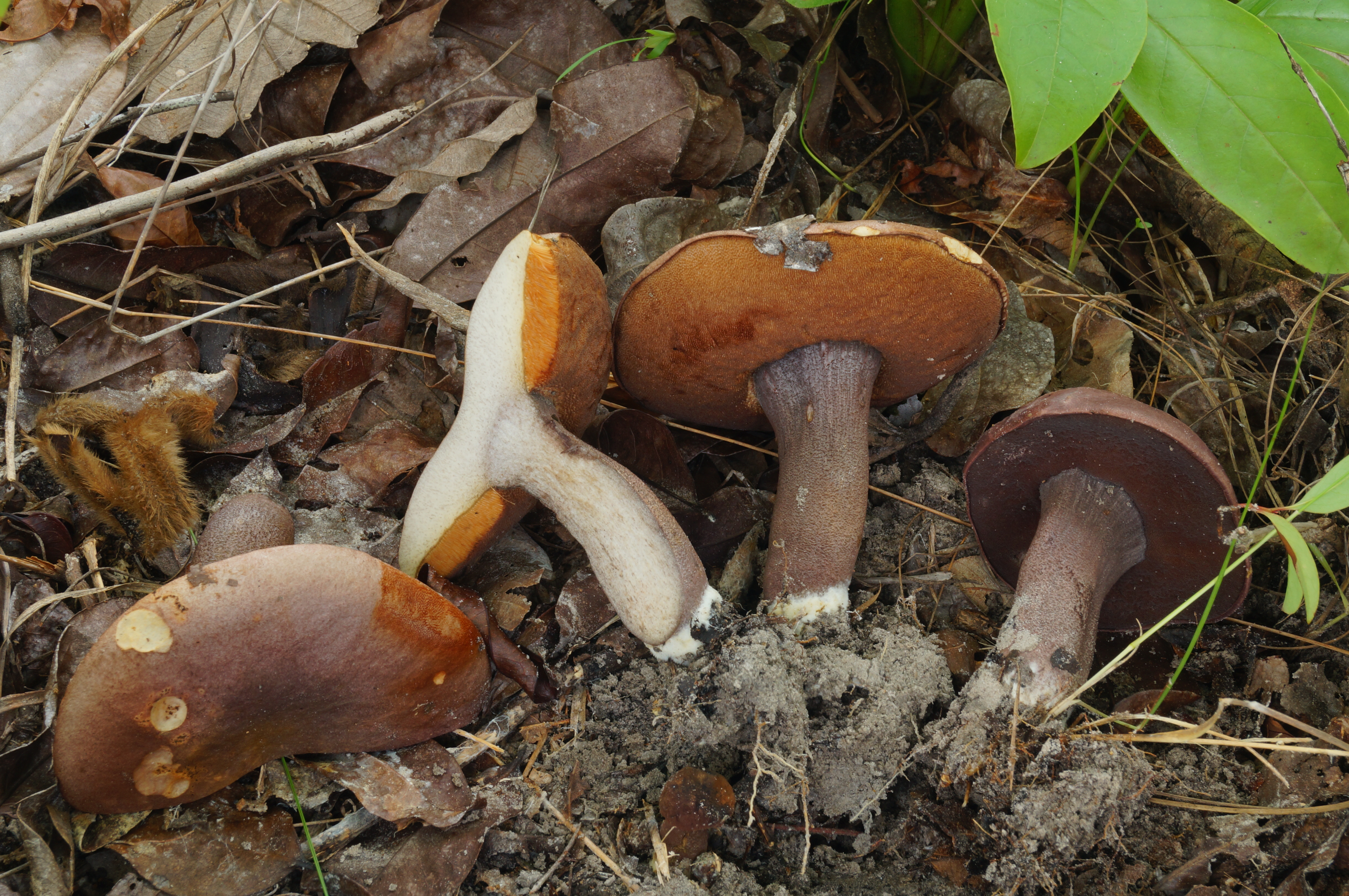
Sutorius ubonensis Vadthanarat, Raspé & Lumyong
- Scientific name
- Sutorius ubonensis
- Author
- Vadthanarat, Raspé & Lumyong
- Common names
 เห็ดผึ้งข้าวก่ำ
- เห็ดผึ้งดำ
- เห็ดผึ้งอีดำ
- IUCN Specialist Group
 Mushroom, Bracket and Puffball
- Kingdom
- Fungi
- Phylum
- Basidiomycota
- Class
- Agaricomycetes
- Order
- Boletales
- Family
- Boletaceae
- Assessment status
- Proposed
- Proposed by
- Santhiti Vadthanarat
- Comments etc.
- Santhiti Vadthanarat
Assessment Notes
Taxonomic notes
S. ubonensis is characterized by the combination of
following characteristics: medium-sized basidiomata, purplish
gray when young becoming purplish to reddish brown with
age; unchanged context; pileipellis a tomentum to slightly
gelatinized tomentum, with cylindrical terminal elements with
rounded apex; found in dipterocarp forest in Northeastern
Thailand. Morphologically, S. ubonensis is superficially similar
to S. eximius in macro-characters especially when young. Both
species are also similar in some microscopic characters.
However, they are different in pileipellis structure, with S. eximius
having a trichoderm, whereas S. ubonensis has a tomentum to
slightly gelatinized tomentum. The two species also occur on
different continents, with S. ubonensis being found in Ubon
Ratchathani Province, Northeastern Thailand, Southeast Asia,
whereas S. eximius is found in North America.NOTE: Sutorius ubonensis, was missed identified, and reported as S. eximius from Thailand.
Why suggested for a Global Red List Assessment?
Sutorius ubonensis is an edible mushroom species, grows in community forests in Ubon Ratchathani Province, Thailand. During the rainy season, this species is totally collected from the community forests by local people for their personal consumption and also for selling in local markets. In the last 10 years, the population of this species seems to be declining due to the decreasing of the areal of community forest and high demand by the local people. The habitat of this species has also been destroyed by fire, rubber trees, and cassava plantations.
At present (2021), the type locality where the holotype was collected, was almost completely destroyed for cassava plantation (about 3,000 from 90,000 square meters remaining).
Geographic range
The species was currently reported only from Ubon Ratchathani Province, the northeastern part of Thailand.
Population and Trends
In the last 10 years, the population of this species seems to be declining due to the decreasing of the areal of community forest and high demand by the local people. The habitat of this species has also been destroyed by fire, rubber trees, and cassava plantations.
Population Trend:
Habitat and Ecology
On soil, solitary to gregarious (up to 20 basidiomata), sometimes fasciculate. The species is an ectomycorrhizal associated with trees in dry dipterocarp forest dominated by Dipterocarpus obtusifolius, D. tuberculatus, Dipterocarpus intricatus, Shorea obtusa, and S. siamensis. elevation about 150 m
Threats
Sutorius ubonensis is ectomycorrhizal, grows in many community forests, produces its basidiomata only in the rainy season. The basidiomata are very famous for consumption by local people. Local people could earn around 200 Thai Baht from selling a kilogram of the mushroom. Therefore, a number of local people go to the community forests and totally collect the mushroom for consumption and selling in local markets.
However, in the past 10 years, the population of this species seems to be declining due to the decreasing of the areal of community forest and high demand by the local people. The habitat of this species has also been destroyed by fire, rubber trees, and cassava plantations. One of the localities where the species was found, is now almost completely destroyed for cassava plantation (about 3,000 from 90,000 square meters remaining).
Conservation Actions
Research needed
Identification of EMC host(s).