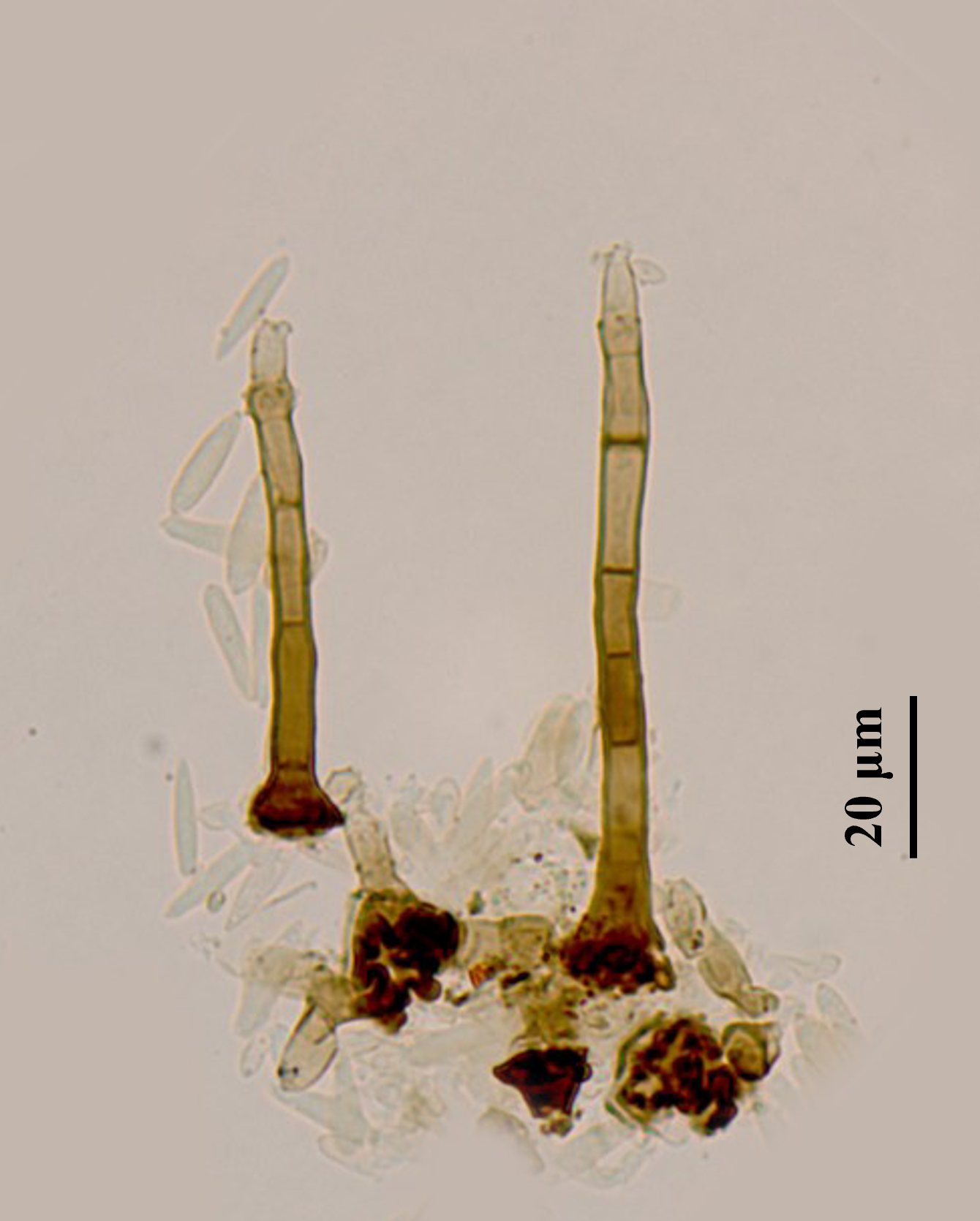
- Proposed
- Under Assessment
- Preliminary Assessed
- DDAssessed
- 5Published
Roselymyces brasiliensis Fiúza, C.R. Silva, R.F. Castañeda & Gusmão
- Scientific name
- Roselymyces brasiliensis
- Author
- Fiúza, C.R. Silva, R.F. Castañeda & Gusmão
- Common names
- IUCN Specialist Group
 Cup-fungi, Truffles and Allies
- Kingdom
- Fungi
- Phylum
- Ascomycota
- Class
- Sordariomycetes
- Order
- Xylariales
- Family
- Incertae sedis
- Assessment status
- Assessed
- Preliminary Category
- DD
- Proposed by
- Patricia Fiuza
- Assessors
- Patricia Fiuza, Flavia Barbosa
- Editors
- E. Ricardo Drechsler-Santos, Kelmer Martins da Cunha, Diogo H. Costa-Rezende
- Reviewers
- E. Ricardo Drechsler-Santos, David Minter, Kelmer Martins da Cunha
Assessment Notes
Justification
Roselymyces brasiliensis is a facultative aquatic fungus endemic to Brazil, known only from the headwaters of the Contas River, Bahia. It has been observed on leaves of Calophyllum brasiliense in both terrestrial and submerged conditions during a single collection in the rainy season, with no subsequent records. Although the environment where the species was found is facing several threats (anthropogenic and climate change), the fungus was recorded only once, in the type locality, what turns it difficult to understand the species population trend. In this case, the species deserves more study and political attention and is considered DD (Data Deficient).
Taxonomic notes
Opus principes: Sydowia 70: 60 (2018)
Why suggested for a Global Red List Assessment?
Geographic range
Roselymyces brasiliensis is a facultative aquatic fungus endemic to Brazil, recorded only in the headwater area of the Contas River. Only known from the type locality since its description (type locality: Brazil, Bahia, Piatã, Serra da Tromba, 13°07′S 041°50′W). The host plant, Calophyllum brasiliense Cambess., is common in naturally flooded or permanently inundated areas, thriving under hypoxic or anoxic conditions resulting from prolonged flooding (Rosa et al. 2017). Although C. brasiliense has a primarily Neotropical distribution according to the GBIF database, R. brasiliensis is expected to occur only in similar habitats along the river basin where its substrate (leaves of C. brasiliense) is present.
Population and Trends
Roselymyces brasiliensis is a facultative aquatic fungus, endemic to Brazil, recorded only once in the headwater area of the Contas River. The species was observed associated with leaves of Calophyllum brasiliense Cambess., both in terrestrial and submerged conditions, in a single site made during the rainy season (Fiuza et al. 2018). The plant is abundant in the riparian forests of the rivers in the Contas River basin. However, the riparian forests in the headwater region of this river show extensive fragmentation due to deforestation. The plant species is commercially important because it produces high-quality timber. The fungus was observed twice, in terrestrial and aquatic environments, but the leaves on which it sporulated came from the same tree, collected during the rainy season, and no subsequent records from the area are known. Based on this information and from its sampling efforts, R. brasiliensis appears to have a very small population, not necessarily in decline.
Population Trend: Uncertain
Habitat and Ecology
Roselymyces brasiliensis is a facultative aquatic fungus that was described in association with leaves of Calophyllum brasiliense from riparian forests in the headwaters of the Contas River, Bahia, Brazil. This fungus is likely endophytic, given that it emerged following substrate incubation while the leaf tissue was still green/fresh.
Threats
Altought it could be hard to confirm that the species population is in decline, its habitat is under several threats. The headwater area of the Contas River, located in the Serra da Tromba, Piatã-BA (a region of high ecological and hydrological importance) is under various anthropogenic pressures that compromise the maintenance of its natural processes. Among the main threats is the deforestation and fires within riparian areas, which reduces bank protection, increases erosion, and affects water infiltration and quality (Dinca et al. 2025). The fragmentation of these vegetation strips, which are essential for the ecological stability of headwater zones, hinders the maintenance of biodiversity and alters hydrological, matter, and energy flows within the ecosystem (Effert‑Fanta et al. 2022). Another significant threat for the habitat is the construction of dams for the irrigation of agricultural fields, such as potato cultivation. Water retention alters the natural flow regime, reduces downstream water availability, and affects the connectivity of aquatic ecosystems (Chakraborty, 2021). Multiple water uses in Brazil indicate that small agricultural dams can significantly impact the water balance of microbasins, especially in headwater regions (ANA, 2020). Furthermore, climate change exacerbates these effects by increasing the irregularity of rainfall distribution, lengthening drought periods, and raising average temperatures. The Intergovernmental Panel on Climate Change (IPCC, 2021) warns that headwater systems and small-order rivers are particularly vulnerable to climate variability due to their dependence on surface and groundwater recharge, which is sensitive to changes in rainfall patterns.
Conservation Actions
Roselymyces brasiliensis could be conserved in situ through actions aimed at protecting the plant with which it is associated, Calophyllum brasiliense, such as the establishment of a Protected Environmental Area at the site. Although the area hosts several headwaters of the Contas River basin and is considered a Permanent Preservation Area (APP) under the Brazilian Forest Code, it faces antrophogenic pressures. Therefore, formal designation of the area as a Protected Environmental Area would be desirable, safeguarding the host plant, the riparian forest, and consequently, the fungus. Ex situ conservation was carried out by depositing the R. brasiliensis culture in the Microorganism Culture Collection of Bahia (CCMB).
Research needed
It is necessary to better understand its role in the ecosystem, its interactions with other organisms (e.g., whether any organisms depend on it and vice versa), host specificity, and the environmental conditions that favor its development. This knowledge is essential for defining strategies for management, monitoring, and habitat protection where the fungus occurs. Additional collections are required to confirm geographic distribution. Also, research is needed to determine whether the species produces secondary metabolites and bioactive compounds of pharmaceutical, environmental, or medicinal interest, which would further increase the importance of conserving the species.
Use and Trade
The fungus has no traditional uses and is not commercially traded.