- Proposed
- Under Assessment
- DDPreliminary Assessed
- 4Assessed
- 5Published
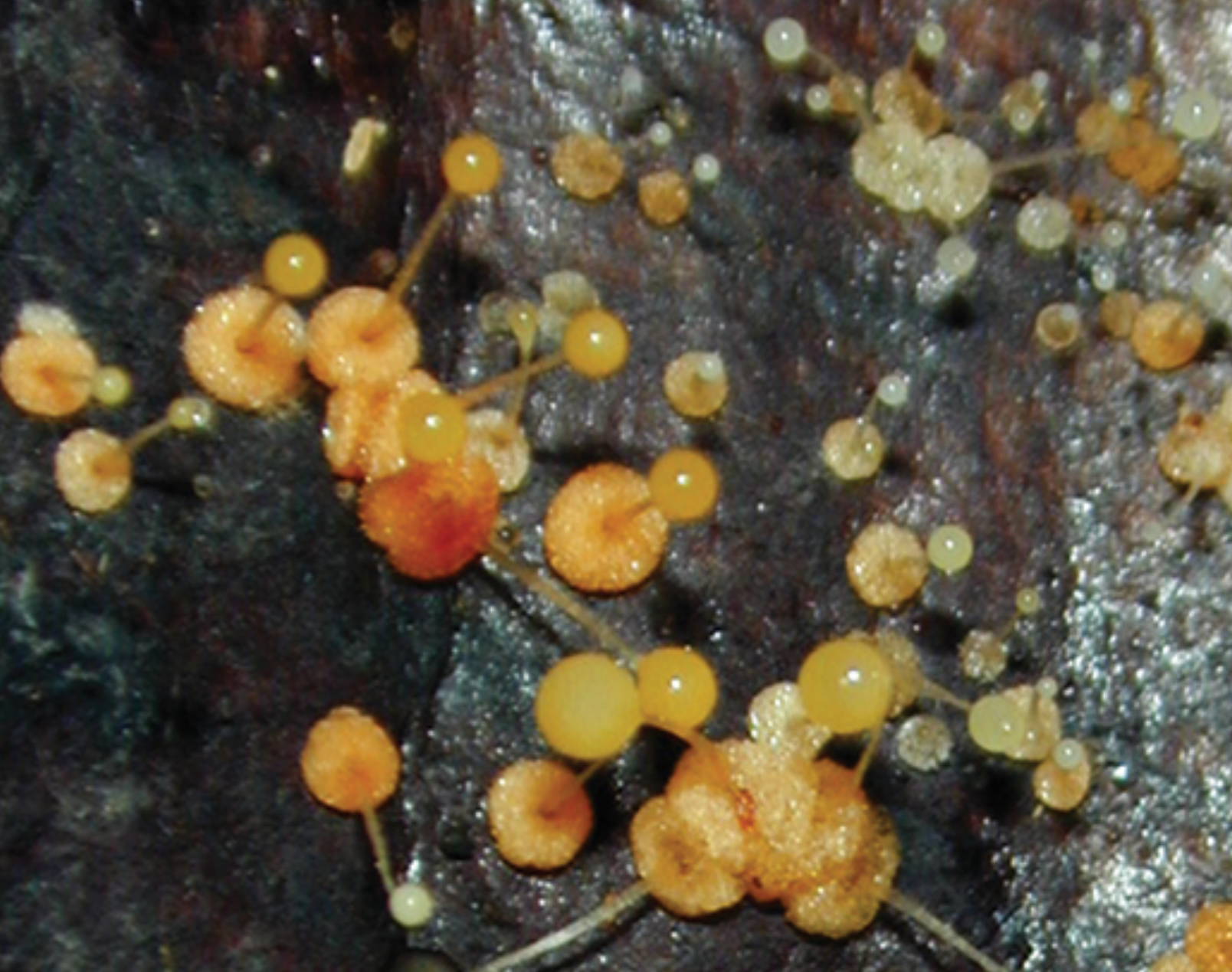
Pycnopulvinus aurantiacus Toome & Aime
- Scientific name
- Pycnopulvinus aurantiacus
- Author
- Toome & Aime
- Common names
- IUCN Specialist Group
 Mushroom, Bracket and Puffball
- Kingdom
- Fungi
- Phylum
- Basidiomycota
- Class
- Microbotryomycetes
- Order
- Heterogastridiales
- Family
- Heterogastridiaceae
- Assessment status
- Preliminary Assessed
- Preliminary Category
- DD
- Proposed by
- Jeff Stallman
- Assessors
- Jeff Stallman, Cathie Aime
- Comments etc.
- Anders Dahlberg
Assessment Notes
Justification
Pycnopulvinus aurantiacus is only known from the holotype location and has not been seen since 2004. Its host and habitat requirements are not fully known. Intermittent fungal surveys in Ecuador have occurred for decades (e.g., Læssøe & Petersen 2008) and systematic surveys have occurred at elevations > 1300 m (Vandegrift et al. 2023), but it has not been recollected. It is reasonable to assume that this small species may have been overlooked, or does not occur at higher elevations as the only collection was made between 300 and 650 m. Therefore, the population trends, size, and range of P. aurantiacus are unknown. Therefore, this species could potentially be either least concern or threatened with the current data available, so it is assessed as data deficient.
Taxonomic notes
There are no synonyms. The species is monotypic, being the only described species in the genus Pycnopulvinus. A nrITS DNA sequence in GenBank (AY323904, from Costa Rica) suggests at least one other species occurs in the genus, or this could potentially be conspecific with P. aurantiacus (Toome & Aime 2014).
Why suggested for a Global Red List Assessment?
The species has only been found once, in Ecuador, and is monotypic.
Geographic range
The species is known from a single collection in Manabi, Ecuador, in the vicinity of Bilsa Biological Station, N 0.350444, W 79.732075 (Toome & Aime 2014).
The nrITS sequence of the holotype has high (98.82%) pairwise similarity to GenBank sequence AY323904 (Spaaij et al. unpublished) isolated from Costa Rica. It is unknown whether this isolate is conspecific with P. aurantiacus or is another species of Pycnopulvinus (Toome & Aime 2014). The nrITS sequence of the holotype also has high pairwise similarity to two ITS1 sequences (both 98.66% over 149 bases, respectively) present in GlobalFungi (Větrovský et al. 2020) from a metabarcoding of fine root tips from Veracruz, Mexico (Schroeder et al. 2018).
No other sequences with high pairwise similarity are present in GlobalFungi or UNITE (Abarenkov et al. 2024). While these sequence data indicate this species, or a closely related species, could be present in Mexico or Costa Rica, this is not conclusive based on the available evidence, and this assessment only considers P. aurantiacus to be confirmed from the type collection in Ecuador.
Population and Trends
The population and current trends of P. aurantiacus are unknown. The species has only been confidently collected once.
P. aurantiacus may be a rare species. Despite sporadic fieldwork in Ecuador throughout the 20th Century (reviewed in Vandegrift et al. 2023) and more recent collection efforts throughout the country (Læssøe & Petersen 2008) or focused on specific regions (Vandegrift et al. 2023), P. aurantiacus has never been found apart from the holotype collection. Despite this, it is quite small and could potentially have been overlooked. Therefore, the current population and overall trend is unknown.
Population Trend: Uncertain
Habitat and Ecology
The species was found in a forest in Ecuador at an elevation of 300–650 m on a palm leaf mid-rib in May. It was found in a region where the Chocó–Darién moist forests grade into Ecuadorian dry forests. It is presumably saprotrophic.
Threats
The species was collected in a protected area, Mache-Chindul Ecological Reserve. Protected areas in Ecuador, including Mache-Chindul, continue to see deforestation, primarily due to agriculture (Kleemann et al. 2022).
Conservation Actions
As little information is known about P. aurantiacus, it is unknown if conservation actions are needed. At this time, site protection of its only known locality, to include input from, and alternative income potential for, those living in or on the borders of Mache-Chindul Ecological Reserve (Perlin & Leguizamón 2024) to reduce deforestation for agriculture may help ensure its only known habitat is not destroyed.
Research needed
Additional searches for this species at or around the type locality may help confirm its rarity. Additionally, collecting at the site in Costa Rica where the isolate from sequence AY323904 was found, and sites in Mexico where the samples (GF01013372S, GF01013405S) from Schroeder et al. (2018) were taken will help determine if these sequences, which share high pairwise similarity with P. aurantiacus, may indeed be from this species.
Use and Trade
n/a