- Proposed
- Under Assessment
- 3Preliminary Assessed
- 4Assessed
- 5Published
Cortinarius flavipallens Kytöv., Liimat. & Niskanen
- Scientific name
- Cortinarius flavipallens
- Author
- Kytöv., Liimat. & Niskanen
- Common names
 Skyggeslørsopp
 Trillingspindling
 Valjunuppiseitikki
- IUCN Specialist Group
 Mushroom, Bracket and Puffball
- Kingdom
- Fungi
- Phylum
- Basidiomycota
- Class
- Agaricomycetes
- Order
- Agaricales
- Family
- Cortinariaceae
- Assessment status
- Under Assessment
- Proposed by
- Martin Axegård
- Assessors
- Martin Axegård
- Editors
- Tor Erik Brandrud
- Comments etc.
- Anders Dahlberg
Assessment Notes
Justification
The estimated European and global population are assumed to comprised approx 230 localities, which correspond to (4368) individuals. The species has small and more or less isolated subpopulations (<250 individuals in every subpopulation). The distribution is assumed to be strongly fragmented. The area of occupancy is estimated to be 804 km^2 (VU, B2). Calcareous coniferous forests is a threatened biotope and is assumed to have had a decline of 15-20% in 50 years (or three generations). The species is assessed as VU according to the B2 as well as according to the C criterion (C2a(i)), the species reaches the threshold to classify as VU, due to its continuous decline (inferred from habitat decline, population size <10 000 individuals and very small/isolated subpopulations (less than 1,000 individuals per subpopulation).
Taxonomic notes
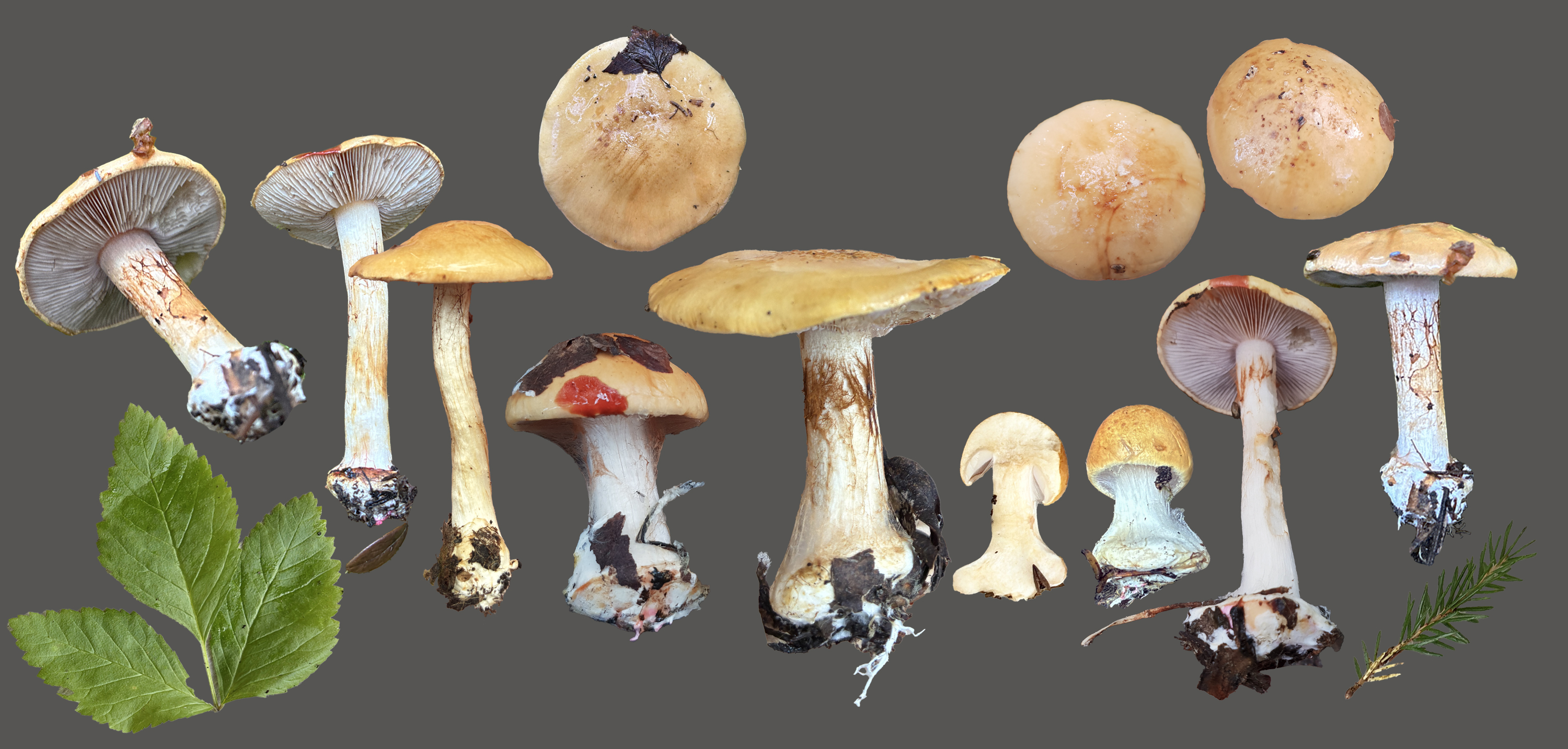
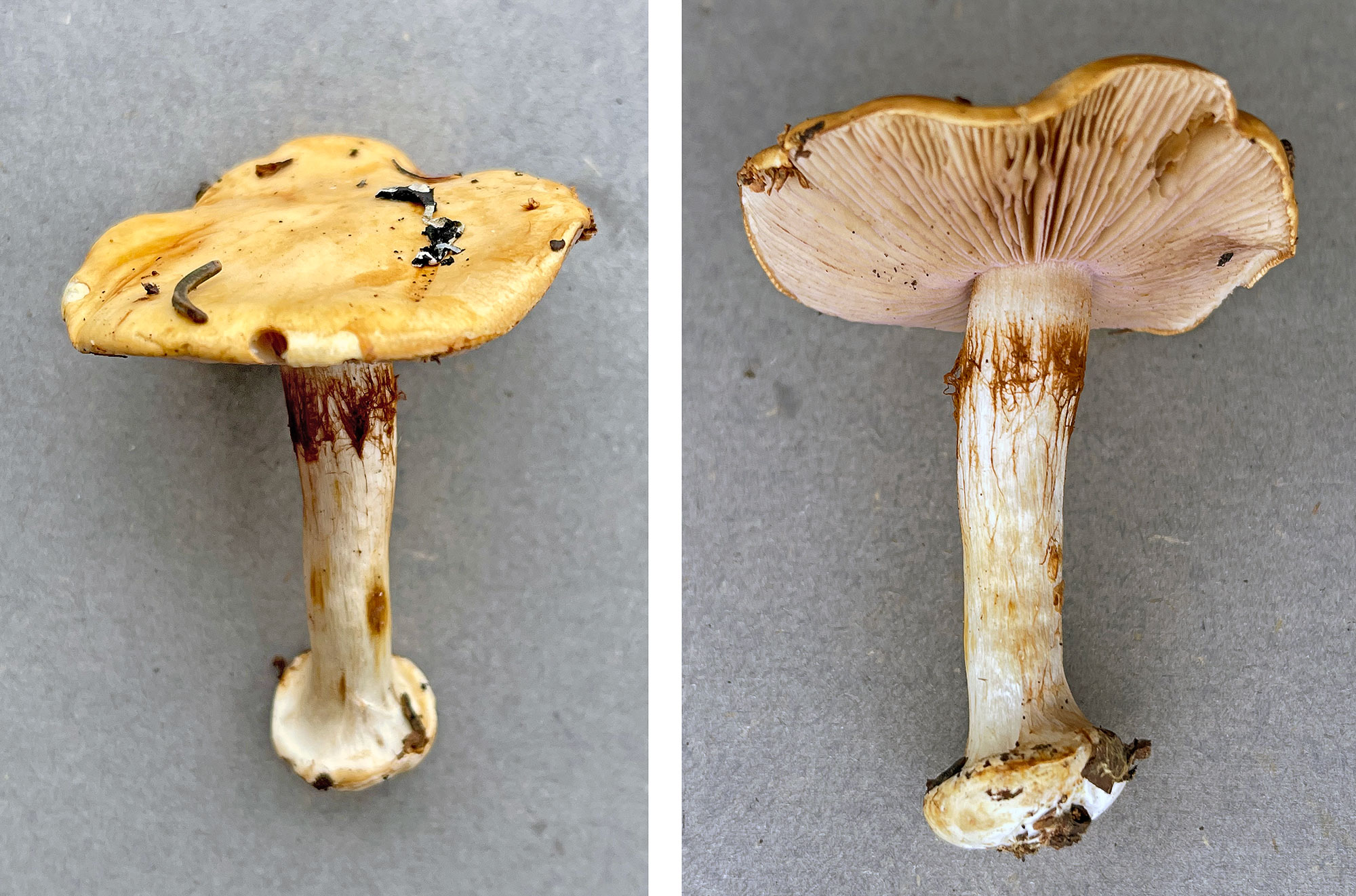
Cortinarius flavipallens is a typical representative of Cortinarius section Calochroi. Species of the group occur in calcareous environments and are characterized by robust basidiomas with smooth pileus, a dry stipe with a well-delimited marginate bulb, (white to) blue violet lamellae and many species have strong red-pink reactions with KOH (such as on the pileus margin, velum and basal mycelium). The morphological variation of C. flavipallens is considerable, but the species often tends to often have a comparatively slender shape (long and relatively narrow stipe in relation to the diameter of the pileus) and the marginate basal bulb is often flattened and sometimes pouch-lite. The pileus color has a warm, apricot tone when young, typically with small appressed freckles/spots concentrated toward the pileus center. Furthermore, the species completely lacks bluish pigments except rarely very weakly on the lamellae. The species overlaps with and may resemble other species of Cortinarius section Calochroi such as Cortinarius piceae, Cortinarius metarius, Cortinarius caesiocinctus and Cortinarius kristinae.
Why suggested for a Global Red List Assessment?
The species is associated with boreal calcareous Picea forests, being almost endemic to Fennoscandia.
Geographic range
Cortinarius flavipallens has a northern (-northeastern), boreal-continental, distribution of the Nordic region with the majority of records from the northern to middle subzones of the boreal zone with a select few outposts in southern boreal zone. It is currently known from Norway (Etnedal; 1 observation, 1 locale), Sweden (mainly from Norrbotten province but also from provinces of Ångermanland, Jämtland and Dalarna) and Finland (confirmed observations from regions Lapland, Kanta-Häme and Päijät-Häme, unconfirmed observations from the regions North Ostrobotnia, Kainuu, Central Finland and Pirkanmaa). There is also a single DNA-sequenced find from Italy.
Population and Trends
The Swedish and Finish populations make up the core areas from a European and worldwide perspective. The species was formally described (2014) based on Finnish collections from three localities. It was found in Sweden for the first time two years later (2016) on two locales in Jämtland region and later (2017) in Norway on a locality in Etnedal (Brandrud et al. 2019), which is so far the only observation from Norway. An additional 14 observations (DNA-sequence-confirmed) from 9 localities in Sweden have been confirmed with DNA-sequencing (2023 -2025). In total in the Nordic countries, there are 19 sequence-confirmed observations from 14 confirmed localities, with an additional 16 localities in Finland that can’t be independently verified (i.e. no public documentation provided).
Population Trend: Decreasing
Habitat and Ecology
The species forms ectomycorrhiza with spruce (Picea abies) in calcareous Picea abies forests. The habitat often has a long forest continuity and the availability of calcareous minerals may not be evident from the ground-level vegetation (dominated by Vaccinium myrtillus) of collection sites, but becomes more evident in the vicinity of superficial flowing ground water in the presence of calciphilous plants. Both the distribution pattern and specific localities show substantial overlap with the vascular plant fairy slipper (Calypso bulbosa).
Threats
Cortinarius flavipallens only known to occur in boreal calcareous Picea abies forests with continuity, environments vulnerable to fragmentation and to loss due to clear cutting. It has been assessed in a two European Red Data lists (Norway and Sweden). It is red-listed as Endangered (EN) (C2a(i)) in Sweden and is expected to continue to decrease due final felling of old growth calcareous Picea abies forests. A similar assessment of endangered (EN) ((B2a(i)b(ii,iii,iv); C2a(i))) was made in the 2021 national Norwegian Redlist. The Swedish and Finish populations make up the known core area and it is yet to be assessed on the Finnish red-list, although similar threat factors are applicable to both countries. The species appears to have difficulty recolonizing after final felling, and there is no evidence that it can re-establish and reproduce over the long term in forests subject to site preparation, fertilization, or clear cutting.
Conservation Actions
To prevent decline and further fragmentation of calcareous Picea abies forests with good habitat quality, it is important to set aside reserves on calcareous hotspots, housing many rare/threatened, habitat-specific species such as C. flavipallens, C. metarius and C. caesiocinctus.
Research needed
Use and Trade
There is no use and trade.