- Proposed
- Under Assessment
- Preliminary Assessed
- VUAssessed
- 5Published
Abrachium floriforme (Baseia & Calonge) Baseia & T.S. Cabral
- Scientific name
- Abrachium floriforme
- Author
- (Baseia & Calonge) Baseia & T.S. Cabral
- Common names
- IUCN Specialist Group
 Mushroom, Bracket and Puffball
- Kingdom
- Fungi
- Phylum
- Basidiomycota
- Class
- Agaricomycetes
- Order
- Phallales
- Family
- Phallaceae
- Assessment status
- Assessed
- Preliminary Category
- VU C2a(ii)
- Proposed by
- Rhudson Cruz
- Assessors
- Rhudson Cruz, Larissa Trierveiler-Pereira, Edilene Leite, Luciana da Canêz
- Editors
- E. Ricardo Drechsler-Santos, Kelmer Martins da Cunha, Diogo H. Costa-Rezende
- Reviewers
- Gregory Mueller, E. Ricardo Drechsler-Santos, Kelmer Martins da Cunha
Assessment Notes
Justification
Abrachium floriforme was only found growing on soil (usually sandy soil) with litter cover, in shaded forest environments along the Brazilian coast in Restinga habitats of the Atlantic Forest, with additional occurences in Caatinga “Brejos de Altitude” and Cerrado transitions. Abrachium floriforme is threatened by anthropic processes and climate change that influence the vegetation reduction of Atlantic Forest and specially to those small fragments of forests in altitudinal areas of the Caatinga domain. Main threats include agricultural expansion, invasive species, fire, monoculture plantations, and increasing urbanization. It is possible to assume 800 sites of a potential area of occurrence, with 6 mature individuals per site, and predicted population size of 4.800, or at least the double for total mature individuals in a single population. The population decline was expected in light of extension loss of suitable habitat and the putative influence that habitat degradation has on species occupation in a given environment. Based on this information, we can assume that the species population is in continuing decline within the next 30 years (three generations). For these reasons this species can be considered as Vulnerable under criterion C2a(ii).
Taxonomic notes
Abrachium floriforme was initially described as Aseroë floriformis by Baseia & Calonge (2005) in Restinga areas in the Atlantic Forest of Rio Grande do Norte, Brazil. Based on morphological and molecular data, the species was inserted in a genus named Abrachium, A. floriforme (Baseia & Calonge) Baseia & T.S. Cabral, published by Cabral et al. (2012).
Why suggested for a Global Red List Assessment?
Abrachium floriforme is an endemic Brazilian species of gasteroid fungi found in coastal and forestal areas of Atlantic Forest, and reaching forestal areas inside the Caatinga domain. The areas where the species is found are threatened by strong and recurrent anthropic actions without control of the existing environmental laws of Brazil. These actions are reducing the species habitat, resulting in a predicted 44,3% population decline in the next 30 years (3 generations), making this species Vulnerable (VU A3c; C1+2a(ii)).
Geographic range
Abrachium floriforme is found along the Brazilian coast (Rio Grande do Norte to Rio Grande do Sul) in Restinga habitats of the Atlantic Forest, with additional occurences in Caatinga “Brejos de Altitude” (Ceará, Bahia and Piauí States) and Cerrado transitions (São Paulo State) (Baseia & Calonge, 2005; Trierveiler-Pereira & Baseia, 2009; 2011; Trierveiler-Pereira et al., 2019; Fernandes et al., 2021). Known records are about 50 km apart in coastal areas, but 300 to 400 km apart in the “Brejos de altitude”. The species is predicted to exist as a single population ranging from the coastal Atlantic Forest to inland wet forests within the Caatinga and Cerrado ecotones. There is a additional photographic iNaturalist record from north of Venezuela, but given the impossibility of verifying the morphological and molecular data from that record, we argue that it should not be considered an official occurence of A. floriforme. It may instead of represent a distinct species.
Population and Trends
Based on the GBIF database, there are a total of 136 occurrence records in Brazil, and mostly in coastal areas in Atlantic Forest (the first record in 2004 at Dunas do Natal State Park, in Natal, Rio Grande do Norte State, growing on soil (Baseia & Calonge, 2005). Additional data were published for Bahia, Rio Grande do Norte, Ceará (Trierveiler-Pereira & Baseia, 2009) and Paraíba (Trierveiler-Pereira & Baseia, 2011) before the proposition of the genus Abrachium by Cabral et al. (2012). After that, records were made for the Caatinga domain (“Brejos de altitude”) in northeastern Brazil (Baseia et al., 2014), Atlantic Forest in Southeast and South Brazil (Trierveiler-Pereira et al., 2019), and the transitional area between Atlantic Forest and Cerrado in the State of São Paulo (Fernandes et al., 2021). It is possible to assume 800 sites of a potential area of occurrence, with 6 mature individuals per site, and predicted population size of 4.800, or at least the double of this (9,600) for total mature individuals in a single population. The population decline was expected in light of extension loss of suitable habitat for the Atlantic rainforest (and “Restinga”) and “Brejos de altitude” into Caatinga (Joly et al., 2014; Beuchle et al., 2015; Câmara et al., 2015; Rezende et al., 2018; Antongiovanni et al., 2020; Silva et al., 2020; Fundação SOS Mata Atlântica & INPE, 2021) and the putative influence that habitat degradation has on species occupation in a given environment (Berglund & Jonsson, 2003; Haddad et al., 2015). Based on this information, we can assume that the species population is in continuing decline within the next 30 years (three generations).
Population Trend: Decreasing
Habitat and Ecology
Abrachium floriforme was only found growing on soil (usually sandy soil) with litter cover, in shaded forest environments. Species from the northeast was found in the initial months of the year (January to June, with sporadic records in August and September in Rio Grande do Norte and Bahia States), while samples from the Southeast and South occur in August to January (with sporadic records between March to May in Rio de Janeiro State). Abrachium is a genus which uses insects as the main dispersal strategy for its spores. The spores are arranged in a disc-shaped mucilage in the upper portion of the flower-shaped sporome receptacle. Due to the strong odor, insects are attracted to the mucilage with spores, and this sticks to the animal’s body, allowing dispersions over relatively long distances, according to the flight area reached by the insect (usually from the Order Diptera).
Threats
Abrachium floriforme is threatened by anthropic processes and climate change that influence the vegetation reduction of Atlantic Forest and specially to those small fragments of forests in altitudinal areas of Caatinga biomes. In the Atlantic Forest, threats are based on agricultural activities, alien species, monoculture plantations, and growing urbanization (Rezende et al. 2018). Regarding the Caatinga domain, the exaggerated fragmentation due to anthropic actions has already reduced the domain to half of its total extension, and the remaining fragments are influenced by fire, deforestation for the formation of pastures, and biological invasion (Câmara et al. 2015; Beuchle et al., 2015; Antongiovanni et al., 2020), mainly for “brejos de altitude”.
Conservation Actions
Maintenance of conservation areas, as well as the creation of new areas in potential locations that have not yet been registered for the fungus. Effective control of human activities, especially illegal deforestation, clandestine fires and agricultural activities, and monoculture plantations should also be better controlled by competent authorities. Ex-situ conservation also is required.
Research needed
It is necessary to expand the phylogenetic analysis of some of the materials from the south and southeast of Brazil, mainly that iNaturalist record for Venezuela. Current data suggests high fragmentation, particularly in the “Brejos de Altitude”, and it remains unclear if these disjunction occurrences function as a single subpopulation. Future studies should qualify the impact of habitat loss and climate change on population trends.
Use and Trade
No commercial or traditional use was known for the species.
Bibliography

Abrachium floriforme in situ (Natal, Rio Grande do Norte, Brazil). Photo by Jefferson Góis.
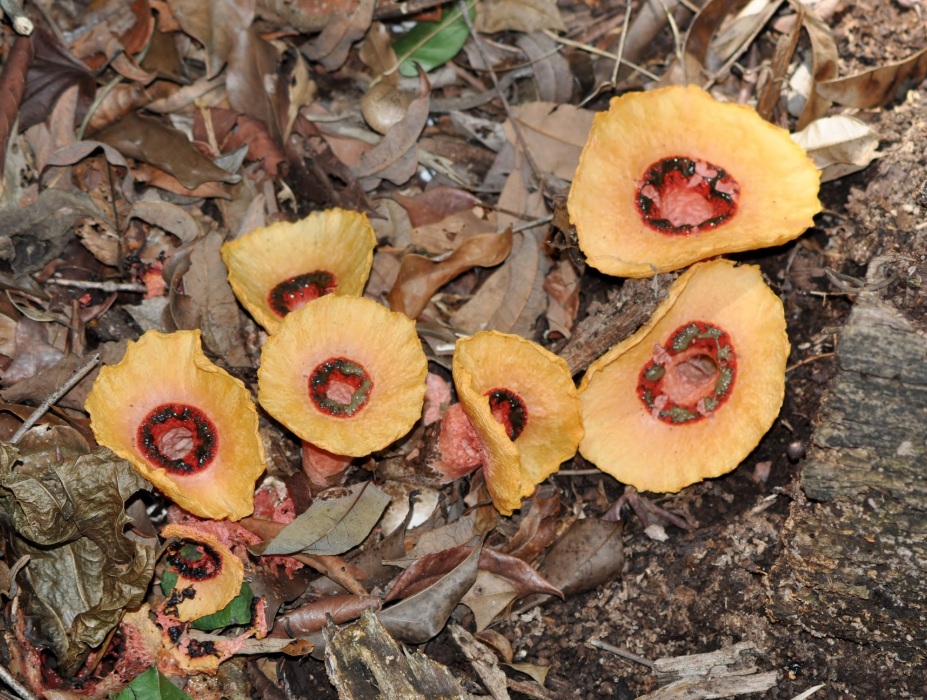
Several basidiomes of Abrachium floriforme (Santa Teresa, Rio de Janeiro, RJ). Photo by Georg H. Engelhard/iNaturalist
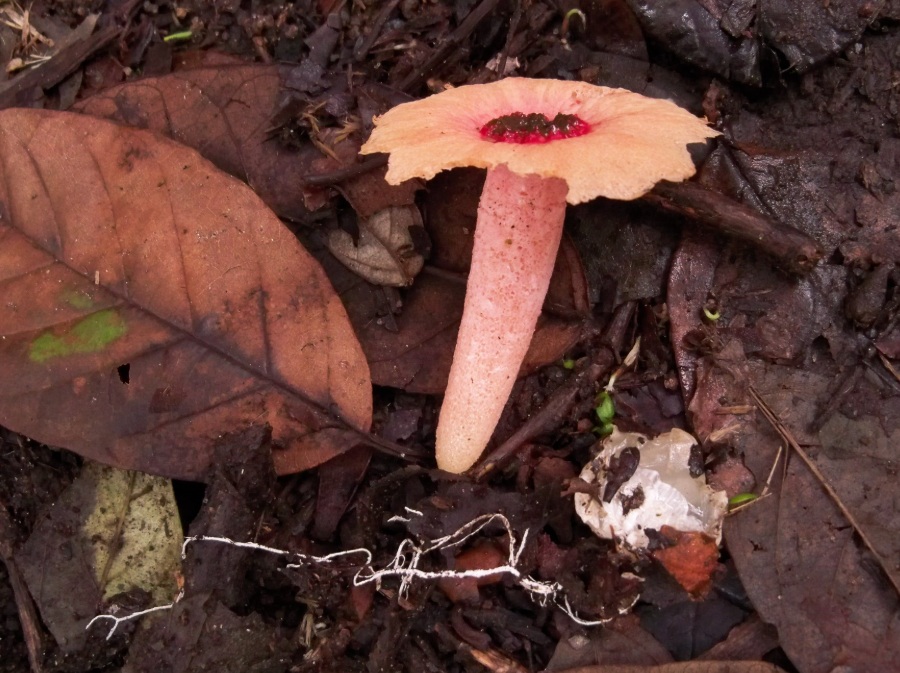
Rebio de Pedra Talhada, Alagoas. Photo by Vitor Xavier de Lima/iNaturalist
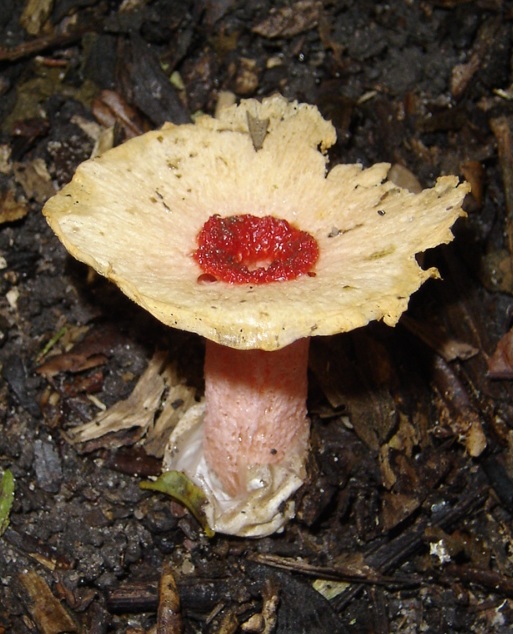
Alagoas, Brazil. Photo by Fernando Costa Straube/iNaturalist
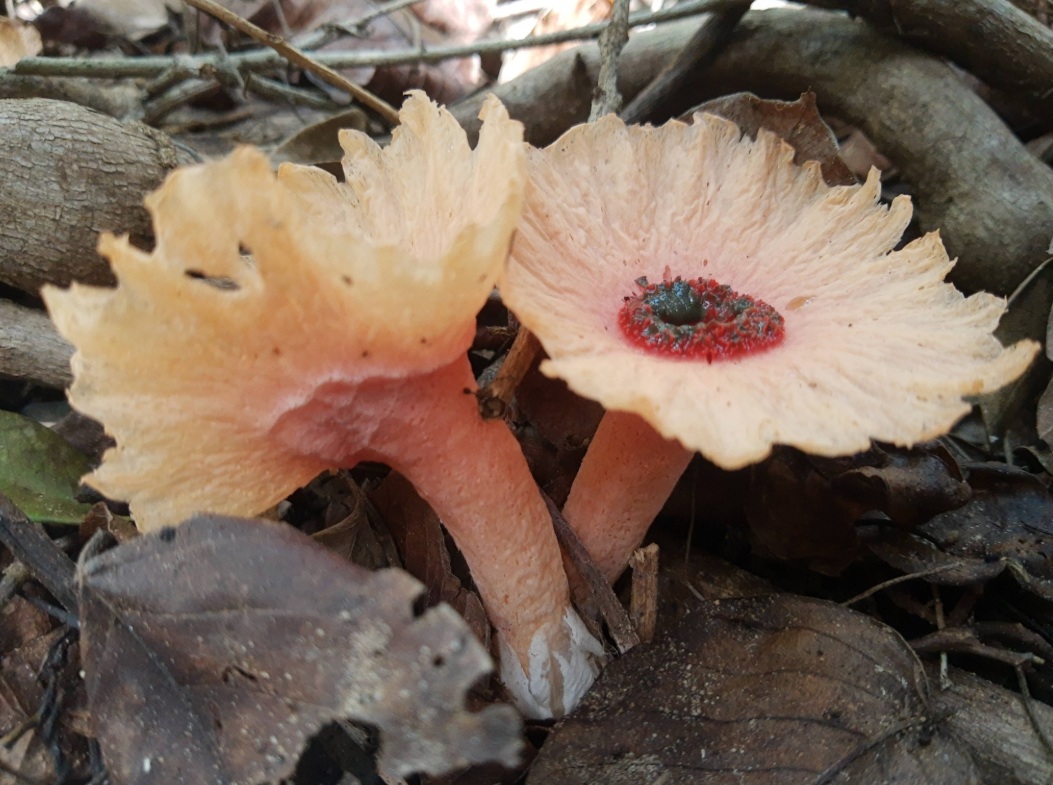
Tibau do Sul - RN, Brazil. Photo by: Glauber Souto/iNaturalist
Country occurrence
Regional Population and Trends
| Country | Trend | Redlisted |
|---|