- Proposed
- Under Assessment
- VUPreliminary Assessed
- 4Assessed
- 5Published
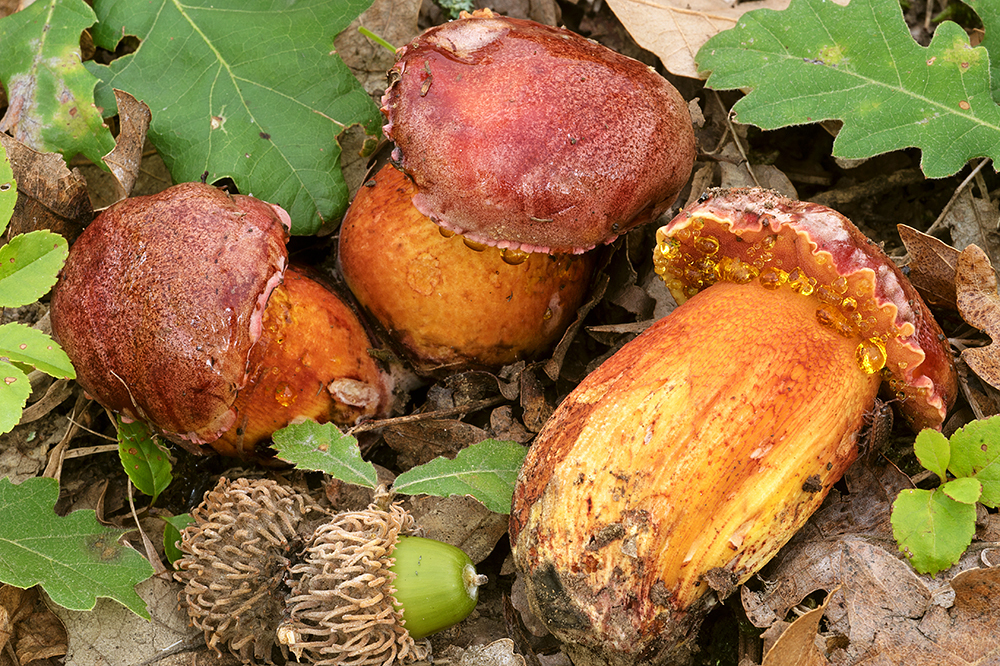
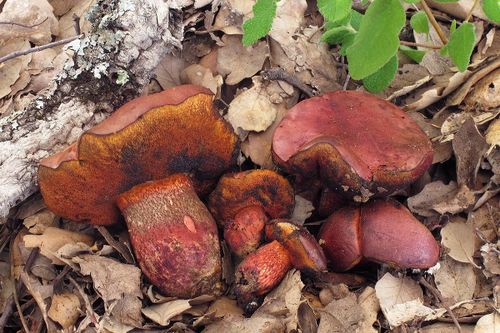
Exsudoporus permagnificus (Pöder) Vizzini, Simonini & Gelardi
- Scientific name
- Exsudoporus permagnificus
- Author
- (Pöder) Vizzini, Simonini & Gelardi
- Common names
- IUCN Specialist Group
 Mushroom, Bracket and Puffball
- Kingdom
- Fungi
- Phylum
- Basidiomycota
- Class
- Agaricomycetes
- Order
- Boletales
- Family
- Boletaceae
- Assessment status
- Preliminary Assessed
- Preliminary Category
- VU C2a(i)
- Proposed by
- Susana P. Cunha
- Assessors
- Susana P. Cunha
- Comments etc.
- Anders Dahlberg, Susana C. Gonçalves, Slavica Tofilovska
Assessment Notes
Justification
Exsudoporus permagnificus occurs in thermophilous oak woods in the European and West Asian regions of the Mediterranean basin. It is a rare species with a small population size that could range between 8,000 and 12,000 mature individuals. Its largest subpopulation is estimated to be between 1,000 and 2,000 mature individuals. A population decline is inferred due to habitat reduction and degradation, which will likely increase in the future. The number of mature individuals range the categories of Vulnerable and Near Threatened. However, given the rarity of the species and using a precautionary approach, it is assessed as Vulnerable (VU) under criterion C2a(i) due to its small population size and continuing decline.
Taxonomic notes
This species was classified as Exsudoporus permagnificus in 2014 (Vizzini, 2014), but the use of this name has been subject to discussion. Some authors have argued for the alternative use of Butyriboletus permagnificus (Wu et al., 2016; Janda et al. 2019), while more recent evidence supports the use of Exsudoporus permagnificus (Biketova et al., 2022; Bozok et al., 2019).
Other synonyms of this taxon are Boletus permagnificus and Suillellus permagnificus (Species Fungorum, 2025).
Why suggested for a Global Red List Assessment?
Geographic range
This species is distributed along the Mediterranean basin in Europe and Western Asia. So far it has been recorded in the south of Portugal (Lisboa, Santarém, Évora and Faro), Spain ( regions of Extremadura, Castile and León, Andalusia, Castile-La Mancha, Valencian Community, Catalonia, Aragon and Navarra), Italy (regions of Piedmont, Emilia-Romagna, Tuscany, Lazio, Calabria, Sicily and Sardinia), France (Occitanie, Provence-Alpes-Côte d’Azur and Corsica), Slovenia (Upper Carniola), North Macedonia, Greece (Western Macedonia and Thessaly), Bulgaria (Haskovo, Varna and Burgas), Turkey (Istanbul), Cyprus (Nicosia) and Israel (Haifa, The Northern District and Golan) (GBIF.org, 2026; Savvas, 2024; SIM, 2026; Wilson et al., 2026; Karaduman (2024); Fungos de Portugal (2026); Biketova et al., 2022; Assyov, 2005; Assyov, 2017; Bozok et al., 2019). However, the limits of its distribution are not yet well established, namely in the Balkans (Biketova et al., 2022; Assyov 2005, Wagensommer et al., 2022).
Population and Trends
This species has been documented in approximately 85 localities: 30 in Italy, 26 in Spain, 7 in France, 5 in Portugal, 5 in Greece, 5 in Israel, 3 in Bulgaria, and 1 in Slovenia, Turkey, North Macedonia and Cyprus each (GBIF.org, 2026; Savvas, 2024; SIM, 2026; Wilson et al., 2026; Karaduman (2024); Fungos de Portugal (2026); Biketova et al., 2022; Assyov, 2005; Assyov, 2017; Bozok et al., 2019, Wagensommer et al., 2022, Karadelev et al., 2018). It is considered rare and localised across its distribution (Biketova et al., 2022), and very rare in some countries, including Bulgaria, where it is Red Listed as Critically Endangered because of its small range in the country (Assyov, 2005; Peev et al., 2015) and Cyprus (Loizides et al., 2019) and in the central region of Italy (Wagensommer et al.,2022). Given the region’s mycological tradition and the conspicuous and easily recognisable nature of the species (Assyov, 2005), the number of undocumented localities is expected to be relatively low. Following guidelines by Dahlberg and Mueller (2011), the total population size is therefore estimated between 8,000 and 12,000 individuals by applying a small multiplier for unknown sites (x5-7), with an estimated number of 2 functional individuals at each locality and 10 mature individuals per functional individual. The regions of Northeastern Spain, South of France and the North and Central regions of Italy likely represent the largest subpopulation for this species, estimated between 1000 and 2000 individuals (25 sites x 2 functional individuals x 10 mature individuals x 2 to 4 multiplier for unknown localities).
The population of this species is likely to be in decline due to habitat reduction and degradation caused by threats and pressures on Mediterranean forests. There are no available estimates of oak forest decline in the Mediterranean region, but oak tree death and forest health declines have been reported in several countries (Gentilesca et al., 2017; Marques et al. 2025) and Global forest Watch shows a percentage of tree cover loss (30% canopy density) of 11% between 2001 and 2024 for the area of distribution estimated for this species (see map).
Population Trend: Decreasing
Habitat and Ecology
Ectomycorrhizal boletoid species that occurs gregariously or less frequently in solitary groups, preferably on acidic, clayey or sandy soil on thermophilous oak woods in the Mediterranean basin (Biketova et al. 2022). It is thought to be ectomycorrhizal with various Quercus species, including the non-native Q. rubra (Bozok et al., 2019). It has also been found in the presence of Castanea sativa and Cistus, or sometimes in mixed woods. (Biketova et al. 2022)
Threats
This species is threatened by a reduction in both the quality and extent of its habitat. Oak forest ecosystems in the region are affected by drought and wildfires, which contribute to forest decline in both area and condition (Marques et al., 2025; Gentilesca et al., 2017). This can prevent natural forest regeneration and lead to the conversion of forests into shrubland habitats (Acácio et al., 2009). Threats also include changes in land use, including to eucalypt and pine plantations, as well as agriculture (Acácio et al., 2017). Native and invasive pathogens and pests can also lead to high mortality of oak trees, including the fungus Phytophthora cinnamomi and beetle species such as Platypus cylindrus (FAO, 2025). Given its edibility, mushroom foraging (Biketova et al., 2022) may constitute an additional localised pressure in areas where it is collected.
These threats are expected to worsen in the future as the Mediterranean basin is projected to be a climate change hotspot. Accelerated changes in warming, precipitation and extreme weather events, such as wildfires, as well as the arrival and expansion of potential invasive species and pests are expected to occur (FAO, 2025), and exacerbate changes oak forest habitats in the region.
Conservation Actions
Monitoring and protection of known locations is recommended, as well as better management and protection of areas of appropriate habitat (e.g., fire prevention, forest cutting and management of invasive species).
Research needed
More research and search efforts are needed to better establish the distribution limits of the species and population size and trends.
Use and Trade
Edible species, after prolonged cooking. Reported to be commonly foraged in coastal areas south of Rome, but rarely prolific enough to be widely eaten (Biketova et al., 2022).