- Proposed
- Under Assessment
- Preliminary Assessed
- VUAssessed
- 5Published
Cortinarius cobaltinus Kytöv., Liimat. & Niskanen
- Scientific name
- Cortinarius cobaltinus
- Author
- Kytöv., Liimat. & Niskanen
- Common names
 Koboltspindling
 Kobolttinuppiseitikki
 koboltslørsopp
- IUCN Specialist Group
 Mushroom, Bracket and Puffball
- Kingdom
- Fungi
- Phylum
- Basidiomycota
- Class
- Agaricomycetes
- Order
- Agaricales
- Family
- Cortinariaceae
- Assessment status
- Assessed
- Preliminary Category
- VU C2a(i)
- Proposed by
- Martin Axegård
- Assessors
- Tor Erik Brandrud
- Editors
- Martin Axegård
- Reviewers
- Anders Dahlberg
Assessment Notes
Justification
Cortinarius cobaltinus is an ectomycorrhizal fungus associated exclusively with Picea abies, in boreal-montane-subalpine calcareous Picea- or mixed Picea-Abies-Pinus forests of N or C Europe, The phlegmacioid Cortinarius-rich, calcareous Picea abies forests often occupies small and fragmented areas, and the habitats are vulnerable of habitat loss and decline due to logging by clear cutting and also caused by urbanization, lime quarries, etc. The decline of the calcareous Picea forests during the last 50 years is estimated to be in the magnitude of 15-20%.
Cortinarius cobaltinus is known from approx. 25 sequence-verified localities in Europe/globally (15 in N Europe, 10 in C Europe), and the total population is estimated to approx. 400 localities, which is equivalent to approx. 8 000 mature individuals according to IUCN standards.
The species is subjected to an ongoing decline, population size <10,000 individuals and has very small/isolated subpopulations with than 1,000 individuals per subpopulation. Therefore, Cortinarius cobaltinus is listed as Vulnerable (C2a(i).
Taxonomic notes
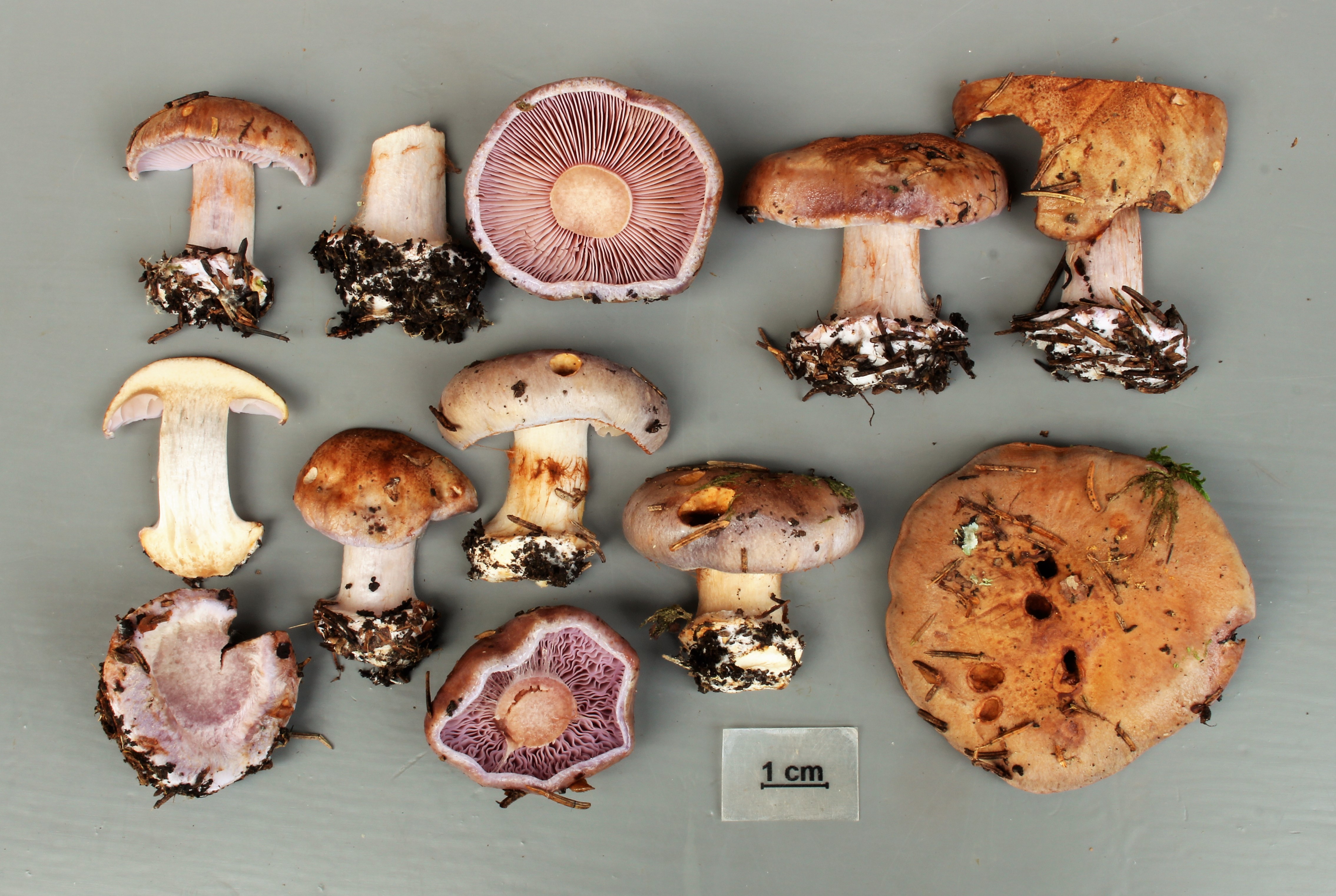
Cortinarius cobaltinus is closely related to the almost exclusively Northern European C. caesiocinctus; both being characterized by a geyish to fulvous brown pileus centre, and initially a bluish pileus margin; bluish lilac young gills and a pink-blood red KOH reaction on pileus margin, bulb and basal mycelium. C. cobaltinus differs from the latter by a more bright and persistent (lilac) blue pileus margin.
Why suggested for a Global Red List Assessment?
Cortinarius cobaltinus is a strictly European species, being habitat-specific for the declining boreal-subalpine calcareous Picea forests.
Geographic range
As many other European calciphilous Cortinarius Picea/conifer associates, Cortinarius cobaltinus shows a strictly European, bicentric distribution, restricted mainly to Central Fennoscandia (Norway, Sweden, Finland and Estonia) of northern Europe and the Jura-Prealp region of central Europe. In central Europe it is so far found mainly in eastern France, Switzerland and northern Italy. Soil samples (e-DNA) from Caucasus Georgia indicate that the species also occur in Caucasus mountains.
Population and Trends
Cortinarius cobaltinus is according to data from national redlists and GBIF data (April 2026) known from approx. 7 localities from Norway, 6 from Sweden, 2 from Finland and approx. 10 localities from the Jura-Prealps countries (E France, Switzerland-N Italy). The exact numbers are still a bit uncertain, due to mixing with the closely related C. caesiocinctus. Due to the complex taxonomy, the species seems little known and little sampled in many parts, especially of E Europe, where it is expected to occur at least in the Carpathians. The total population is estimated to not exceeding 400 localities, which is equivalent to less than 8 000 mature individuals (Dahlberg & Mueller, 2011).
The inferred past, inferred ongoing and suspected future decline of the calcareous Picea forests in the evaluation period (last 50 years, approximately 3 generations) is estimated to be in the magnitude of 15-20%. Based on this, the species could be red-listed as NT according to the A-criterion (A2c + 3c + 4c). However, the species is assessed as Vulnerable according to the C-criterion (C2a(i), due to ongoing decline, population size <10,000 individuals and very small/isolated subpopulations (less than 1,000 individuals per subpopulation).
Population Trend: Decreasing
Habitat and Ecology
Cortinarius cobaltinus seems to be associated exclusively with Picea abies. Its major habitats are strongly calcareous, mossy, herb-rich Picea abies forests or mixed Picea-Abies-Pinus forests of N or C Europe. In N Europe it is typical of almost barren limestone surfaces with karst structures (holes and furrows). These are forest types with many habitat-specific phlegmacioid taxa of Cortinarius, especially of the sect./subgen. Calochroi, where several are globally redlisted C. caesiocinctus (VU), C. dalecarlicus (VU), C. cupreorufus (NT), C. meinhardii (NT) and C. piceae (NT). The species occurs mainly in old-growth forests, but where habitat conditions otherwise are optimal, and mother-populations are prevailing in the landscape, it may also re-establish in >40 years old forest plantations after clear-cuts.
Threats
Cortinarius cobaltinus and its habitats, calcareous Picea abies and Picea-Abies-Pinus forests, have been declining e.g. due to areal loss (urbanization, including tourist resorts, road constructions, expansion of limestone quarries) as well as decreased habitat quality/ecological conditions due to modern forestry with clear-cuttings. The boreal calcareous spruce forests of Norway are now redlisted as Vulnerable or Near Threatened (dependent on region), mainly due to extensive forestry with clear-cuts (Artsdatabanken 2025). It should be noted that the species may re-establish and produce basidiocarps in formerly clear-cutted forests after approx. 40 years, but with repeated clear-cut forestry with rotation time of 50-55 years, the species will have a very short “dispersal window” with increasing problems with new re-establishments. Modern forestry is an increasing threat also in C Europe. Forest statistics from Austria indicates that forestry activity has been doubled the last 40 years, and according to a habitat-redlist in Austria, the Abies-Picea forests are endangered in many regions of Austria.
Conservation Actions
To prevent decline and further fragmentation of calcareous Picea forests with good habitat quality, it is important to set aside reserves on calcareous hotspots, housing many rare/redlisted, habitat-specific species such as C. caesiocinctus, C. cobaltinus, C. cupreorufus, C. dalecarlicus and C. piceae. It is furthermore important to establish also woodland key biotopes and similar (less strict) conservation regimes, where only non-destructive human activities are accepted (such as less intensive forestry, with closed cutting). To ensure time for dispersal and re-establishment between clear-cuts, it might also be important to lengthen the rotation time in production forests.
Research needed
More mapping/surveying and monitoring of C. cobaltinus are needed. The species is sometimes difficult to distinguish from the closely related C. caesiocinctus, and must be regarded as fairly little known, especially from e.g. the Carpathians, where it probably occurs, possibly also in the Balkan region and Caucasus. Finally, more documentation on the degree of decline of the habitats themselves is needed.
Use and Trade
The species is not utilized.