- Proposed
- Under Assessment
- Preliminary Assessed
- NTAssessed
- 5Published
Phellodon excentrimexicanus R.E. Baird
- Scientific name
- Phellodon excentrimexicanus
- Author
- R.E. Baird
- Common names
- IUCN Specialist Group
 Mushroom, Bracket and Puffball
- Kingdom
- Fungi
- Phylum
- Basidiomycota
- Class
- Agaricomycetes
- Order
- Thelephorales
- Family
- Bankeraceae
- Assessment status
- Assessed
- Preliminary Category
- NT B2b(ii,iii)
- Proposed by
- Roberto Garibay Orijel
- Assessors
- Roberto Garibay Orijel
- Comments etc.
- Anders Dahlberg, Gregory Mueller
Assessment Notes
Phellodon excentrimexicanus is an ectomycorrhizal fungus endemic to central Mexico where it is abundant. Currently it does not match any of the IUCN criteria to be classified as threatened. However its habitat is very fragmented and the current AOO is approaching the vulnerable category. As Mexico has one of the highest deforestation rates in the world, it is very probable that it would be threatened in the future.
Justification
P. excentrimexicanus AOO is declining, if deforestation rates in the center of Mexico continue it could decrease to less than 2000 km in the future; additionally, due to fragmentation the quality of the habitat is also decreasing.
Taxonomic notes
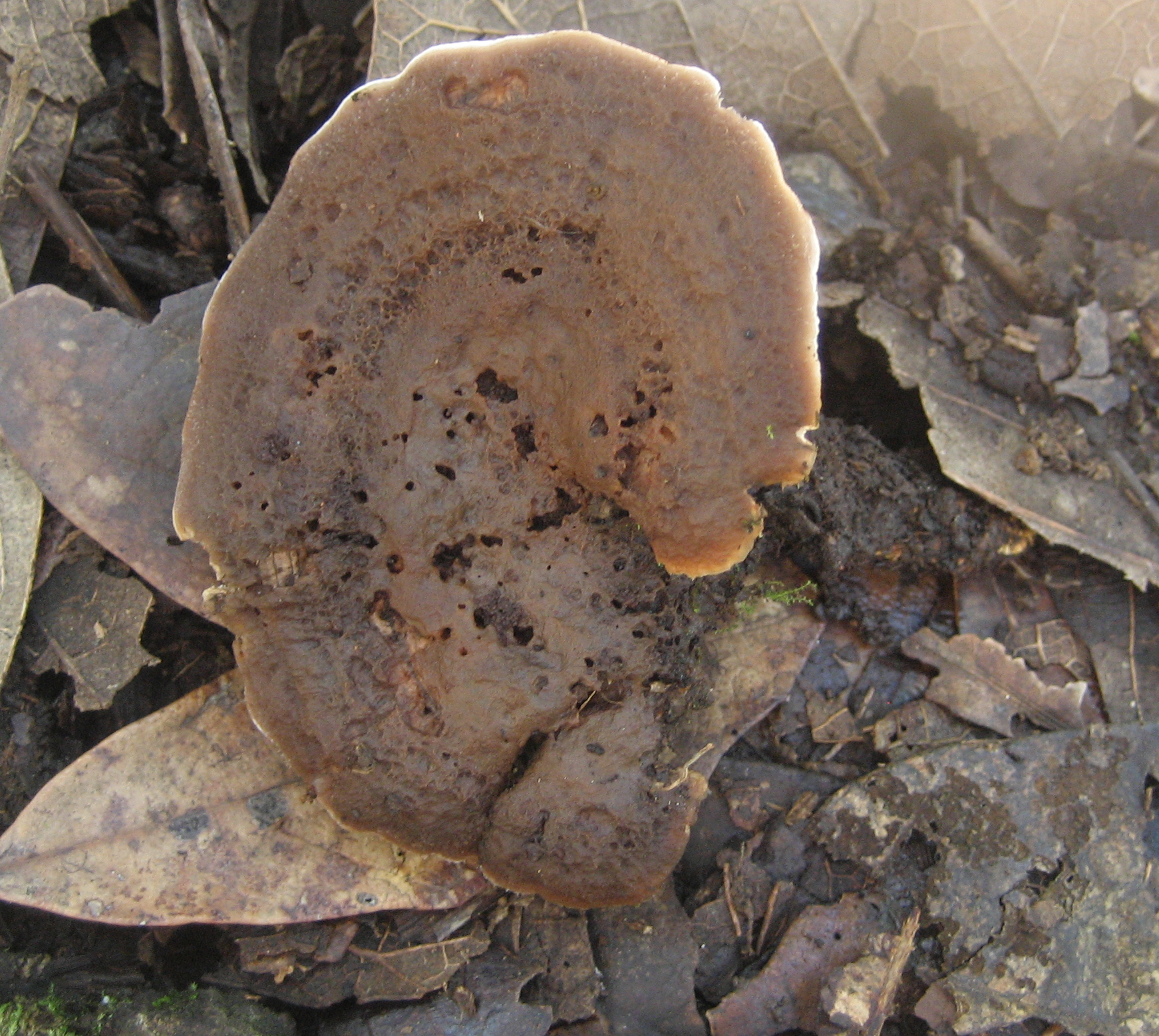
Phellodon excentrimexicanus (also referred as P. excentri-mexicana) is clearly delimited by an eccentric orange tomentous stipe, and a pileus with yellowish and cream colors, changing to dark violaceus color with damage. An absence of clamp connections in P. excentrimexicanus is a distinctive character in relation to its closest relative P. fibulatus (Baird, 1985). Another close species is P. plicatus, which can be distinguished because it has a brown-greyish pileus and a long and thin stipe (Cifuentes, 1996).
Why suggested for a Global Red List Assessment?
NOTE The documentation of this assessment is being revised and edited when finalized when entered to IUCNs Red-List database. Phellodon excentrimexicanus is an ectomycorrhizal fungus endemic to central Mexico whose main distribution is the Transmexican Volcanic Belt. As it develops in subtropical forests dominated by oaks its EOO is large. However this vegetation types are very fragmented and the current AOO is approaching the vulnerable category. As Mexico has one of the highest deforestation rates in the world, it is very probable that it would be threatened in the future.
Geographic range
Until 1996, P. excentrimexicanus was known only from the type specimen, recovered from Hidalgo state, Mexico. According to Cifuentes (1996) it distributes in ten states of Mexico, mainly from the central part of the country, with the majority of records form Estado de Mexico and Veracruz. This includes La Sierra de Las Cruces volcanic range and La Sierra del Chichinautzin, Nevado de Toluca volcano, La Sierra Nevada volcanic complex, La Sierra de Nanchititla (Nava Mora & Valenzuela Garza, 1997), La Malinche volcano, Sierra de Santa Rosa, and the northern records recovered are from Nayarit and Tamaulipas states (GBIF, 2018).
It has an EOO of 221,645.704 km2 and an AOO near 5000 km2.
Population and Trends
According to gbif database (GBIF, 2018) there are 16 P. excentrimexicanus subpopulations across La Sierra de Las Cruces volcanic range, and another six in La Sierra del Chichinautzin that includes Estado de Mexico, Morelos, and Mexico City. The majority of records from Estado de Mexico are between Valle de Bravo and Nevado de Toluca volcano. It also has another subpopulation in La Sierra Nevada. In Hidalgo state, there is one subpopulation near to Mineral El Chico, one close to Tlalchinol and another one in Tulancingo. Near to Xalapa City, Veracruz, there are six records in one subpopulation. Close to La Malinche Volcano, Tlaxcala there are two more records, and another three in northern Sierra de Puebla. There is another subpopulation with two records in La Sierra de Santa Rosa, Guanajuato. Also, there is one subpopulation in La Sierra Gorda, Querétaro, with two records; in Guerrero, surrounding Taxco City, there are another three records in one subpopulation. Its northern records are from Nayarit (two) and Tamaulipas (two).
This is the most abundant Phellodon species in Subtropical forests of Mexico; however, as it is endemic to central Mexico and the population is severely fragmented the population is in decline.
Population Trend: Decreasing
Habitat and Ecology
Always with gregarious habit, and few individual sporocarps. It generally grows in subtropical oak-pine, oak and cloud forests. Landeros et al. (2006) also reported a occasional record from Abies religiosa forests. Fruiting season is mainly in September.
Threats
Phellodon excentrimexicanus is an ectomycorrhizal fungus that grows in some of the most disturbed ecosystems types in Mexico like oak and cloud forests, these forests are been deforested for agriculture and cattle raising. Also, Quercus and Pinus forests are constantly under illegal timber extraction pressures. Some of the localities where this species grows are close to urban sites, where growing cities and pollution are some of the future major threats.
Conservation Actions
Even when some pine-oak forests are considered in National Parks territories, these ecosystems are under constant pressures in terms of pollution and timber extraction. Law enforcement in national parks should applied to stop illegal logging. Deforestation of temperate and subtropical forests outside national parks should also stop.
Research needed
There is little knowledge of occurrence of P. excentrimexicanus outside the Trans Mexican Volcanic Belt, with only two populations registered from Nayarit and Tamaulipas states. Research will be needed for clarifying if this species is restricted to central parts in Mexico. Also there is only one report of P. excentrimexicanus in Abies religisosa forests (Landeros et al., 2006), an extremely endangered forests type in Mexico due to climate change.
Use and Trade
There are not reports about edibility or use of these species.
Bibliography
Baird, R. E. (1985). New species of stipitate hydnums from southeastern United States and Mexico. Mycotaxon, 23, 297-304.
Cifuentes Blanco, J. (1996). Estudio Taxonómico de los Géneros Hidnoides Estipitados (Fungi: Aphyllophorales) en México. (PhD Thesis). Universidad Nacional Autónoma de México, Mexico City, Mexico.
Nava Mora, R., & Valenzuela Garza, R. (1997). Los macromicetos de la Sierra de Nanchititla. Polibotánica, (5), 21-36.
Landeros, F., Castillo, J., Guzmán, G., & Cifuentes, J. (2006). Los hongos (macromicetos) conocidos en el Cerro el Zamorano (Querétaro-Guanajuato), México. Revista Mexicana de Micología, (22), 25-31.
GBIF.org (9th February 2018) GBIF Occurrence Download https://doi.org/10.15468/dl.gepmmw