- Proposed
- Under Assessment
- Preliminary Assessed
- NTAssessed
- 5Published
Frantisekia mentschulensis (Pilát ex Pilát) Spirin
- Scientific name
- Frantisekia mentschulensis
- Author
- (Pilát ex Pilát) Spirin
- Common names
 bělochoroš naoranžovělý
 Abrikosporesvamp
 orange bokticka
 Orangebraune Tramete
- IUCN Specialist Group
 Mushroom, Bracket and Puffball
- Kingdom
- Fungi
- Phylum
- Basidiomycota
- Class
- Incertae sedis
- Order
- Incertae sedis
- Family
- Incertae sedis
- Assessment status
- Assessed
- Preliminary Category
- NT A4c, C1
- Proposed by
- Monika Kolényová
- Assessors
- Monika Kolényová
- Comments etc.
- Jan Merta, Irmgard Krisai-Greilhuber, Anders Dahlberg
Assessment Notes
Number of known sites is 120, estimated number of sites is 1000 (500 - 2000). The number of individual per site is 10, generation length is 30 years. Number of mature individuals is 10 000 (5 000 - 20 000).
Justification
Frantisekia mentschulensis is a fungus inhabiting the large trunks of deciduous trees in natural forests
and is threatened by forestry, habitat deterioration, and habitat loss, which reduce the availability of suitable substrate. Although it occurs on a broader range of host trees, it is found mainly on beech, which appears to be spreading to higher elevations, indicating that host-tree availability is not the principal constraint. Most known sites are located in protected areas, suggesting that the species was formerly more widespread and now persists mainly in well-preserved forest refugia. The loss of suitable habitat in Slovakia and Romania (EuroNatur, 2024) due to deforestation will limit the occurrence of this species in the future.
It is included in the Red Lists of few countries, ranged as EN to NT.
Taxonomic notes
Syn.: Antrodiella mentschulensis, Antrodiella fissiliformis s. auct. eur.
Why suggested for a Global Red List Assessment?
Rare polypore that grows in natural temperate deciduous forests (mixed mountain and ravine forests) and requires thick tree logs (Fagus sylvatica, Populus tremula, Tilia cordata, Acer platanoides, Carpinus betulus) to grow.
Geographic range
Frantisekia mentschulensis is an European species with scattered records over the continent. Most records are from Austria, Czech Republic (60 records, mostly in beech reserves), Denmark, Slovakika (15) and Sweden (10). From other countries, only few records are available, or entirely missing. Expected areas include Switzerland, Romania, and the Balkan countries. The known number of known sites is around 120 (combined with records of Antrodiella fissiliformis in Europe which is an North American hence rather refer to F mentschulensis, The total number of sites is estimated to be abound 1000.
Population and Trends
Population Trend:
Habitat and Ecology
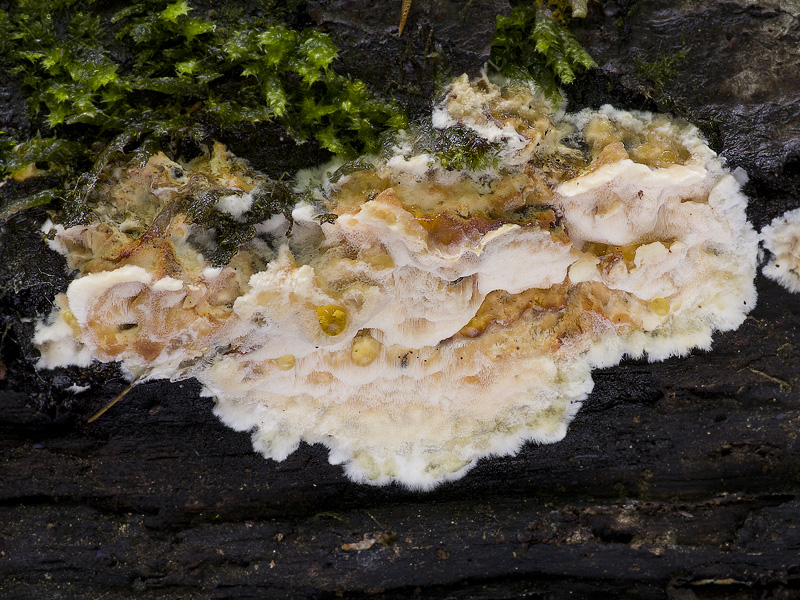
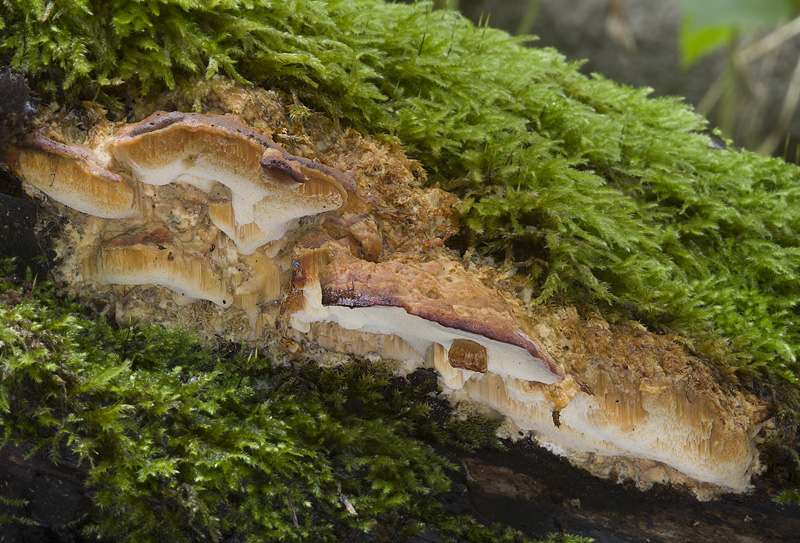
Frantisekia mentschulensis grows on decaying trunks of deciduous trees, primarily beech (but also oak, linden, and others), mostly in old-growth forests with a large amount of deadwood.
Threats
Destruction of habitat due to logging (especially of old beech trees).
Conservation Actions
Protection of natural and near-natural forest sites is needed. Leaving a high amount of high quality, i.e. coarse, dead wood is recommended.
Research needed
Use and Trade
It has has no known use or trade.