- Proposed
- Under Assessment
- NTPreliminary Assessed
- 4Assessed
- 5Published
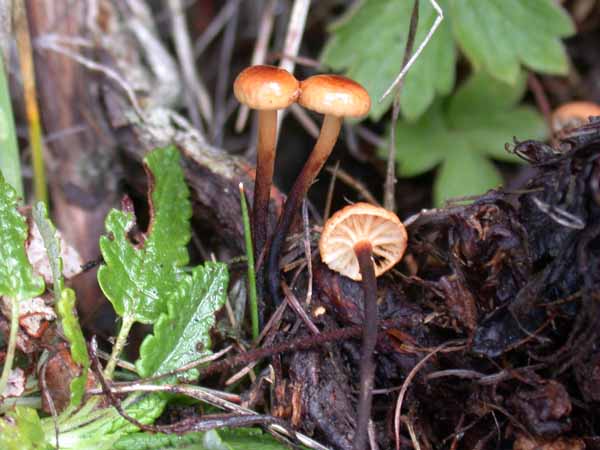
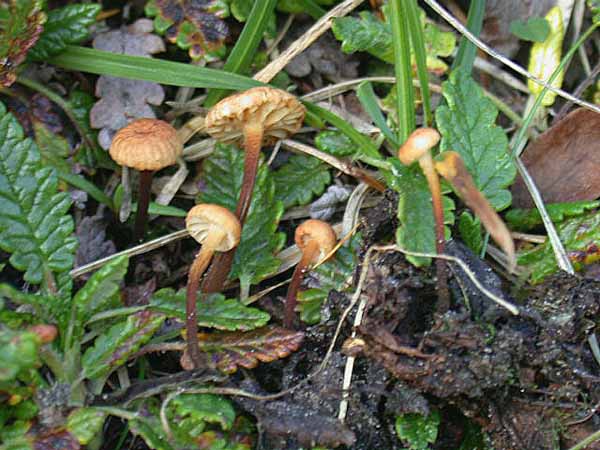
Marasmius epidryas Kühner ex A. Ronikier
- Scientific name
- Marasmius epidryas
- Author
- Kühner ex A. Ronikier
- Common names
 Silberwurz-Schwindling
- IUCN Specialist Group
 Mushroom, Bracket and Puffball
- Kingdom
- Fungi
- Phylum
- Basidiomycota
- Class
- Agaricomycetes
- Order
- Agaricales
- Family
- Marasmiaceae
- Assessment status
- Preliminary Assessed
- Preliminary Category
- NT A3c+4c
- Proposed by
- Artemis Treindl
- Assessors
- Artemis Treindl, Irmgard Krisai-Greilhuber, Tor Erik Brandrud
- Editors
- Anders Dahlberg
- Reviewers
- Anders Dahlberg
Assessment Notes
Justification
Rhizomarasmius epidryas is a widespread but not common arctic-alpine and alpine species, strictly associated with Dryas on calcareous soils. The extent and quality of suitable habitat have declined and are expected to decline substantially over the coming decades with more thermophilous and fast-growing species expanding upslope and affecting specialized alpine and arctic plant communities (see Threats section for references). Based on these observed and projected habitat trends and the species’ ecological specialization, an ongoing and future global population reduction of at least 15% over a 50-year assessment period is conservatively inferred. The species is therefore assessed as Near Threatened (NT) under Criteria A3c+4c.
Taxonomic notes
Marasmius epidryas Kühner ex A. Ronikier is a synonym.
Why suggested for a Global Red List Assessment?
Geographic range
The species has a circumpolar distribution and is restricted mainly to the arctic and alpine zones, following its host distribution (Dryas octopetala in Europe & Asia, D. alaskanus, D. drummondii and D. integrifolia in North America), (Ronikier & Ronikier 2010).
Population and Trends
There are only 492 occurrences in GBIF, a number which definitely is underestimating the actual distribution when comparing with rather well studied alpine areas like Switzerland (with 105 records) or Norway (with 40 known and estimated 1000 localities). We estimate the total number of known and unknown localities to be no less than 1500 for Northern Europe and the same number for the Alps and possibly the Carpathian Mountains. Records are more scarce in Russia and North America but the species also seems to be widely distributed there. We assume an additional 1500 localities for these regions. This adds up to an estimated number of 4500 localities worldwide. We assume on average 5 (10) fungal individuals (unique genotypes) per site each potentially comprising of several clones resulting in a total population size of >20000 mature individuals (cf. Dahlberg and Mueller, 2011).
Rhizomarasmius epidryas is a characteristic and easily identifiable species, however, its alpine and arctic-alpine habitats are relatively poorly surveyed for fungi. Known records therefore likely represent only a fraction of the true population. It is strictly associated with Dryas in alpine and arctic-alpine habitats, where suitable habitat is expected to decline, particularly due to climate-driven vegetation change. Based on these habitat trends and the species’ ecological specialization, a global population decline of at least 15% over the next 50 years is conservatively inferred.
Population Trend: Decreasing
Habitat and Ecology
This species is associated with Dryas spp. and lives saprotrophically on dead leaves and stems. It is highly specific to its host, which forms dense cushions on calcareous soils. Rhizomarasmius epidryas is known almost exclusively from the alpine and arctic-alpine zone.
Threats
Rhizomarasmius epidryas is threatened primarily by climate warming and associated changes in arctic–alpine vegetation. Alpine habitats are already undergoing substantial compositional change, with more thermophilous and fast-growing species expanding upslope and affecting specialized alpine and arctic plant communities (Pauli et al. 2012; Ramskogler et al. 2025). Because R. epidryas is closely dependent on Dryas spp. as a substrate, declines in the extent or condition of Dryas-dominated habitats are expected to negatively affect its populations. Dryas cushions can be very old and slow-growing, making them particularly vulnerable to climatic stress such as increasing drought and reduced snow cover, while vegetation shifts may further reduce suitable open habitat. Range expansion upwards is likely very limited due to a lack of suitable calcareous habitats. Local populations may also be affected by physical disturbance and habitat degradation from infrastructure development and tourism.
Conservation Actions
Conservation should focus on maintaining the extent, quality, and ecological integrity of known and potential arctic and alpine habitats and preventing avoidable local degradation from infrastructure development, intensive recreation, and other physical disturbance. Although the broader impacts of climate change cannot be addressed through species-specific conservation measures, protecting intact and well-connected habitats where Dryas occurs is key to the conservation of Rhizomarasmius epidryas populations.
Research needed
Monitoring of sites with known occurrences of Dryas would help clarify the distribution, population trends, and response of Rhizomarasmius epidryas to ongoing habitat and climatic changes.
Use and Trade
There is no known significant use or trade of this species.