- Proposed
- Under Assessment
- Preliminary Assessed
- ENAssessed
- 5Published
Lactarius coccolobae O.K. Mill. & Lodge
- Scientific name
- Lactarius coccolobae
- Author
- O.K. Mill. & Lodge
- Common names
- IUCN Specialist Group
 Mushroom, Bracket and Puffball
- Kingdom
- Fungi
- Phylum
- Basidiomycota
- Class
- Agaricomycetes
- Order
- Russulales
- Family
- Russulaceae
- Assessment status
- Assessed
- Preliminary Category
- EN A3c; C1
- Proposed by
- Julieta Alvarez-Manjarrez
- Assessors
- Roberto Garibay Orijel, Julieta Alvarez-Manjarrez
- Editors
- Roberto Garibay Orijel
- Comments etc.
- Anders Dahlberg
Assessment Notes
Lactarius coccolobae is an ectomycorrhizal fungi associated to Coccoloba uvifera in some Caribbean islands. Its distribution range is limited to dune ecosystem in coastal line, this ecosystem is highly threatened by the touristic activities and urbanization. Additionally, climate change scenarios predict, the sea level will increase 1-2 m in the Caribbean in the next century with a concurrent 1,300 km2 coastal land area lost (Clark et al., 2015; Simpson 2017). In consequence this ecosystem is in sever risk.
Justification
Lactarius coccolobae should be listed as Endangered under the criteria A3c as its population is going to reduce at least 50% in the next 100 years do to a reduction in AOO by sea level increase, urbanization and increase of hurricanes and flooding. Additionally, its populations are very small and geographically restricted. Recent studies (Polme et al., 2017; Séne et al., 2018) have not found again again L. coccolobae fruit bodies nor environmental sequences. In consequence, the only two known subpopulations are estimated to contain no more than 2000 mature individuals that will suffer a 50% decline in the next 50 years. So it should listed also as Endangered under criteria C1.
Taxonomic notes
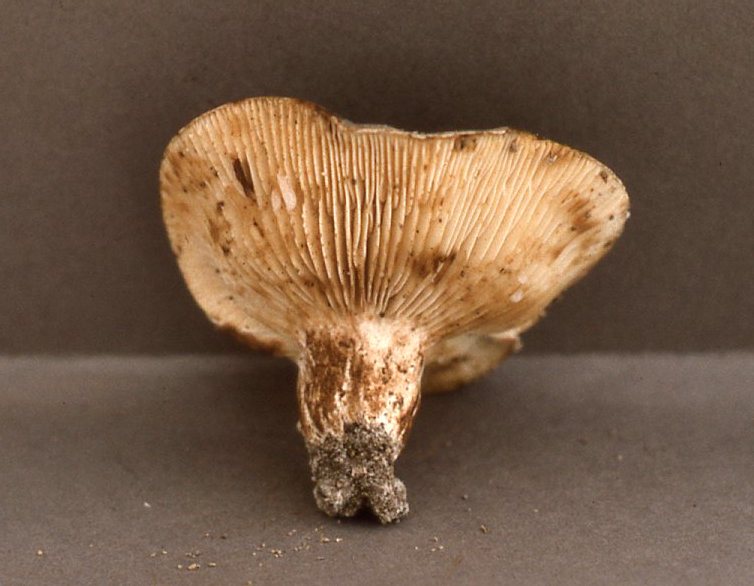
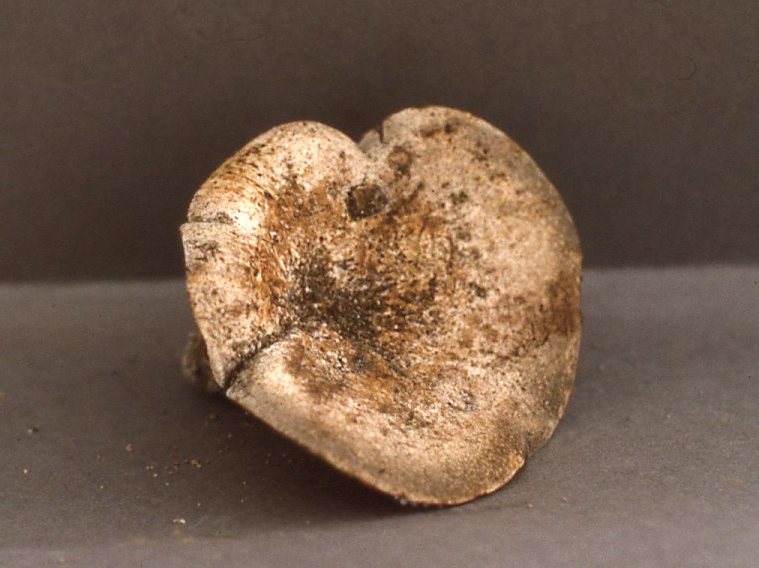
Basidiomata very robust, with pileus light brown. The flesh of fruit body stain brown when bruised. It is similar to Lactarius caribaeus Pegler (Pegler 1983), both have similar microscopic anatomy, with warts on the spores, and its size. However, basidia are shorter and the pileipellis is gelatinized in L. coccolobae.
Why suggested for a Global Red List Assessment?
Lactarius coccolobae is an ectomycorrhizal fungi associated to Coccoloba uvifera in some Caribbean islands. Its distribution range is limited to dune ecosystem in coastal line, this ecosystem is highly threatened by the touristic activities and urbanization. Additionally, climate change scenarios predict, the sea level will increase 1-2 m in the Caribbean in the next century with a concurrent 1,300 km2 coastal land area lost (Clark et al., 2015; Simpson 2017). In consequence this ecosystem is in sever risk.
Lactarius coccolobae should be listed as Endangered under the criteria A3c as its population is going to reduce at least 50% in the next 100 years do to a reduction in AOO by sea level increase, urbanization and increase of hurricanes and flooding. Additionally, its populations are very small and geographically restricted. Recent studies (Polme et al., 2017; Séne et al., 2018) have not found again again L. coccolobae fruit bodies nor environmental sequences. In consequence, the only two known subpopulations are estimated to contain no more than 2000 mature individuals that will suffer a 50% decline in the next 50 years. So it should listed also as Vulnerable under criteria C1.
Geographic range
Guana Island, British Virgin Islands. Puerto Rico
Population and Trends
Three populations reported from the publication where the species was described.
Population Trend: Decreasing
Habitat and Ecology
Ectomycorrhizal fungi associated to Coccoloba uvifera
Threats
This species was described from sand dunes related to Coccoloba uvifera. Constatly this sand dunes are transformed to touristic stations.
Conservation Actions
None
Research needed
There are studies about the ectomycorrhizal fungal communities from Coccoloba uvifera, however they had not report again L. coccolobae. It is necessary to extend the sampling in the same sites to know if the type populations stay there. Also, more sampling in other islands could help to clarify the distribution.
Use and Trade
Unknown
Bibliography
Clark PU, Church JA, Gregory JM, Payne AJ. 2015. Recent Progress in Understanding and Projecting Regional and Global Mean Sea Level Change. Current Climate Change Reports 1: 224–246.
Laffoley D, Baxter JM. 2016. Explaining ocean warming: causes, scale, effects and consequences.
Miller OK, Lodge DJ, Baroni TJ. 2000. New and interesting ectomycorrhizal fungi from Puerto Rico, Mona, and Guana Islands. Mycologia 92: 558–570.
Pegler DN. 1983. Agaric flora of the Lesser Antilles. Kew Bulletin Add Series IX: 1-668.
Põlme S, Bahram M, Kõljalg U, Tedersoo, L. 2017. Biogeography and Specificity of Ectomycorrhizal Fungi of Coccoloba uvifera. In: Tedersoo L (ed.). Biogeography of Mycorrhizal Symbiosis. Ecological Studied vol 230. Springer. DOI 10.1007/978-3-319-56363-3
Séne S, Avril R, Chaintreuil C, Geoffroy A, Ndiaye C, Diédhiou AG, Sadio O, Courtecuisse R, Sylla SN, Selosse MA, et al. 2015. Ectomycorrhizal fungal communities of Coccoloba uvifera (L.) L. mature trees and seedlings in the neotropical coastal forests of Guadeloupe (Lesser Antilles). Mycorrhiza 25: 547–559.
Simpson, M. C. (2017). Quantification and Magnitudeof Losses and Damages Resulting from the Impacts of Climate Change: Modelling the Transformational Impacts and Costs of Sea Level Rise in the Caribbean (Key Points andSummary for Policy Makers Document).