- Proposed
- Under Assessment
- Preliminary Assessed
- LCAssessed
- 5Published
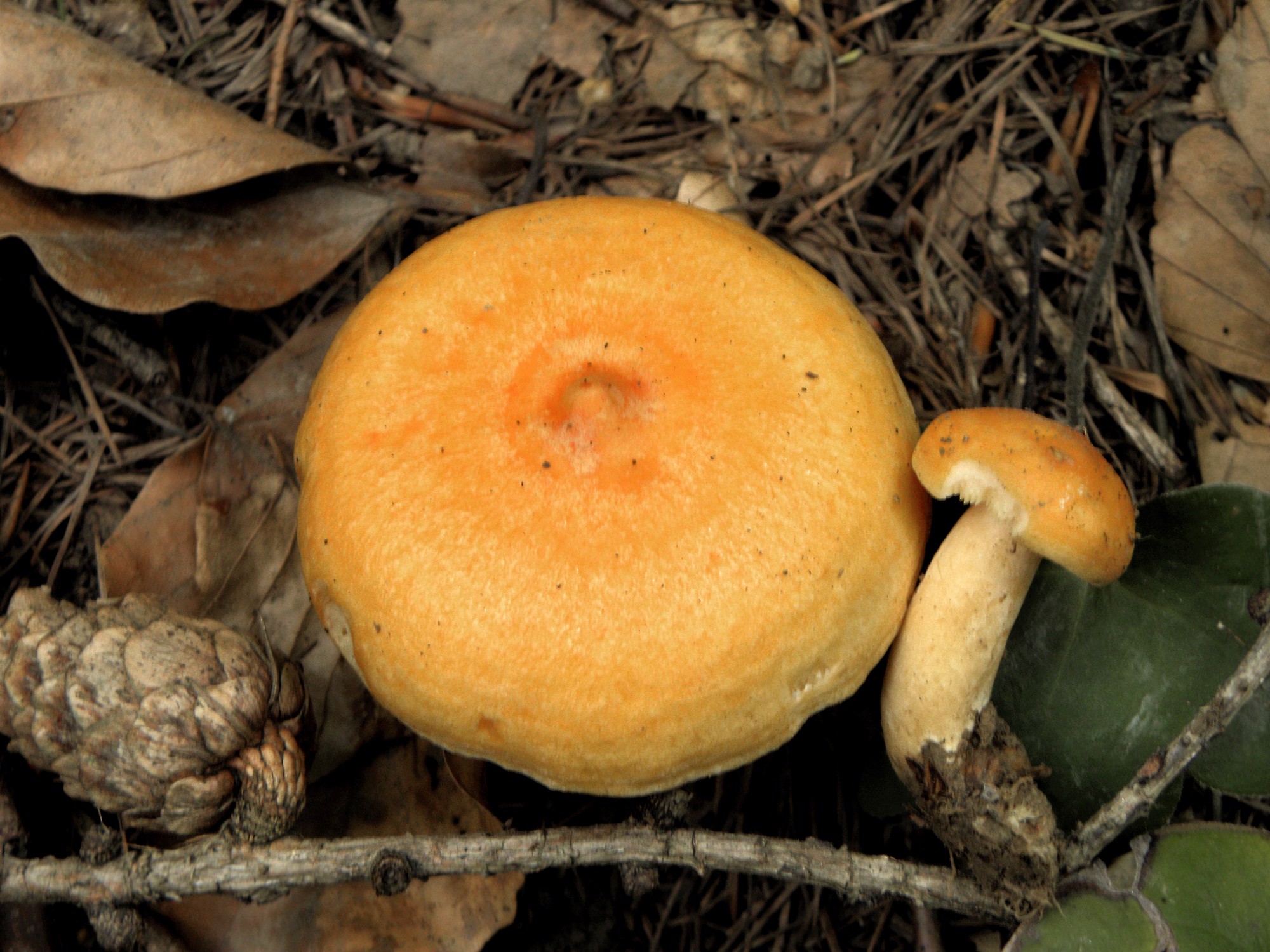
Lactarius porninsis Rolland
- Scientific name
- Lactarius porninsis
- Author
- Rolland
- Common names
 Larch Milkcap
 Lärchen-Milchling
 Lapegļu pienaine
 ryzec modřínový
- IUCN Specialist Group
 Mushroom, Bracket and Puffball
- Kingdom
- Fungi
- Phylum
- Basidiomycota
- Class
- Agaricomycetes
- Order
- Russulales
- Family
- Russulaceae
- Assessment status
- Assessed
- Preliminary Category
- LC
- Proposed by
- Irmgard Krisai-Greilhuber
- Assessors
- Irmgard Krisai-Greilhuber, Iris Fischinger, Matt Wainhouse, Petr Zehnálek
- Editors
- Gregory Mueller
- Comments etc.
- Inita Daniele
- Reviewers
- Anders Dahlberg
Assessment Notes
Justification
Lactarius porninsis is an ectomycorrhizal fungus primarily occurring in Europe. It is bound to special habitats with its host tree speceis, Larix decidua, but it is common and not affected by a global decline. Due to stable population sizes across much of its range and large population size, it is assessed as Least Concern (LC).
Taxonomic notes
This species is widely accepted and recognized in scientific literature and taxonomy.
Why suggested for a Global Red List Assessment?
Lactarius porninsis is an ectomycorrhizal fungus primarily occurring in Europe. It is bound to special habitats with its host tree speceis, Larix decidua, but it is common and not affected by a global decline. Due to stable population sizes across much of its range, it is assessed as Least Concern.
Geographic range
Lactarius porninsis forms ectomycorrhiza with the European larch (Larix decidua), making it dependent on larch stands. It only occurs in regions where its symbiotic partner is present, primarily in mountainous areas, predominantely in the Alps and als regularly found in the Carpathians (Korfel, 2000). According to GBIF, it is commonly found in Central Europe and is one of the most important mycorrhizal fungi associated with Larix decidua. Documented occurrences outside Europe include populations in Japan and Russia, although these are much rarer and the species might be introduced there.
Population and Trends
Globally and regionally, the populations of Lactarius porninsis are stable and show no significant decline. It is not considered threatened. On regional red lists, such as those in Austria and Germany, the mushroom is classified as “Least Concern” (LC). Therefore, it can be assumed that the species has stable populations in the Alps. (Austrian Mycological Society, 2021-ongoing; Red List Center, n.d.-b). No records of population trends in the Carpathians could be found. However, based on the evidence available for the Alps, it can be reasonably assumed that the populations in the Carpathians are also stable.
Population Trend: Stable
Habitat and Ecology
Lactarius porninsis occurs from July to October in montane larch forests. In lowland areas, it is only found where larches have been introduced through larch plantations (Laux, 2025, p. 136). As a substrate specialist, it is strictly mycorrhizal with the European larch (Larix decidua) and can be found with both old and young trees. Symbiotic partners of larches, including L. porninsis, can significantly enhance the growth of the host trees and improve the uptake of nitrogen and phosphorus compared to larches without mycorrhizal associations. Thus, Lactarius porninsis is an important species for the Alpine region, contributing to the vitality of larch stands (Mandolini et al., 2025).
Threats
Lactarius porninsis is not considered threatened, as it is regularly documented across large parts of the Alps and the Carpathians. However, its ecological specialization on Larix decidua makes it more vulnerable and sensitive to changes in its habitat. Climate change and forestry practices pose greater risks to L. porninsis compared to L. deliciosus. The decline of natural larch stands, afforestation with other tree species, or intensive forest management could negatively impact its populations.
Despite these potential threats, there is no evidence of a general decline in the species. It is classified as “Least Concern” (LC) in various national red lists, including the Austrian Red List. However, it is listed as threatened in the Croatian and Danish Red Lists as threatened. To ensure that more countries do not classify it as threatened in the future, populations in protected areas should be monitored to detect long-term impacts of climate change on the species early (Leonardi et al., 2021).
Conservation Actions
Conservation of natural larch forests is of priority when it comes to conservation measures for Lactarius porninsis. However, no global measures are currently necessary.
Research needed
The impacts of climate change on larch forests, and consequently on Lactarius porninsis populations, need to be studied. Additionally, population monitoring should be encouraged.
Use and Trade
Lactarius porninsis is an edible species, which is picked locally but not or only rarely traded.
Bibliography
just a reminder for me to fill in correctly later:
Korfel, 2000
Austrian Mycological Society, 2021-ongoing
Red List Center, n.d.-b
Laux, 2025, p. 136
Mandolini et al., 2025
Leonardi et al., 2021