- Proposed
- Under Assessment
- Preliminary Assessed
- VUAssessed
- 5Published
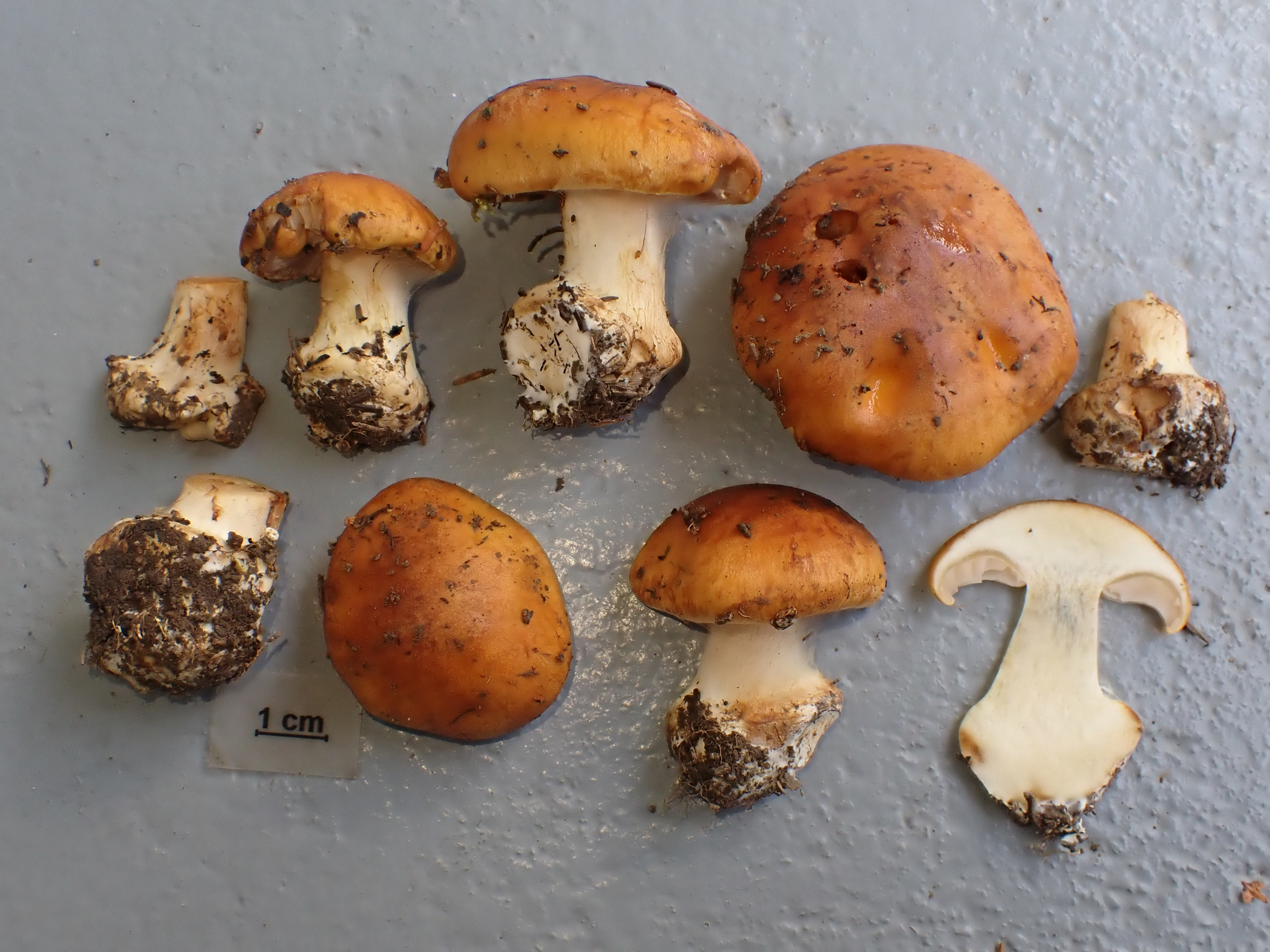
Cortinarius fulminoides (M.M. Moser) M.M. Moser
- Scientific name
- Cortinarius fulminoides
- Author
- (M.M. Moser) M.M. Moser
- Common names
- IUCN Specialist Group
 Mushroom, Bracket and Puffball
- Kingdom
- Fungi
- Phylum
- Basidiomycota
- Class
- Agaricomycetes
- Order
- Agaricales
- Family
- Cortinariaceae
- Assessment status
- Assessed
- Preliminary Category
- VU C2a(i)
- Proposed by
- Tor Erik Brandrud
- Assessors
- Tor Erik Brandrud
- Editors
- Martin Axegård
- Reviewers
- Anders Dahlberg
Assessment Notes
Justification
Cortinarius fulminoides is an ectomycorrhizal fungus associated mainly with Abies species, sometimes in mixed Abies-Pinus forests and very rarely in pure Picea abies forests. Its major habitat is montane, calcareous Abies- or Abies-Picea-Fagus forests of C and S Europe,
The Phlegmacium-rich, calcareous Abies or mixed Abies-Picea-Fagus forests often occupies small and fragmented areas, and the habitat is vulnerable of habitat loss due logging, to exploitation from urbanization, lime quarries and impacted by selective deer overgrazing.
Cortinarius fulminoides is known from about 25 sites in mainly Europe. The total population is estimated to consist of approx. 250 sites which corresponds to an estimated total population of about 5,000 mature individuals with very small and isolated subpopulations. The population is suspected to be in continuous decline.Therefore, Cortinarius fulminoides is assessed as Vulnerable (C2 a(i)).
Taxonomic notes
Cortinarius fulminoides may resemble C. glaucopus, but differs on the complete lack of bluish tinges on young lamellae and stipe. The species belongs to the section Aureocistophili, which is rather close to sect Glaucopodes (Soop et al. 2019). Within Aureocistophili, C. fulminoides resembles C. subrugulosus, which might occur in the same habitats, but the latter has more silvery white veil remnants upon pileus (Soop et al. 2019). Cortinarius kytoevuori, known only from Picea-Pinus forests from Finland, is apparently very similar.
Why suggested for a Global Red List Assessment?
Cortinarius fulminoides is a almost strictly European species being habitat-specific for declining forest types; calcareous Abies alba and Abies nordmanniana forests.
Geographic range
Cortinarius fulminoides is mainly distributed in the montane regions with (mixed) Abies alba forests of the Jura and Prealps. It is known also from the eastern Pyrenées, and from the montane Abies nordmanniana forests of W Caucasus. The species probably has a wider distribution within the natural Abies alba range of the Carpathians, the Italian Apennines and the Balkan-Greech mountains (but the calcareous fir forests are little investigated in most of these regions). Outside the natural Abies forest range, the species is recorded once under Picea abies in E Sweden. There are also a few finds from N America (California, Quebec), with slightly deviating ITS-DNA sequences.
Population and Trends
Cortinarius fulminoides is known from approx. 25 sites globally; most records are from the Jura-Prealps-Black Forest region; E France-SW Germany-Switzerland-Austria-N Italy, furthermore a few from NE Spain, one from Russuian Caucasus, and an ITS-sequence-verified northern outpost in E Sweden and finally a few verified from California and Quebec. The total population is estimated to probably be approx. 250 sites which corresponds to an estimate of approx. 5,000 mature individuals (Dahlberg & Mueller, 2011).
The area of calcareous Abies forests, or mixed Abies-Picea forests, of appropriate habitat quality is suspected to have declined during the last 50 years in the magnitude of 15-20%. The decline is ongoing and suspected continue into the future. The population of C. fulminoides is inferred to correlate well with the amount of its suitable habitat. Based on this, the species could be red-listed as NT according to the A-criterion (A2c + 3c + 4c).
However, the species is assessed as Vulnerable according to the C-criterion (C2a(i), due to ongoing decline, population size <10,000 individuals and very small/isolated subpopulations (less than 1,000 individuals per subpopulation).
Population Trend: Decreasing
Habitat and Ecology
Cortinarius fulminoides is associated mainly with montane calcareous, herb-rich-mossy Abies or Abies-Picea-Fagus forests, a forest type with many habitat-specific taxa of Cortinarius, subgenus Phlegmacium. Cortinarius fulminoides forms mycorrhiza with Abies alba, in Caucasus with Abies nordmanniana. The species apparently rarely also associate with Picea abies in areas with mixed Abies-Picea forests. North of the natural Abies alba forest range, the species is once recorded in pure Picea abies forest. The species regularly occur together with other Phlegmacium species of the calcareous Abies forest element, such as C. atrovirens, C. haasii and C. subgracilis.
Threats
Cortinarius fulminoides and its habitats (calcareous Abies(-Picea) forests) have been declining e.g. due to areal loss (urbanization, expansion of limestone quarries, shift from Abies stands to Picea by planting, and as selective overgrazing and bark stripping by deers, climate warming with severe droughts) as well as decreased habitat quality/ecological conditions due to modern forestry with clear-cuttings (Bledy et al. 2024). Forest statistics from Austria indicates that forestry activity has been doubled the last 40 years, and according to a habitat-redlist in Austria, the Abies-Picea forests are endangered in many regions of Austria. Severe decline and die-back of Abies alba forests was reported already 40 years ago due mainly to SO2 air pollution. In recent years, the decline is apparently due to a complex mix of factors (Bledy et al. 2024). Decline of Abies alba forests in recent years is reported from several C & S European countries, such as Austria, Czech Republic, Italy, Slovenia, N Spain, etc.
Conservation Actions
To prevent decline and further fragmentation of calcareous Abies (-Picea) forests with good habitat quality, it is important to set aside reserves on calcareous hotspots, housing many rare/redlisted, habitat-specific species such as C. atrovirens, C. camptoros, C. citrinoolivaceus, C. fulminoides and C. haasii. It is furthermore important to establish also sites with a less strict conservation regime, such as woodland key biotopes, where some non-destructive human activities are accepted (such as non-intensive forestry, with closed cutting).
Research needed
More mapping/surveying and monitoring of C. fulminoides is needed. More data on occurrences in the little studied calcareous Abies alba forests of the Carpathians and the montane regions of Balkan-Greech is especially needed. Finally, more documentation on the degree and causes of decline of the habitats themselves is needed.
Use and Trade
The species is not utilized.