- Proposed
- Under Assessment
- DDPreliminary Assessed
- 4Assessed
- 5Published
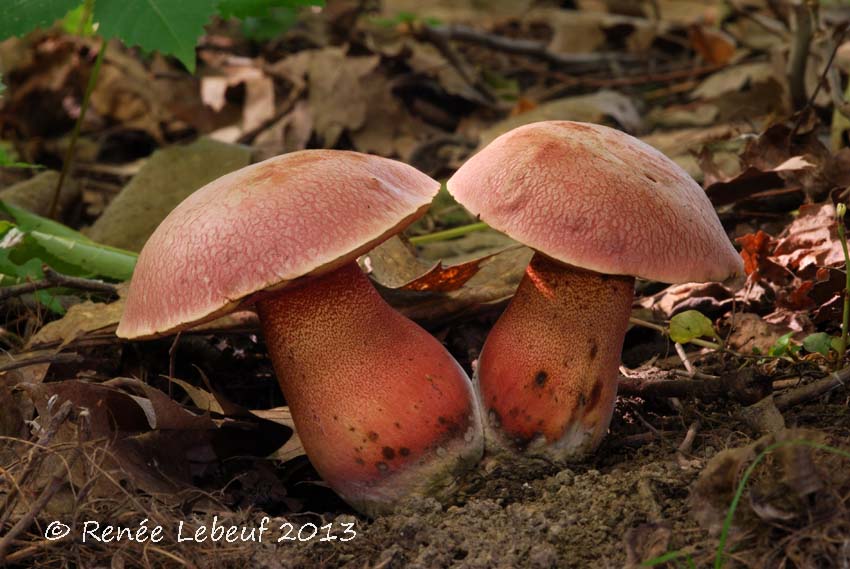
Boletus rhodosanguineus Both
- Scientific name
- Boletus rhodosanguineus
- Author
- Both
- Common names
 Bolet rouge sang
- IUCN Specialist Group
 Mushroom, Bracket and Puffball
- Kingdom
- Fungi
- Phylum
- Basidiomycota
- Class
- Agaricomycetes
- Order
- Boletales
- Family
- Boletaceae
- Assessment status
- Preliminary Assessed
- Preliminary Category
- DD
- Proposed by
- Jean Berube
- Assessors
- Jean Berube
- Contributors
- Anders Dahlberg
- Comments etc.
- Jean Berube, Nika Kiknadze, Nicolas Schwab
Assessment Notes
DD
Taxonomic notes
Synonym: Rubroboletus rhodosanguineus (Both) Kuan Zhao et Zhu L. Yang
Why suggested for a Global Red List Assessment?
Large, colourful and very rare species.
Geographic range
Found 13 times in North America, in 8 localities
USA: West Virginia, 4 localities, one in a State park, 2005, 2001 twice, 2013; Iowa 2011; NY one station only, but seven times in a park, 1987, 1992, 1998.
Canada: Quebec, two stations, 2002 and 2010; Ontario Port Dover.
Population and Trends
With 13 records worldwide in 30 years and found in 9 localities worldwide, but the number of localities may be up to 50 times higher because this large colourful species is not always easy to differentiate, so we believe it goes misidentified in most occasions it is collected. So we estimate is to be found in 450 localities. This estimate corresponds to 900 genetically unique mycelia. The number of ramets are expected to be 10 times higher, so total number of individual worldwide is estimated to be 9000. Its habitat is under pressure by urban and agricultural occupancy.
This population estimate would usually qualify for LC status but the high uncertainty on its number of localities could be reduced by better diagnostic morphological characters and surveys. For these reason we rate it DD in order to get data to reduce its uncertainty in number of sites.
Population Trend: Decreasing
Habitat and Ecology
Under oaks, Carya and hemlocks of the North Eastern American forest.
This species is a mycorrhizal fungus species so it is dependent on living host trees for population viability. This mutually beneficial symbiotic association between fungus and plant host roots conveys numerous critical advantages for plant host survival. Mycorrhizal fungi are essentially the uptake organs for many nutrients i.e., nitrogen, phosphorus, numerous micronutrients, i.e., boron, selenium, copper, and plays a major role in uptake of water. Both the fungus and the plant host does not exist in nature without each other.
Threats
This type of forest is threatened in Canada by urban and agricultural development.
Conservation Actions
Determine is distribution in Canada to protect forests harbouring this species.
Research needed
Better identification characters and subsequent survey to reduce the uncertainty on the number of known sites.
In northeastern North America, where this species is found, there are numerous groups of amateur mycologists. Members of these groups can be recruited and instructed where to find and how to identify this species so they can target this species during forays. Data from amateur mycologists can be critical to define its population size, distribution and trends, as well as its ectomycorrhizal associations.