- Proposed
- Under Assessment
- Preliminary Assessed
- Assessed
- VUPublished
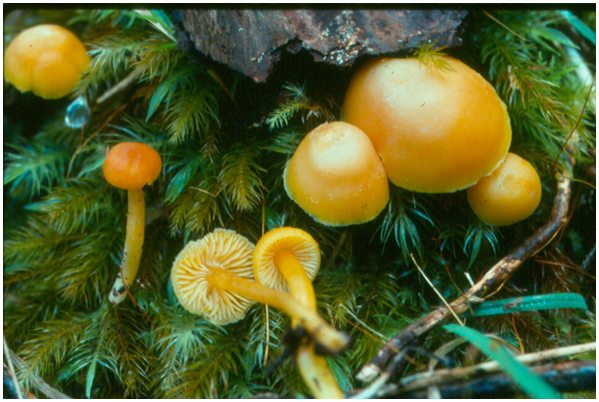
Hygrocybe lamalama Desjardin & Hemmes
- Scientific name
- Hygrocybe lamalama
- Author
- Desjardin & Hemmes
- Common names
- IUCN Specialist Group
 Mushroom, Bracket and Puffball
- Kingdom
- Fungi
- Phylum
- Basidiomycota
- Class
- Agaricomycetes
- Order
- Agaricales
- Family
- Hygrophoraceae
- Assessment status
- Published
- Assessment date
- 2019-08-22
- IUCN Red List Category
- VU
- IUCN Red List Criteria
- A3ce+4ce
- Assessors
- Else Vellinga (UC Berkeley Herbarium, Berkeley, California, USA)
- Reviewers
- Anders Dahlberg (Swedish Species Information Centre, Uppsala / IUCN SSC Cup-fungus, Truffle and Ally Specialist Group)
Assessment Notes
Justification
Hygrocybe lamalama is a conspicuous deep orange to yellow-orange species with a dry cap and stem, which is found only in native tropical wet montane forests dominated by Metrosideros polymorpha (ʻŌhiʻa) and Cibotium spp. on four Hawaiian islands. The habitat is under constant threat, from invasion of non-native plant species, habitat destruction for road construction (especially on Hawai’i), and lately especially the rapid spread of ʻŌhiʻa rapid wilt, caused by Ceratocystis fimbriata which kills ʻŌhiʻa trees. A reduction in population size of more than 30% is projected within the span of 3 generations (30 years) for the occurrence of this species on Hawai’i, due to the spread of the introduced pathogen that kills the overstory tree, M. polymorpha, which results in a severe decline in habitat quality, making it unsuitable for this species. The main subpopulation of this species is known from Hawai’i with fewer records from Kaua’i, Mau’i, and Moloka’i, where the habitat is still widely available. Therefore, Hgrocybe lamalama is listed as Vulnerable under criteria A3ce+4ce.Geographic range
This species is endemic to Hawaii, U.S.A. It is known from a few sites on four Hawaiian islands: Hawai’i, Kaua’i, Maui and Moloka’i.Population and Trends
Hygrocybe lamalama grows only in native tropical wet montane forests dominated by Metrosideros polymorpha (ʻŌhiʻa) and Cibotium spp. The habitat is under constant threat, from invasion of non-native plant species, habitat destruction for road construction (especially on Hawai’i), and, lately, especially the rapid spread of ʻŌhiʻa rapid wilt, caused by Ceratocystis fimbriata which kills ʻŌhiʻa trees. A reduction in population size of more than 30% is projected within the span of 3 generations (30 years cf Dahlberg and Mueller 2011) for the occurrence of this species on Hawai’i, due to the spread of the introduced pathogen that kills the overstory tree, Metrosideros polymorpha, which results in a severe decline in habitat quality, making it unsuitable for this species. The main subpopulation of this species is known from Hawai’i with fewer records from Kaua’i, Mau’i, and Moloka’i, where the habitat is still widely available.
Population Trend: Decreasing