- Proposed
- Under Assessment
- VUPreliminary Assessed
- 4Assessed
- 5Published
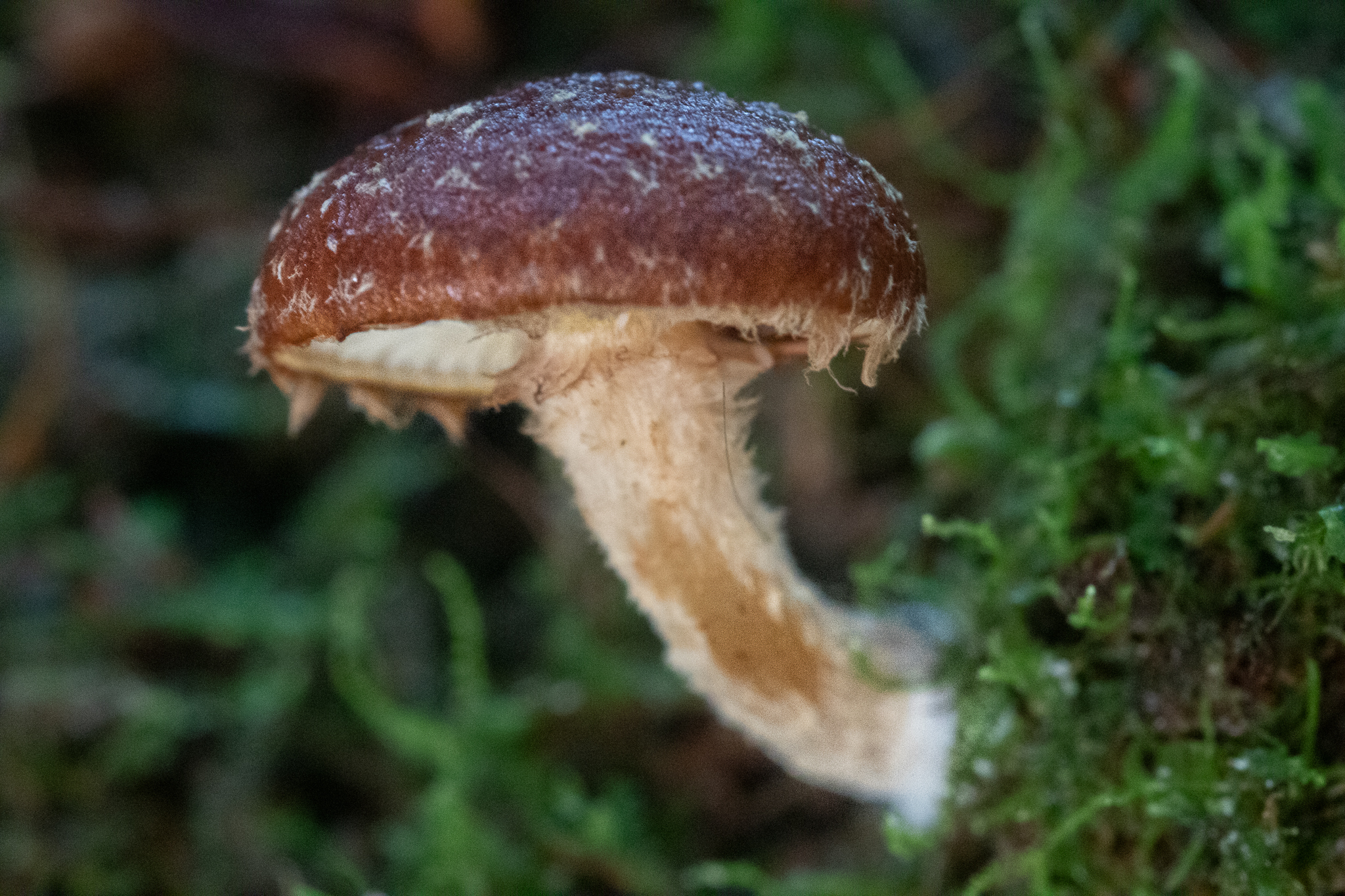
Pholiota peleae E. Horak & Desjardin
- Scientific name
- Pholiota peleae
- Author
- E. Horak & Desjardin
- Common names
- IUCN Specialist Group
 Mushroom, Bracket and Puffball
- Kingdom
- Fungi
- Phylum
- Basidiomycota
- Class
- Agaricomycetes
- Order
- Agaricales
- Family
- Strophariaceae
- Assessment status
- Preliminary Assessed
- Preliminary Category
- VU C2a(ii)
- Proposed by
- Jeff Stallman
- Assessors
- Jeff Stallman
- Editors
- Susana P. Cunha, Vida Svahnström, Izabela L. Kalucka
Assessment Notes
Pholiota peleae is a saprotroph found on fine decaying plant material, such as tree fern fronds and mosses, as well as more woody substrates, such as larger logs. Therefore, I considered three generation lengths to be 20 years, using the lower number for fungi from woody substrates (Dahlberg & Mueller 2011). The species is known from four Hawaiian Islands (Hawaii, Maui, Molokai, and Kauai). Two islands (Oahu and Lanai) have small areas of habitat (less than ~2km2 each) where it could potentially be found, but it has never been found on either, and Maui and Hawaii Island also have larger areas of habitat where the species could occur, but has never been recorded. All individuals of the species are considered to be found in the same subpopulation. Although the confirmed sites on Kauai and Molokai are ~290km apart, the potential habitat on Oahu may mean these sites are not so distant. Additionally, ITS sequences from a collection on Kauai and a collection on Hawaii Island—at the extremes of the range—were identical, and the only population genetics study of a fungus in the Hawaiian Islands showed that shared alleles existed across the species which is also found in wet, montane, forests on multiple islands (Keirle et al. 2012).
The fungus can be confidently identified from decent to good macroscopic photos without microscopy or DNA sequence data. Although the fungus may face different threats throughout its range (for example, destruction of habitat from lava flows on Hawaii Island), the main threat to all sites is habitat degradation and conversion to non-native forest caused by invasive species. Considering all (non-duplicate) records from GBIF.org, iNaturalist.org, MushroomObserver.org, MycoPortal.org, and Horak et al. (1996), P. peleae has been found 60 times since 1990 at 31 unique sites. When found, there are usually one to a few, aggregated sporocarps on a single substrate, rarely on multiple substrates. The number of mature individuals of P. peleae was estimated by taking the 31 sites where the fungus is known to occur and multiplying this by a minimum of 25 and a maximum of 50 additional sites to account for sites with suitable habitat where the fungus may occur but has not been observed. These figures were chosen to balance a potentially low amount of search effort for this relatively small species with the fact that it is macroscopically identifiable and its range is restricted to a single habitat type in the Hawaiian Islands, so it has a small range. Each site was considered to contain two suitable substrates, each containing two mature individuals. Therefore, the population is estimated at 3100 to 6200 mature individuals and P. peleae is assessed as VU under criterion C2a(ii)
Pholiota peleae is not threatened under other criteria because while population declines are expected in the long-term due to degraded and disappearing habitats and substrates, in the short-term, deaths of native trees in these habitats are expected to lead to an increase in substrate availability.
Justification
Pholiota pelae is only found growing on native substrates in wet, montane habitats in the Hawaiian Islands and all individuals occur in a single subpopulation. The number of mature individuals was estimated to be greater than 2,500 but less than 10,000. Therefore, it is assessed as VU under criterion C2a(ii).
Taxonomic notes
Pholiota peleae has no synonyms. It can be recognized by its macroscopic features as it is the only Pholiota species known from the Hawaiian Islands (Stallman et al. 2022).
Why suggested for a Global Red List Assessment?
The species is only known to occur in native, wet, montane forests in the Hawaiian Islands. Native forests in the islands are contracting, under threat from various factors.
Geographic range
Pholiota peleae is endemic to native, wet, montane forests of the Hawaiian Islands (Hemmes & Desjardin 2002; Horak et al. 1996). ITS sequences of P. peleae (MW018900) do not have high pairwise identity with any sequences in the global metabarcoding datasets UNITE (Abarenkov et al. 2024) or GlobalFungi (Větrovský et al. 2020), providing additional evidence that it is only found in the Hawaiian Islands. While P. peleae is only known from Kauaʻi, West Maui, Molokai, and East Hawaiʻi Island, it may be possibly be found on East Maui, Kohala, Hualalai, and Kaʻū areas of Hawaiʻi Island, and in very small areas of potential habitat on Oʻahu and Lānaʻi.
Population and Trends
There are 60 total observations or collections of P. peleae since 1990 (as of April 2026) at 31 unique sites. Pholiota peleae is restricted to a single habitat type in the Hawaiian Islands that is contracting. This habitat contraction will lead to an expected decrease in population for P. peleae in the long-term. In the short term, the increased substrate availability from dead native vegetation is expected to stabilize its population. The number of mature individuals of P. peleae was estimated by taking the 31 sites where the fungus is known to occur and multiplying this by a minimum of 25 and a maximum of 50 additional sites to account for sites with suitable habitat where the fungus may occur but has not been observed. These figures were chosen to balance a potentially low amount of search effort for this relatively small species with the fact that it is macroscopically identifiable and its range is restricted to a single habitat type in the Hawaiian Islands, so it has a small range. Each site was considered to contain two suitable substrates, each containing two mature individuals. Therefore, the population was estimated to be between 3100 to 6200 mature individuals.
All individuals of Pholiota peleae are considered to be in a single subpopulation. Although the confirmed sites on Kauaʻi and Molokai are ~290km apart, the potential habitat on Oʻahu may mean these sites are not so distant. Additionally, ITS sequences from a collection on Kauaʻi and a collection on Hawaiʻi Island—at the extremes of the range—were identical. A population genetics study of a fungus in the Hawaiian Islands with a similar distribution to P. peleae in native, wet, montane forests did not show large genetic differentiation between individuals on different Hawaiian Islands (Keirle et al. 2012).
Population Trend: Decreasing
Habitat and Ecology
The species is a saprotroph, producing basidiomata on mosses and various native woody plants (Cibotium spp., Metrosideros polymorpha, Myrsine spp., Psychotria spp.) in wet, montane, native forests in the Hawaiian Islands. Pholiota peleae forms sporocarps throughout the year (Horak et al. 1996; Hemmes & Desjardin 2002).
Threats
Many threats exist to forests in the Hawaiian Islands, including wet, montane, native forests. The invasive pathogenic fungi Ceratocystis huliohia and Ceratocystis lukuohia, collectively known as Rapid ‘Ōhi‘a Death (ROD), have been killing large numbers of M. polymorpha trees throughout the islands (Fortini et al. 2019). Metrosideros polymorpha is the dominant tree in these wet, montane forests, and is also a substrate of P. peleae. Additional threats to forests in the Hawaiian Islands include competition from invasive plant species (Gillespie et al. 2008), particularly Psidium cattleianum, and habitat degradation by non-native animals, such as feral pigs (Murphy et al. 2013). Overall, a canopy replacement is occurring in which native tree species are being replaced by non-native tree species (Potter et al. 2023), a process that can be accelerated by M. polymorpha mortality due to ROD.
Conservation Actions
Conservation actions to preserve or restore wet, montane, native forests in Hawaiʻi, mitigate M. polymorpha mortality from ROD, and slow native to non-native tree species replacement would all benefit P. peleae.
Research needed
Searching for P. peleae in habitats that may suitable for this fungus, but for where it has not yet been observed or collected, would be helpful to confirm its range. This includes locations in wet, montane, native forests on Oʻahu, Lānaʻi, East Maui, and Kohala, Hualalai, and Kaʻū regions on Hawaiʻi Island. Continuing to document observations of known populations of P. peleae as forests undergo conversion from native-dominated woody species to nonnative-dominated woody species, will provide additional insight on population trends.
Use and Trade
n/a