- Proposed
- Under Assessment
- Preliminary Assessed
- ENAssessed
- 5Published
Veligaster mexicanus Guzmán & Tapia
- Scientific name
- Veligaster mexicanus
- Author
- Guzmán & Tapia
- Common names
- IUCN Specialist Group
 Mushroom, Bracket and Puffball
- Kingdom
- Fungi
- Phylum
- Basidiomycota
- Class
- Agaricomycetes
- Order
- Boletales
- Family
- Sclerodermataceae
- Assessment status
- Assessed
- Preliminary Category
- EN C2a(i)
- Proposed by
- Roberto Garibay Orijel
- Assessors
- Roberto Garibay Orijel
- Comments etc.
- Anders Dahlberg, Gregory Mueller
Assessment Notes
Justification
Assessed as Endangered (EN) under criterion C2a(i) as the number of estimated localities is not more than 25 and population estimate much below 100 mature individuals in each subpopulation; with ongoing and projected habitat loss due to change in land use of 30% in the last 15 years and 20%-40% in the next 15 years.
Taxonomic notes
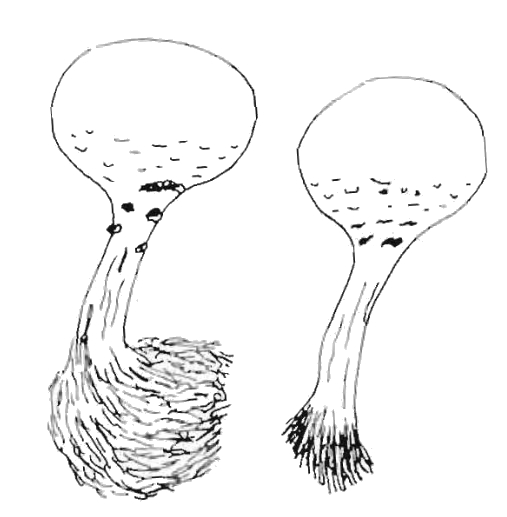
Recommended name should be Scleroderma mexicana Guzman et Tapia according to Guzman et al (2013). Scleroderma mexicana is a species known only from Chiapas state, Mexico. All macroscopic sizes descriptions were done from dry specimens. Basidiome from 10–26 mm in diameter and a well-delimited solid stipe 12–18 × 2–5 mm. Base of the stipe with a conspicuous well developed whitish mycelial mass. Peridium poorly developed, thin (<1mm thick) at the upper part of the basidiome, slightly areolate towards the base, yellowish-brown with vinaceous color stains. Breaking into dark reddish veil-like membranaceous patches, formed by lysis of exoperidium hyphae. (Guzmán & Tapia, 1995). Spores ranging from 8–10 µm in diameter and echinulated. Spines 0.8–1.5 µm high (Guzmán et al., 2013). Scleroderma mexicana is closely related with S. columnare from Malaysia, but differs in the size of the basidiospores and spines. Also, it is close to S. pseudostipitatum, but that presents the exoperidium verrucose-scaly like S. areolatum or S. verrucosum (Guzmán et al., 2013).
Why suggested for a Global Red List Assessment?
The only record of Scleroderma mexicana (Veligaster mexicanus) comes from the type locality, at Laguna Bélgica Educational Park in Chiapas, Mexico. Since Guzmán and Tapia (1995) described the species (as Veligaster mexicanus), the only specimen that exists is the type specimen. This species should be protected because of its limited distribution and apparently rare occurrence, even when the knowledge about the Scleroderma genus is relatively well established in Mexico with Guzmán (1970) monograph of the genus.
Geographic range
There is only one record from the type locality at Laguna de Bélgica Educational Park, located at Ocozocuautla de Espinosa municipality, on the road to Apic-Pac in Chiapas state, Mexico.
Population and Trends
Besides the record of Guzmán & Tapia (1995) from the type locality, there are no more records of this species. Chanona-Gómez et al. (2007) report at the same locality (Laguna de Bélgica Ecological Park) three species of Scleroderma. One of them was S. verrucosum, but the other two were published as Scleroderma sp. Even if those records were assigned to S. mexicana, this would be the only locality where this species is registered.
Scleroderma species in Mexico were actively collected and monographed by Guzmán in a period of at least 25 years (Guzman, 1970; Guzmán & Tapia 1995). These studies included full herbaria specimens review and across-seas type comparisons. Thus, the rarity of the species is not due to overlooking or undersampling, at least in Mexico. Posisble unknown subpopulations may inhabit neighboring tropical forests of Guatemala.
Based on this, we assume that there would not be more that 100 subpopulations with no more that 100 mature individuals in the whole Mesoamerican corridor.
Population Trend: Decreasing
Habitat and Ecology
Gregarious. Growing on soil in a tropical evergreen rainforest at Laguna de Bélgica Educational Park, within 850 m. The whole site has a elevation range from 800–1300 m with different successional stages of tropical rain forest (Escobar-Ocampo & Ochoa-Gaona, 2007). Major fruiting season of Scleroderma mexicana occurs in July.
Threats
Globally, the proportion of Mexico covered by tropical forests has reduced from 26.1% in 1970 to 16.1% in 2008 (11.1 million ha of closed forests and 20.5 million ha of secondary forest (Challenger & Soberón 2008).
Regionally, in the Chiapas part of the Mesoamerican corridor has been a 30% loss of closed tropical forests in the last 15 years. In this region, the land use change scenarios project a drastic change in the extent of tropical forests with a reduction of 20% - 40% (conservative - pesimistic scenarios) in the next 15 years (Ramírez-Mejía et al 2017).
Locally, Laguna de Bélgica Educational Park (only know subpopulation) is highly affected by edge effects due to the proximity to highways and the reserve limits with adjacent urban and agricultural terrains (Escobar-Ocampo & Ochoa-Gaona, 2007).
Conservation Actions
The type locality of Scleroderma mexicana, Laguna Bélgica Educational Park, was established by the Chiapas government in 1996, with the goal of developing environmental education activities. This site has a historical use associated with cattle production and some parts were used for coffee cropping. The genus Scleroderma is considered to be ectomycorrhizal, so it will be important to preserve natural rain forests at the sampling site.
Research needed
The main need is to increase the sampling effort, to elucidate if their actual distribution is constrained by the absence of sampling, or if it represents the range of natural distribution of the species.
Use and Trade
There are no reports about edibility or use of this species.
Bibliography
Challenger A, Soberón J. (2008). Los ecosistemas terrestres. In: Capital natural de México, vol. I: Conocimiento
actual de la biodiversidad. México: CONABIO, 87-108.
Escobar-Ocampo, M., & Ochoa-Gaona, S. (2007). Estructura y composición florística de la vegetación del Parque Educativo Laguna Bélgica, Chiapas, México. Revista mexicana de biodiversidad, 78(2), 391-419.
Gómez, F. C., Gallegos, R. H. A., Albores, J. C., & Sánchez, J. E. (2007). Macromicetos del Parque Educativo Laguna Bélgica, municipio de Ocozocoautla de Espinosa, Chiapas, México. Revista Mexicana de Biodiversidad, 78(2), 369-382.
Guzmán, G. (1970). Monografía del género Scleroderma Pers. emend. Fr. (Fungi-Basidiomycetes). Darwiniana, 233-407.
Guzmán, G., Cortés-Pérez, A., Guzmán-Dávalos, L., Ramírez-Guillén, F., & del Refugio Sánchez-Jácome, M. (2013). An emendation of Scleroderma, new records, and review of the known species in Mexico. Revista Mexicana de Biodiversidad, 84, S173-S191.
Guzmán, G. & Tapia, F. (1995). New species, new combinations and new records of Veligaster (Sclerodermataceae). Documents Mycologiques (25), 185-195.
Ramírez-Mejía, D., Cuevas, G., Meli, P., & Mendoza, E. (2017). Land use and cover change scenarios in the Mesoamerican Biological Corridor-Chiapas, México. Botanical Sciences, 95(2), 221-234.