- Proposed
- Under Assessment
- 3Preliminary Assessed
- 4Assessed
- 5Published
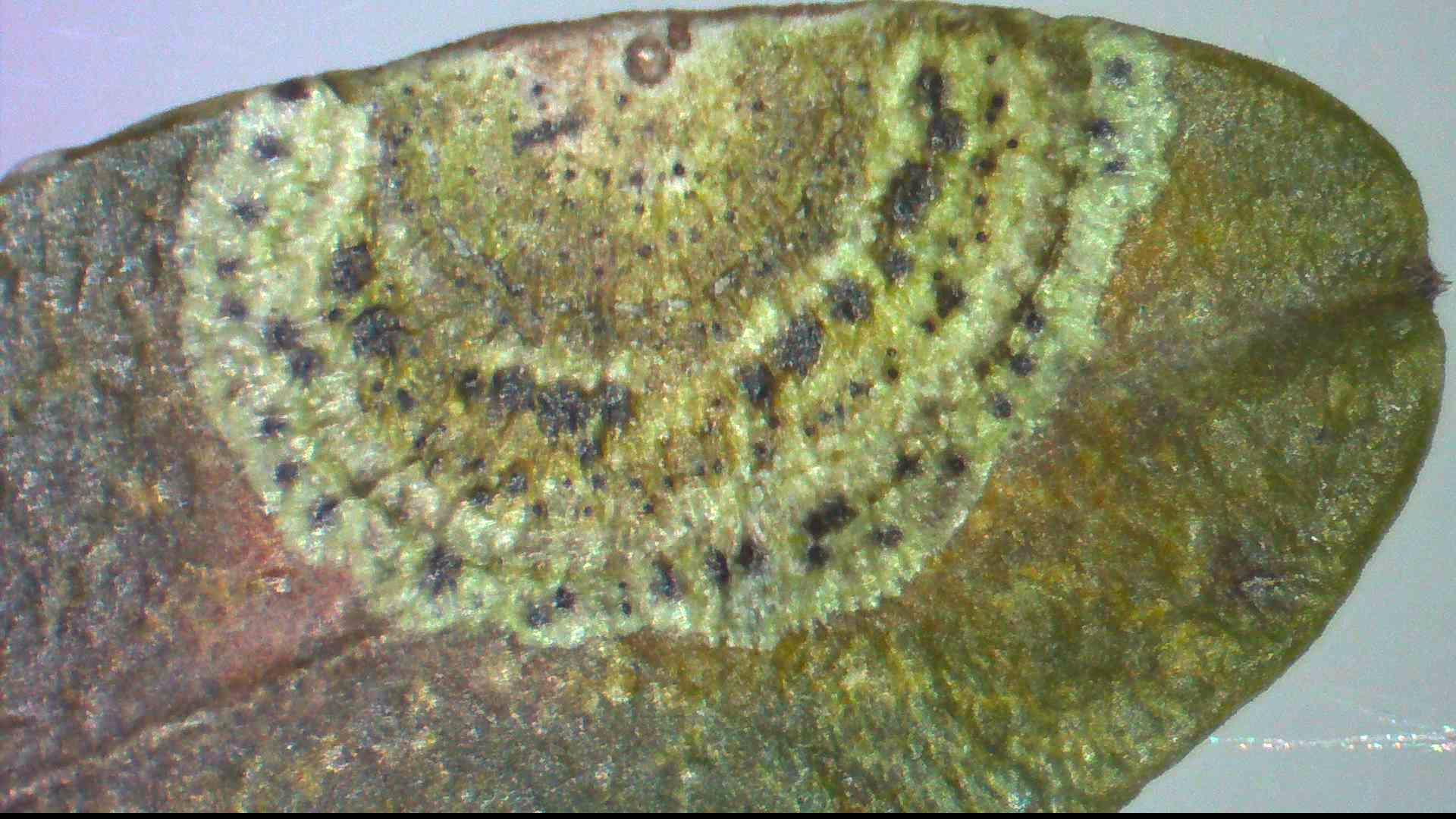
Strigula buxi Chodat
- Scientific name
- Strigula buxi
- Author
- Chodat
- Common names
- IUCN Specialist Group
 Lichens
- Kingdom
- Fungi
- Phylum
- Ascomycota
- Class
- Dothideomycetes
- Order
- Incertae sedis
- Family
- Strigulaceae
- Assessment status
- Under Assessment
- Proposed by
- Rebecca Yahr
- Assessors
- Sareh Kazemi
- Comments etc.
- Rebecca Yahr
Assessment Notes
During surveys of the Hyrcanian boxwood forests in northern Iran, Strigula buxi was found on approximately 10 leaves from several trees across multiple sites. Further data are needed to assess its distribution, abundance and global conservation status.
Justification
Strigula buxi is currently assessed as Data Deficient (DD) because available information is insufficient to determine its global extinction risk. The species was recorded for the first time in Iran by Kazemi et al. (2024). During field surveys in the Hyrcanian boxwood forests of northern Iran, it was found on approximately 10 leaves from several trees across multiple sites. However, its global distribution, population size and trends, and the potential effects of habitat change on its populations remain insufficiently documented. Further research is needed to determine whether the species qualifies for a threatened category.
Taxonomic notes
Strigula buxi Chodat, Bull. Soc. bot. Genève, 2 sér. 4: 246 (1912)
Why suggested for a Global Red List Assessment?
Strigula buxi is a foliicolous lichen reported for the first time from Iran by Kazemi et al. (2024), based on material collected in boxwood forest. Its host, Buxus hyrcana, is an endangered tree native to the Hyrcanian forests of northern Iran. Recent research has documented extensive defoliation and mortality of B. hyrcana associated with box tree moth infestation and box blight disease (Saba et al., 2024). Furthermore, climate-based distribution models predict substantial future loss of suitable habitat for B. hyrcana in the Hyrcanian ecoregion (Sękiewicz et al., 2024). The decline of the host tree may reduce the availability of suitable leaf substrates for S. buxi. However, the lichen’s distribution, host specificity and population trends remain insufficiently known. A global Red List assessment is therefore needed to clarify its conservation status and evaluate the potential consequences of host decline for its persistence.
Geographic range
Strigula buxi is reported from the Canary Islands, France, Georgia, Italy, Russia and Spain (Roux & Sérusiaux, 2004; McCarthy, 2013), with an additional record from the western Caucasus in Russia (Urbanavichene & Urbanavichus, 2016). The species was reported for the first time from Iran by Kazemi et al. (2024), based on material collected in boxwood forest in northern Iran. Published records indicate a scattered distribution, but its full global range remains insufficiently documented.
Population and Trends
Global population size and trends of Strigula buxi are unknown. The species is classified as Critically Endangered (CR) in Italy, where it is known from a single locality (Nascimbene et al., 2013). In northern Iran, it was recorded on approximately 10 leaves across several trees and sites (Kazemi et al., 2024). These records are insufficient to infer global population trends.
Population Trend: Uncertain
Habitat and Ecology
Strigula buxi is a foliicolous lichen recorded in evergreen boxwood forests in northern Iran, growing on leaves of Buxus hyrcana (Kazemi et al., 2024).
Threats
In Iran, Strigula buxi occurs in the Hyrcanian boxwood forests of northern Iran, where it grows on leaves of Buxus sempervirens (Kazemi et al., 2024). These forests are threatened by boxwood blight disease caused by Calonectria pseudonaviculata, defoliation by the invasive box tree moth (Cydalima perspectalis), and associated boxwood decline (Mirabolfathy et al., 2013; Saba et al., 2024). The degradation and loss of boxwood stands may reduce the availability of suitable substrates for S. buxi. However, the direct effects of these threats on the distribution and population trends of the lichen in Iran have not been assessed.
Conservation Actions
Conservation measures are being implemented to protect the Hyrcanian boxwood forests in northern Iran. However, no species-specific conservation measures for Strigula buxi have been documented. Protection and restoration of boxwood forest habitats may indirectly benefit the species, but its specific conservation requirements remain unknown.
Research needed
Further research is needed to establish the extent of occurrence and area of occupancy of Strigula buxi, document its distribution across known localities, and obtain reliable estimates of population size and trends. In Iran, the species has been recorded in the Hyrcanian boxwood forests of Golestan Province, but available observations are insufficient to estimate its regional population size or determine population trends.
Use and Trade
Information on the use and trade of Strigula buxi is currently unavailable.