- Proposed
- Under Assessment
- 3Preliminary Assessed
- 4Assessed
- 5Published
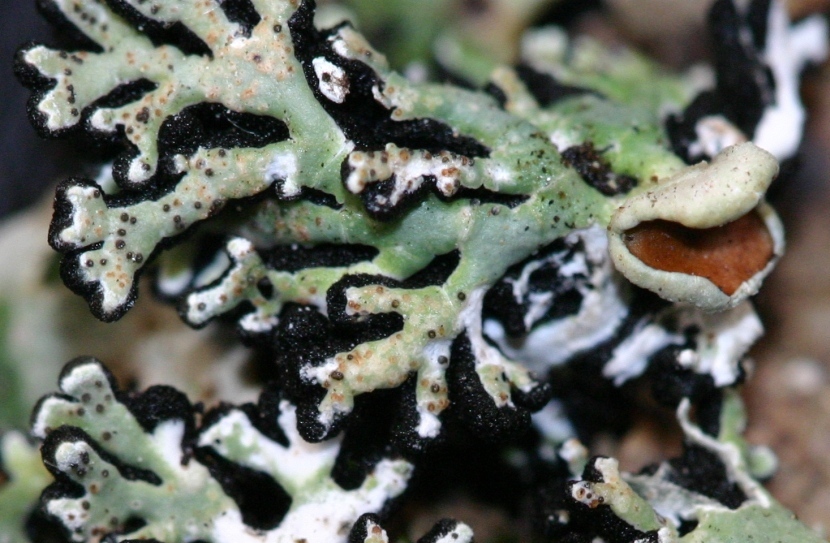
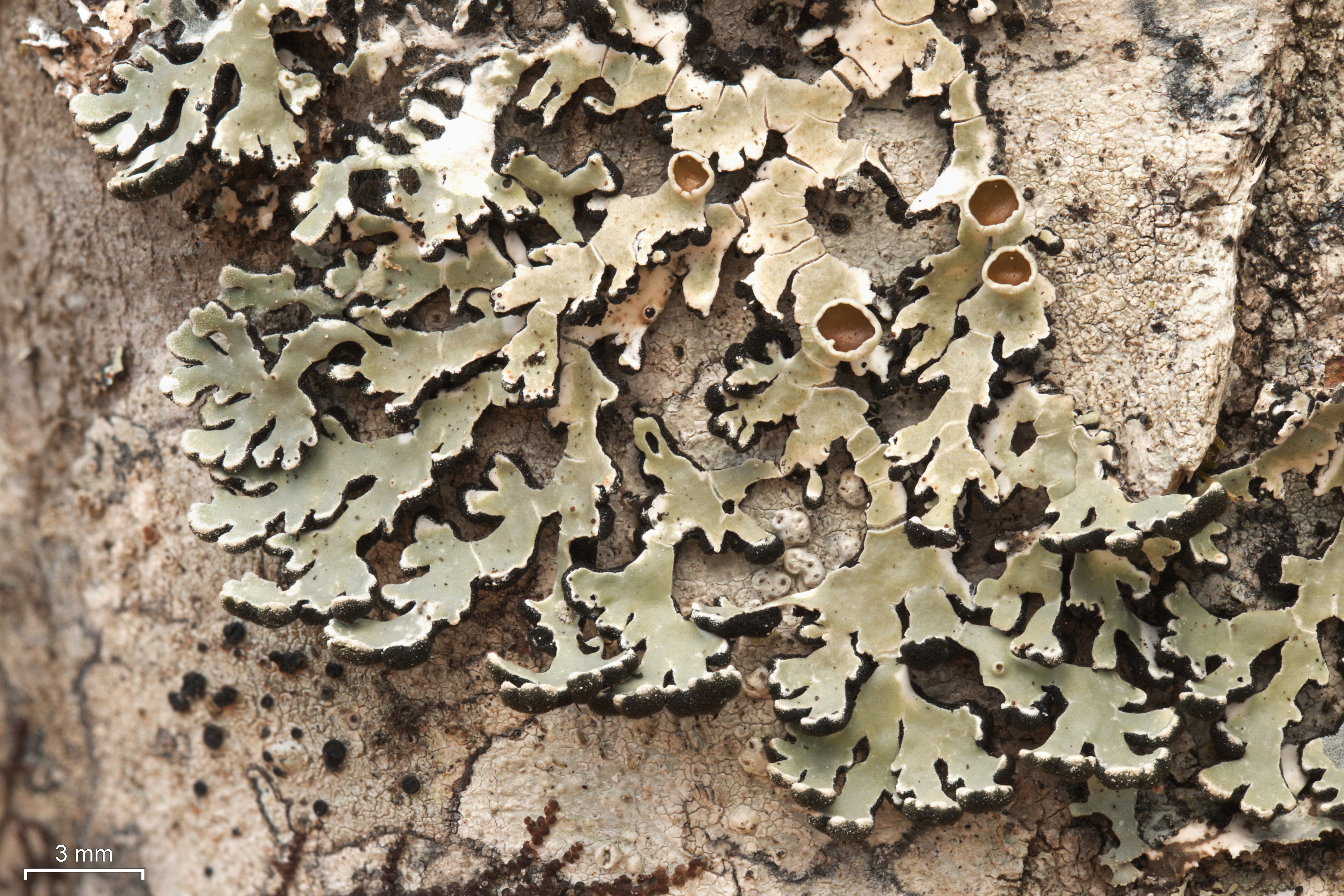
Anzia colpodes (Ach.) Stizenb.
- Scientific name
- Anzia colpodes
- Author
- (Ach.) Stizenb.
- Common names
 Black-foam Lichen
- IUCN Specialist Group
 Lichens
- Kingdom
- Fungi
- Phylum
- Ascomycota
- Class
- Lecanoromycetes
- Order
- Lecanorales
- Family
- Parmeliaceae
- Assessment status
- Under Assessment
- Proposed by
- None
- Assessors
- James Lendemer, Belkes Stambouli
- Contributors
- James Lendemer, Troy McMullin
- Comments etc.
- Anders Dahlberg, Julie McKnight
Assessment Notes
Taxonomic notes
Swartz initially named it lichen colpodes Ach in 1799, then it was changed to Lichen diatrypus colpodes (Ach.) Lam. in 1813, and later to Parmelia colpodes (Ach.) Ach. in 1803 (Species Fungorum, n.d )
Why suggested for a Global Red List Assessment?
Anzia colpodes (Common Name: Black Fringe Foam Lichen) is endemic to eastern North America where it is widespread. The species has been extirpated from large portions of its range and remaining populations in many areas appear to be in decline.
Geographic range
The Black-foam Lichen is primarily endemic to North America, In the USA, it has been collected extensively, spanning from the Appalachian Mountains in Georgia to Maine, and across the Ozark Plateau, as well as in Illinois, Wisconsin, and Michigan. In Canada, it is mainly found in the northern part of its range, with documented occurrences in Ontario, Quebec, New Brunswick, and Nova Scotia. Recent surveys indicate its absence in Ontario and Quebec, and no records have been reported in New Brunswick over the past decade. In Nova Scotia, it is widespread but not commonly encountered (Lichen Portal, n.d.) ( Richardson et al. 2015).
Population and Trends
The EOO of Anzia from 1839 until now is estimated to be 3711549 km2. Historically From 1924 until now it became 3507885 km2 with 484 sites this resulted in a decline of 6%. While the AOO was 2692 km2 and became 1704 km2 with 190 sites with a 37% decline.
When measuring the population reduction over three generations according to A2(c), we observe a 37% decline in AOO, indicating vulnerability. This decline is attributed to the diminishing quality of habitat resulting from the reduction of old-growth forests (Boggess et al. 2024) (Tripp et al. 2020). Similarly, under A4(b), we’ve estimated a significant 61% decline in mature individuals over the past century, marking it as endangered. With an estimated count of 50 mature individuals per site, this decline is alarming.
The geographical range, as determined by form B2 (area of occupancy) at 660 km2, also indicates vulnerability. Anzia’s habitat, nestled within old-growth forests (Tripp et al. 2020), faces severe fragmentation (Boggess et al. 2024). This scenario meets condition ‘a’, with AAO declining by 37% over a century, aligning with condition ‘b’ under B2 ii. Moreover, the state of the old-growth forest, marked as condition ‘iii’, has deteriorated, alongside a 61% decline in mature individuals.
Population Trend: Decreasing
Habitat and Ecology
It thrives on mature deciduous tree trunks in areas with flat or sloping landscapes, drawing moisture from nearby wetlands, lakes, or streams. While primarily found on Red Maple (Acer rubrum), it also inhabits White Ash (Fraxinus americana), Sugar Maple (Acer saccharum), and Red Oak (Quercus rubra), occasionally appearing on other tree varieties.
Threats
T
The species faces significant threats, primarily from historical extirpation and population declines, alongside habitat changes at both macro- and micro-scales due to the deposition of pollutants and alterations in the ecosystem. These alterations stem from residential and commercial development, as well as changes induced by housing and urban areas, commercial and industrial zones, and tourism and recreation sites. Moreover, energy production, including oil and gas drilling, mining and quarrying, and renewable energy installations, exacerbates habitat shifts. Transportation and service corridors, such as roads, railroads, and utility lines, further encroach upon its habitat.Logging and wood harvesting contribute to ongoing habitat degradation, while natural system modifications and fire suppression efforts also impact its environment. Pollution, including agricultural and forestry effluents, airborne pollutants, acid rain, and smog, adds to the species’ challenges. Climate change and severe weather events, such as habitat shifting, alteration, droughts, temperature extremes, storms, and flooding, pose additional risks. These cumulative pressures threaten the species’ survival and further complicate conservation efforts.
Conservation Actions
This species is currently being considered to listing by COSEWIC in Canada. There are many conservation actions that can be taken including educating and training land managers and local botanists to identify the species so we can monitor its health, federally listing the species as endangered in the United States, improving air quality regulation, and providing increased protection for forest stands where the species occurs.
Research needed
The distribution of this species is well understood. Further research that will aid in the conservation of this species includes population assessments and monitoring, population genetics studies, and ecological studies that incorporate threats to the species. Additionally, a species recovery plan needs to be written.
Use and Trade
Bibliography
Laura M. Boggess, Christy M. McCain, Erin A. Manzitto-Tripp, Scott M. Pearson, James C. Lendemer, Disturbance and diversity: Lichen species richness decreases with increasing anthropogenic disturbance, Biological Conservation, Volume 293, 2024, 110598,
ISSN 0006-3207, https://doi.org/10.1016/j.biocon.2024.110598.
Tripp, Erin, and James Lendemer. 2020. Field Guide to the Lichens of Great Smoky Mountains National Park. Univ Tennessee Press; First Edition.
Brodo, I. M., S. D. Sharnoff and S. Sharnoff. 2001. Lichens of North America. Yale University Press. New Haven and London. (Brodo et al. 2001)
Richardson, David & Anderson, Frances & Cameron, Robert & Clayden, Stephen & McMullin, Richard. (2015). COSEWIC assessment and status report on the Black-foam Lichen Anzia colpodes in Canada.
Species Fungorum. (n.d.). Anzia. Retrieved 2024, from https://www.speciesfungorum.org/Names/SynSpecies.asp?RecordID=376252”
Lichen Portal. (n.d.). Taxon: Anzia. Retrieved 2024, from https://lichenportal.org/portal/taxa/index.php?taxon=54298
Brodo, IM/ Duran Sharnoff, S/ Sharnoff, S 2001: Lichens of North America. - Yale University Press, New Haven & London. 795 pp.
http://explorer.natureserve.org/servlet/NatureServe?searchName=Anzia+colpodes