- Proposed
- Under Assessment
- Preliminary Assessed
- Assessed
- ENPublished
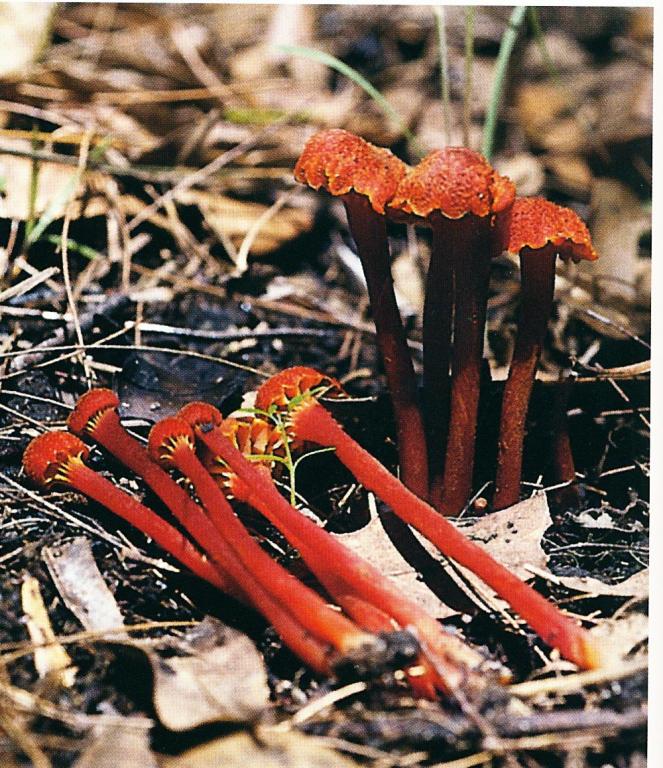
Hygrocybe boothii A.M. Young
- Scientific name
- Hygrocybe boothii
- Author
- A.M. Young
- Common names
- IUCN Specialist Group
 Mushroom, Bracket and Puffball
- Kingdom
- Fungi
- Phylum
- Basidiomycota
- Class
- Agaricomycetes
- Order
- Agaricales
- Family
- Hygrophoraceae
- Assessment status
- Published
- Assessment date
- 2019-07-25
- IUCN Red List Category
- EN
- IUCN Red List Criteria
- B1ab(iii,v); D
- Assessors
- Patrick Leonard (Queensland Mycological Society, Australia)
- Reviewers
- Gregory Mueller (Chicago Botanic Garden / IUCN SSC Mushroom, Bracket and Puffball Specialist Group)
Assessment Notes
Justification
Hgrocybe boothii is an Australia endemic restricted to the Atherton Tablelands of North Queensland. Its distribution is limited to a small forest area undergoing rapid change, and it has only been found in damp hollows which are uncommon throughout this distribution. Despite being a distinctive species, and there having been two targeted survey events, it is known only from six collections.Based on this, it is probably a genuinely a rare species. It is estimated that in total there are no more than 20 sites where the species occurs, with a total population size of 200-1000 mature individuals, which is likely to be in continuing decline.
Its extent of occurrence is calculated as up to 700 km2 and there are two locations based on the threats of fire or grazing by farm and feral animals. Even with the discovery of new sites, the number of locations would not be expected to exceed five.
The species is therefore assessed as Endangered B1ab(i,v); D.
Taxonomic notes
Geographic range
This species is an Australia endemic restricted to the Atherton Tablelands of North Queensland. It is known from six collections: two from Mt. Baldy and four from Kooloomboola National Park. There are no more recent documented sightings despite two targeted survey events. This lack of new sightings is especially noteworthy given that there has been a substantial increases in the sightings and collections of Hygrocybe species following the publication of an Australian monograph on the genus (Young 2005). There is an unconfirmed, doubtful photo posted on Facebook from south Queensland outside of the accepted distribution of the taxon; this was not included as part of the assessment.Population and Trends
This species has only been recorded in 2001 and 2002 from five sites, each with 4-12 sporocarps in clusters. The species is restricted to damp hollows which are uncommon throughout the distribution of the species. There are no more recent documented sightings despite two targeted survey events. This lack of new sightings is especially noteworthy given that there has been a substantial increase in the sightings and collections of Hygrocybe species following the publication of Dr Young’s monograph on the genus in 2005. It is estimated that there are no more than 20 sites in total where the species occurs, each with 2-5 functional individuals, themselves each representing 5-10 mature individuals. The population size is therefore estimated to be between 200 and 1000 mature individuals.
Population Trend: Decreasing
Habitat and Ecology
Hygrocybe boothii is restricted to areas of damp woodland among moss in on nutrient poor soils in open savannah forest dominated by Eucalyptus spp. This habitat is uncommon throughout its range. It is thought that many Hygrocybe species are biotrophic and may be associated with mosses (e.g. Halbwachs et al. 2013).Threats
The Mount Baldy National Park was a Forest Reserve until 2010 and was commercially exploited for timber. The forest and the National Park were also subject to grazing and disturbance by farm animals and continue to be disturbed by feral animals, particularly wild pigs. As part of the management plan there are controlled burns undertaken on a rotational basis. Although this species is probably associated with damp hollows which the management plan seeks to exclude from the fire regime, it is not clear that this has been a successful policy. All these factors are known to affect the survival of Hygrocybe species in other localities. Extensive land clearance and severe drought in Queensland pose more general threats to this species. These forests have been exploited for timber and have from time to time been grazed by farm and feral animals, both of which can damage the habitat of Hygrocybe species.Conservation Actions
The sites where these fungi occur were designated as a National Park in 2010 but there are no specific conservation policies for fungi in the Park’s management plan.Work is needed to clarify the biology of this fungus including its fruiting patterns and habitat requirements.