- Proposed
- Under Assessment
- Preliminary Assessed
- Assessed
- ENPublished
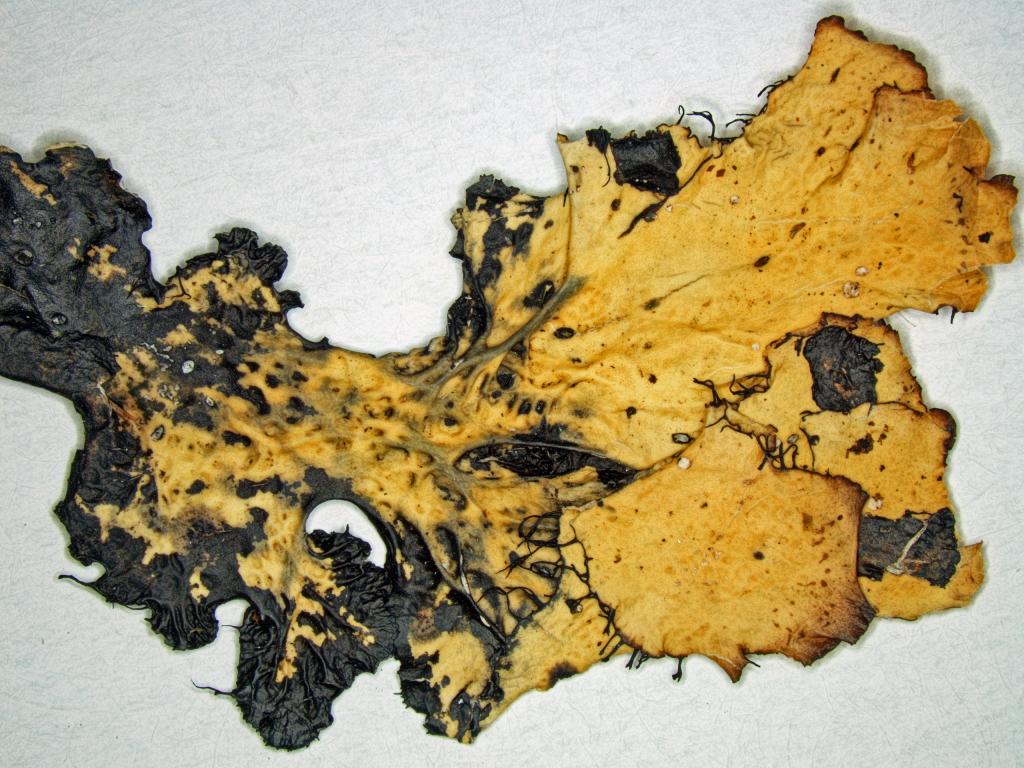
Cetreliopsis papuae Randlane & Saag
- Scientific name
- Cetreliopsis papuae
- Author
- Randlane & Saag
- Common names
- IUCN Specialist Group
 Lichens
- Kingdom
- Fungi
- Phylum
- Ascomycota
- Class
- Lecanoromycetes
- Order
- Lecanorales
- Family
- Parmeliaceae
- Assessment status
- Published
- Assessment date
- 2017-08-25
- IUCN Red List Category
- EN
- IUCN Red List Criteria
- B2ab(iii,iv)
- Assessors
- André Aptroot (ABL Herbarium, The Netherlands); Tiina Randlane (Institute of Ecology & Earth Sciences, University of Tartu, Estonia)
- Reviewers
- Christoph Scheidegger (IUCN SSC Lichen Specialist Group)
Assessment Notes
Justification
Criterion A is not applicable as there is no information about the trends of population size over long time periods.
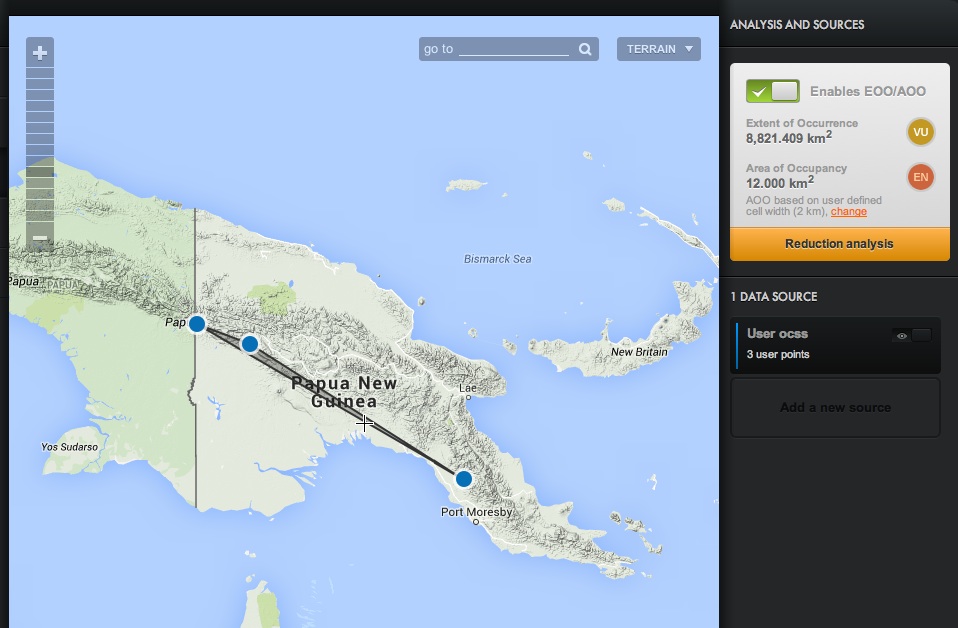
Criterion B: using GeoCat tool, EOO was assessed 8,821 km². The species has been recorded only in 3 mountain tips in Papua New Guinea and is definitely absent from some relatively often visited mountains in between these three localities. It might extend also to the mountains in Papua province, Indonesia (earlier Irian Jaya). Even so, the whole mountain range would be less than 20,000 sq km. Lichen population in mountain tips is clearly fragmented within this range, and the population reduction is inferred because of possible fires and mining activities in the species habitat. Cetreliopsis papuae is assessed EN.
Criterion C is not applicable as there is no information about the number of mature individuals.
Criterion D: AOO was assessed 12 sq km; no of known localities is 3
Geographic range
The species occurs only in one island and in one country – Papua New Guinea.
Location records:
1. Papua New Guinea, [Western province,] Star Mountains, Mt. Scorpion, 3600 m, open herbfield, leg. Hope 1975 (US, holotype).
2. Papua New Guinea, Central distr., Tapini subdistr., Mt. Strong, 3450 m, shrublet communities, leg. Coode 03.05.1971 (Herb. Aptroot).
3. Papua New Guinea, Southern Highlands, Mt. Giluwe, 4140 m, leg. D. McVean 1967 (BM).
Population and Trends
Cetreliopsis papuae is an extremely rare species with very restricted distribution area in New Guinea. Only three localities are known till now (collections made in 1967, 1971 and 1975), all from high altitudes (over 3400 m) in montane areas of Papua New Guinea.
Population Trend: Unknown
Habitat and Ecology
Cetreliopsis papuae grows in high mountains (over 3400 m) of Papua New Guinea, in open herbfields or shrublet communities, on the ground.Threats
Cetreliopsis papuae has very restricted distribution area and specific habitat; it is endangered by possible damage of this habitat, alpine grasslands, by fires and economic activities. Regular burning takes place in many localities of these mountain ranges, both in grasslands and in forests (Lambley 1991). For instance, in 2008 it was declared, based on satellite images, that Papua New Guinea has lost 24% of its rainforest during last 30 years through commercial logging, agriculture and burning (Satellite images uncover… 2008). Additionally, deposits of gold and copper in the Star Mountains (enclosing one recorded locality of Cetreliopsis papuae), are increasingly exploited with large mining operations which have implications for the surrounding areas (Lambley 1991).The species is sterile and probably reproduces vegetatively by thallus fragments, therefore the dispersal distance cannot be large, and ability of colonising additional localities is likely to be limited.
Conservation Actions
No conservation plan is available; the known localities are not situated in protected areas, according to the present knowledge. There is an urgent need for a detailed assessment of the current extent of occurrence, population size and trend.
The first concern is whether Cetreliopsis papuae is still growing in the area where it has been recorded in 1960-70s; any further data about its ecology, biology and population trends are required as well.