- Proposed
- 2Under Assessment
- 3Preliminary Assessed
- 4Assessed
- 5Published
Mycena dura Maas Geest. & Hauskn.
- Scientific name
- Mycena dura
- Author
- Maas Geest. & Hauskn.
- Common names
- IUCN Specialist Group
 Mushroom, Bracket and Puffball
- Kingdom
- Fungi
- Phylum
- Basidiomycota
- Class
- Agaricomycetes
- Order
- Agaricales
- Family
- Mycenaceae
- Assessment status
- Proposed
- Proposed by
- Simon Harding
- Comments etc.
- Simon Harding
Assessment Notes
Taxonomic notes
Why suggested for a Global Red List Assessment?
Mycena dura is proposed for assessment because it is a rare, grassland‑associated species with an exceptionally small known global range, recently confirmed in Britain for the first time through combined morphological and molecular evidence. Current records indicate that the species is restricted to unimproved calcareous and dry grasslands—habitats that have undergone long‑term and ongoing decline across Europe due to agricultural intensification, land‑use abandonment, nutrient enrichment, and scrub encroachment.
Its narrow ecological niche, strong association with threatened grassland types, and extremely sparse global records suggest that it may meet B‑criteria thresholds, particularly in relation to very small AOO and continuing habitat decline. A formal Red List assessment is therefore warranted to clarify its conservation status and to highlight the vulnerability of the grassland ecosystems on which it depends.
Geographic range
Mycena dura is confirmed from Austria, Switzerland, Italy, the Netherlands, Sweden, Denmark, Germany, Spain and the United Kingdom (England). All verified occurrences are European and associated with semi‑natural calcareous or dry grasslands. Records are few, widely scattered and typically represent isolated localities within each country.
The distribution is highly fragmented, reflecting the limited extent of suitable ancient grasslands. The Area of Occupancy is very small, and continuing decline in habitat extent and quality across Europe supports an inference of ongoing reduction in AOO and number of locations.
Population and Trends
Mycena dura is known from a small number of confirmed sites across Europe, each typically supporting low densities of fruitbodies. Populations are inferred to be small, localised and fragmented, reflecting the restricted availability of suitable habitat. No quantitative population data exist, but long‑term decline, fragmentation and degradation of calcareous and dry grasslands indicate a continuing reduction in the number of mature individuals, number of locations and habitat quality. Recolonisation of degraded sites is unlikely due to the species’ dependence on long‑established, low‑nutrient conditions.
Population Trend: Decreasing
Habitat and Ecology
Mycena dura occurs in semi‑natural calcareous and dry grasslands, typically in short‑sward or lightly grazed areas with low nutrient input. Verified records indicate a preference for unimproved or minimally improved grassland systems on well‑drained soils. The species fruits caespitose, producing small tufted groups of basidiocarps, and is presumed to be saprotrophic, decomposing herbaceous litter within open grassland habitats. No records exist from woodland, improved pasture or other habitat types, indicating a narrow ecological amplitude and a dependence on ancient, low‑nutrient grassland systems.
Threats
The primary threat to Mycena dura is the widespread and ongoing loss, degradation and fragmentation of semi‑natural calcareous and dry grasslands across Europe. These habitats have undergone major long‑term declines due to several interacting pressures:
Agricultural intensification, including reseeding, fertilisation, ploughing and conversion to improved pasture, which removes or fundamentally alters the low‑nutrient grassland systems required by the species.
Abandonment of traditional low‑intensity grazing, leading to rapid scrub encroachment and successional change, reducing the open, short‑sward conditions characteristic of suitable habitat.
Nutrient enrichment from atmospheric deposition, manure drift and agricultural runoff, which shifts plant communities toward more competitive species and reduces habitat suitability for nutrient‑sensitive grassland fungi.
Afforestation and land‑use change, further reducing the extent of ancient grasslands and increasing fragmentation of remaining sites.
Small, isolated populations, which heighten vulnerability to stochastic events and local extinctions, particularly given the species’ apparent low dispersal capacity and dependence on long‑established grassland conditions.
These combined pressures are causing continuing declines in habitat extent, quality and connectivity, directly threatening the persistence of M. dura across its range.
Conservation Actions
Protection and appropriate management of remaining semi‑natural calcareous and dry grasslands are the highest priorities for this species. Key actions include:
• Safeguarding long‑established calcareous and dry grasslands through site protection and avoidance of land‑use change, reseeding or conversion to improved pasture.
• Maintaining low‑intensity or traditional grazing regimes that preserve short‑sward structure and prevent scrub encroachment.
• Preventing nutrient enrichment by minimising fertiliser drift, run‑off and other sources of eutrophication affecting adjacent grasslands.
• Avoiding afforestation and tree‑planting schemes within or near ancient grassland sites.
• Recognising the conservation value of ancient grasslands in local planning and agri‑environment policy.
• Supporting targeted surveys and molecular verification to clarify distribution and inform site‑level conservation.
• Monitoring known sites to detect changes in habitat condition, grazing continuity and nutrient status.
Research needed
Further work is required to clarify the species’ distribution, ecology and long‑term trends. Priority areas include:
• Targeted field surveys in semi‑natural calcareous and dry grasslands to refine the known range and identify additional sites.
• Molecular sequencing to confirm species boundaries and support verification of historical and recent records.
• Studies of habitat requirements and fruiting ecology, including responses to grazing regimes, sward structure and nutrient inputs.
• Monitoring of known sites to track habitat condition, detect impacts of land‑use change or abandonment, and assess long‑term population trends.
Use and Trade
This species is not known to be used or traded
Bibliography

Mycena dura — Cotswolds, England (sequenced). © Simon Harding

Mycena dura — Cotswolds, England (sequenced). © Simon Harding

Mycena dura — Cotswolds, England (sequenced). © Simon Harding
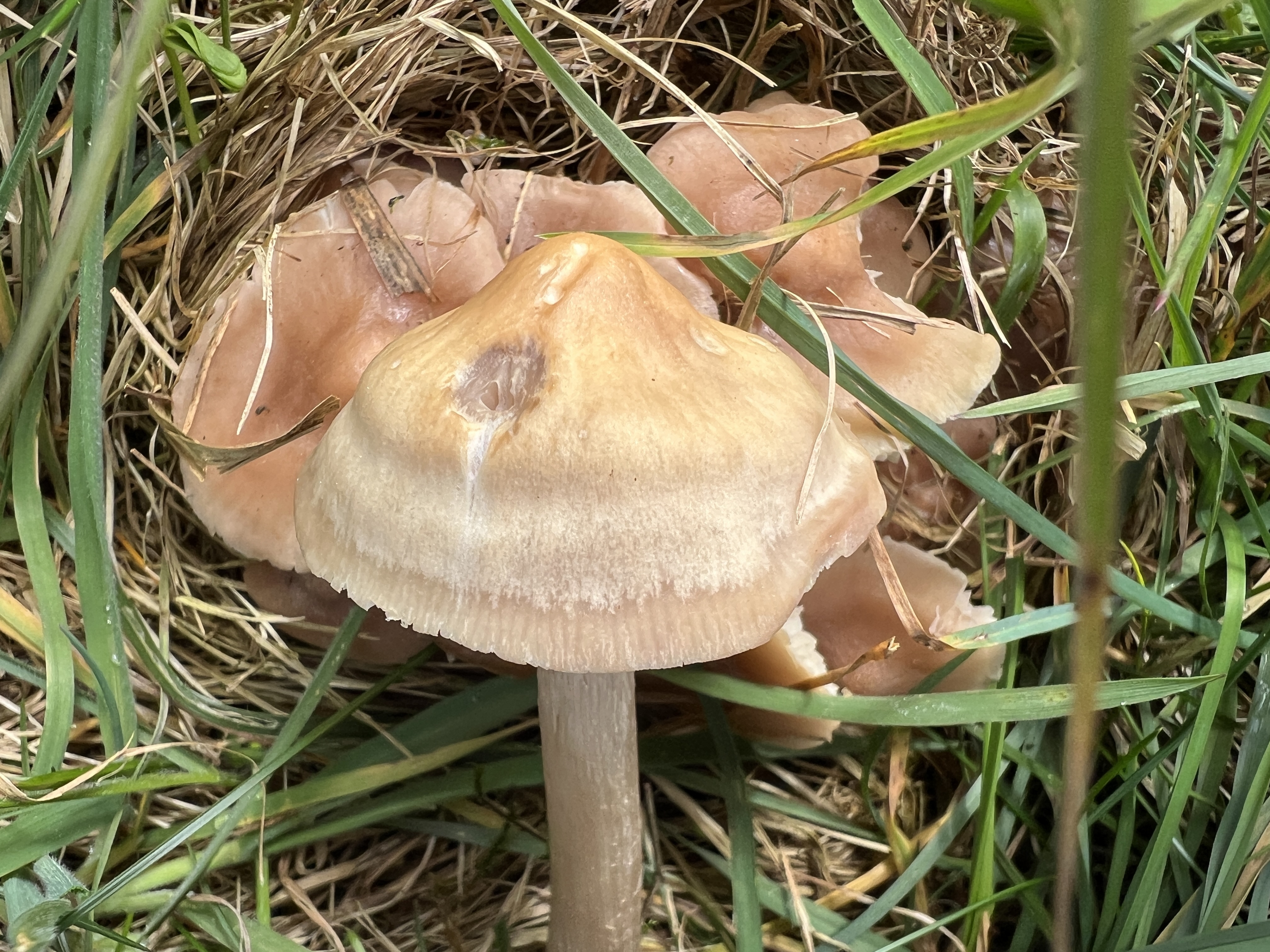
Mycena dura — Cotswolds, England (sequenced). © Simon Harding

Mycena dura — Cotswolds, England (sequenced). © Simon Harding

Mycena dura — Cotswolds, England (sequenced). © Simon Harding

Mycena dura — Cotswolds, England (sequenced). © Simon Harding

Mycena dura — Cotswolds, England (sequenced). © Simon Harding
Country occurrence
Regional Population and Trends
| Country | Trend | Redlisted |
|---|