- Proposed
- Under Assessment
- Preliminary Assessed
- Assessed
- NTPublished
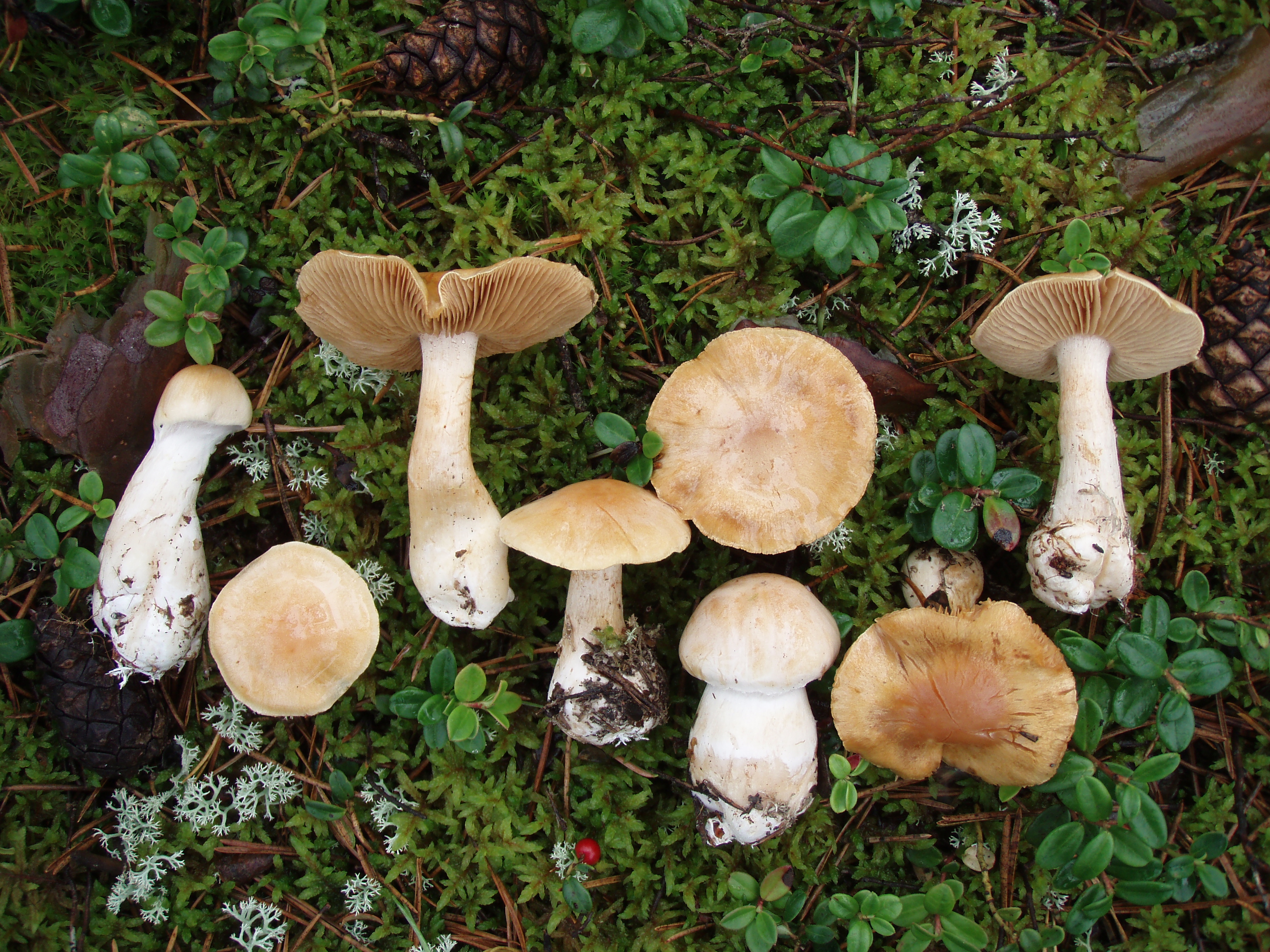
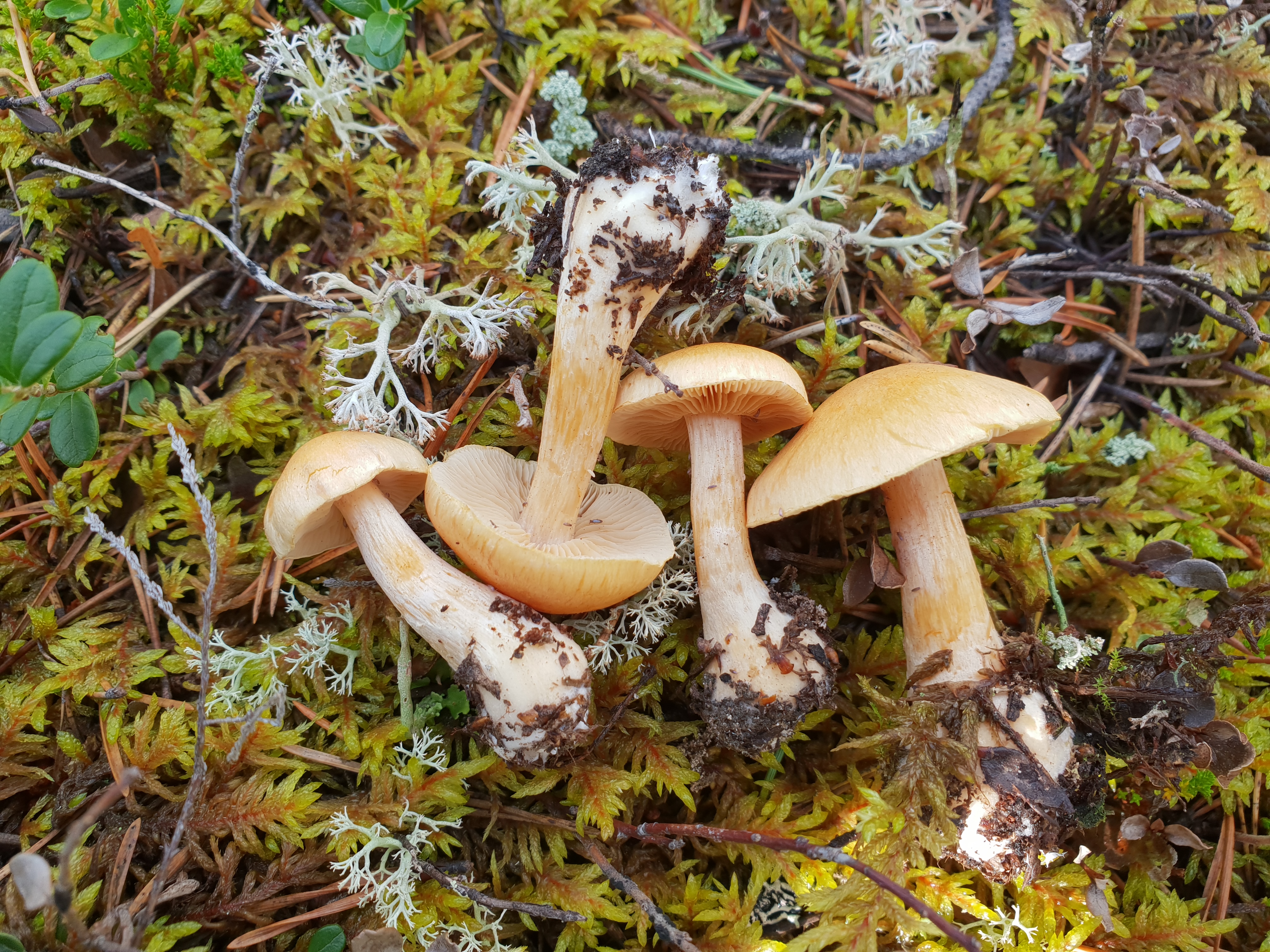
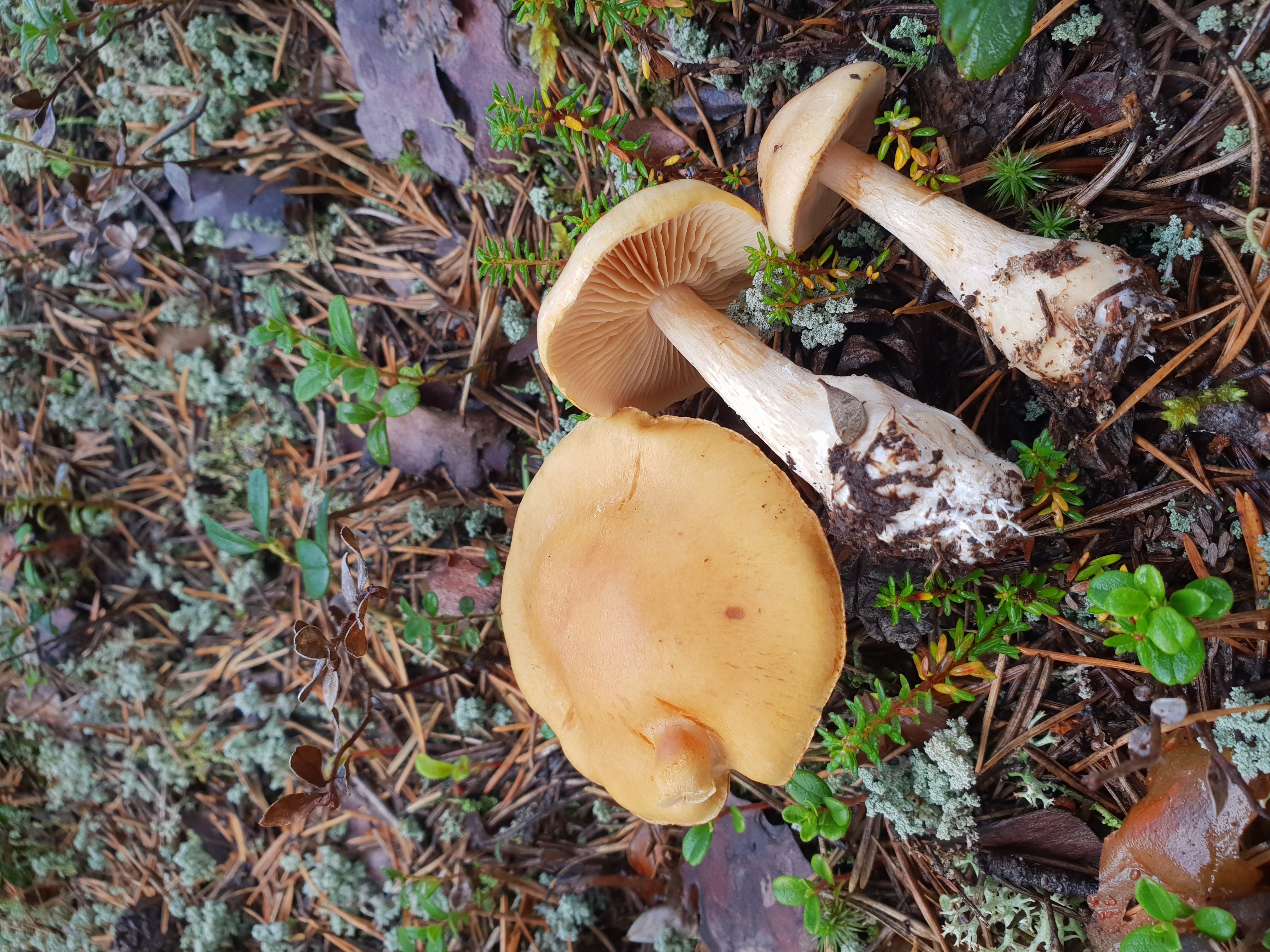
Cortinarius pinophilus Soop
- Scientific name
- Cortinarius pinophilus
- Author
- Soop
- Common names
- IUCN Specialist Group
 Mushroom, Bracket and Puffball
- Kingdom
- Fungi
- Phylum
- Basidiomycota
- Class
- Agaricomycetes
- Order
- Agaricales
- Family
- Cortinariaceae
- Assessment status
- Published
- Assessment date
- 2019-03-27
- IUCN Red List Category
- NT
- IUCN Red List Criteria
- A2c+3c+4c
- Assessors
- Tor-Erik Brandrud (Norwegian institute for nature research (NINA), Norway)
- Reviewers
- Tea von Bonsdorff (Finnish Museum of Natural History); Tatyana Svetasheva
Assessment Notes
Justification
Cortinarius pinophilus is associated with Pinus sylvestris in Europe and adjacent Asia (W Siberia). In North America associated with Tsuga heterophylla, Pseudotsuga menziesii and Pinus contorta. Its habitat in Eurasia is dry, lichen/moss-dominated sandy pine forests, exceptionally also in ombrotrophic Sphagnum bogs with Pinus (Siberia). The species occurs mainly in older/old-growth forests. In N America the species is not reported in sandy forests, but apparently in oligotrophic sites with deep moss including hummocks.The lichen/moss-dominated sandy pine forests in large parts of Europe have been seriously declining, suffering from eutrophication (N-enrichment; changing to grass-dominant communities), forestry, roads/industry/settlements/military activity as well as gravel pits. Intact sandy pine forests with good ecological conditions are now remaining mainly in boreal N Europe including adjacent Asia (w/ W Siberia). Little is known about the decline in C. pinophilus habitats in N America.
The decline of the major habitat of C. pinophilus (dry, sandy pine forests) in is estimated to be in the magnitude of 15-20% in 50 years (three generations) and predicted to continue to decline. The population size is inferred to undergo a similar decline, between 15 and 30%. The species is thus assessed as NT (A2c+3c+4c).
Geographic range
The species apparently follows the boreal, sandy pine forests on glacifluvial deposits, throughout Fennoscandia and as far east to W Siberia (Khanty-Mansiysk-Tomsk region), probably also further east. In Fennoscandia, the species is more or less confined to the boreal regions (only exceptionally in boreonemoral zone). In C Europe, the species is known from a few glacial/glacifluvial sites in N Italy and Hungary. Little is known about the distribution and frequency of the species in C/W Europe before the depauperation of this habitat (eutrophication, etc.).In N America the species is known from Canada, NW British Colombia, and USA, W Washington (Ammirati et al. 2012).
Population and Trends
The species is known from approx. 90 sites/localities in Fennoscandia (20 localities in E Norway, approx. 40 in Sweden, and approx. 30 in Finland). The total population in Fennoscandia is estimated to occur in approx. 900 sites/localities. The species is apparently locally more frequent in sandy Scots pine forests of W Siberia, and the total Russian populations are estimated to approx. 2,000 sites/localities. The species is at present very rare in C Europe (but known from N Italy and W Hungary). According to Dahlberg and Mueller (2011), the number of individuals is estimated as 60,000 in Europe (around 3,000 sites/localities x 20 individuals in each).
In North America, the species are so far reported from four sites. Quite roughly, the American occurrences are estimated to be >1,000 sites/localities (>20,000 mature individuals in North America). The global population size is then estimated to be of approx. 80,000 mature individuals.
The decline of the major habitat of C. pinophilus (older, dry, sandy pine forests) in the last 50 years (three generations) is estimated on average to be in the magnitude of 15-20%, with especially much habitat-loss in The Netherlands, Germany, Poland and adjacent regions, where this habitat has almost disappeared (Brandrud and Bendiksen 2014) an in the Siberian forest (Flintoff 2013, Kukavskaya et al. 2013). The species population size is inferred to undergo a similar decline (15-20%).
Population Trend: Decreasing
Habitat and Ecology
Cortinarius pinophilus is associated with Pinus sylvestris in Europe and adjacent Asia (W Siberia). In North America associated with Tsuga heterophylla, Pseudotsuga menziesii and Pinus contorta. Its habitats in Eurasia are dry, lichen/moss-dominated sandy pine forests (Brandrud and Bendiksen 2014), exceptionally also in ombrotrophic Sphagnum bogs with Pinus (Siberia; pers. obs.). The species occurs mainly in older/old-growth forests. In N America the species is not reported in sandy forests, but apparently in oligotrophic sites with deep moss including hummocks (Ammirati et al. 2012).Threats
The major habitat of C. pinophilus, the lichen/moss-dominated sandy pine forests has been seriously declining in large parts of Europe (Brandrud and Bendiksen 2014), suffering from eutrophication (N-enrichment; changing to grass-dominant communities), forestry, roads/industry/settlements/military activity as well as gravel pits. Intact sandy pine forests with good ecological conditions are now remaining mainly in boreal N Europe including adjacent Asia (w/ W Siberia), but also here the forests are subject to intensive forestry (Flintoff 2013, Kukavskaya et al. 2013). Little is known about the status of the C. pinophilus habitats in N America. If the species and its habitat in N America are not declining, the species is probably near the threshold value for listing as NT.Conservation Actions
To prevent decline and further fragmentation of dry, sandy pine forests with good habitat quality, it is important to set aside reserves, housing many rare/threatened, habitat-specific species such as C. neofurvolaesus, C. quarciticus and C. pinigaudis. It is furthermore important to establish also sites with a less strict conservation regime, such as woodland key biotopes, where some non-destructive human activities are accepted (such as non-intensive forestry, with closed cutting).More mapping/surveying and monitoring of C. pinophilus is needed, especially in N America, but also in remote parts of Siberia. Finally, more documentation on the degree of decline of the habitats themselves is needed, especially from N America.