- Proposed
- Under Assessment
- 3Preliminary Assessed
- 4Assessed
- 5Published
Graphis alboscripta Coppins & P. James
- Scientific name
- Graphis alboscripta
- Author
- Coppins & P. James
- Common names
 White Script-Lichen
- IUCN Specialist Group
 Lichens
- Kingdom
- Fungi
- Phylum
- Ascomycota
- Class
- Lecanoromycetes
- Order
- Ostropales
- Family
- Graphidaceae
- Assessment status
- Under Assessment
- Proposed by
- Beppo Fischer
- Assessors
- Beppo Fischer, Rebecca Yahr
- Editors
- Rebecca Yahr
Assessment Notes
Justification
Fissurina alboscripta is an epiphytic lichen endemic to Scotland, and thus Scotland carries international responsibility for the survival of this species. The habitat of this species is smooth-barked shoots of old-growth hazel shrubs in Atlantic hazelwoods. These woodlands are confined to the Scottish west coast, since they are temperate rainforests and dependent on the hyperoceanic climate present there. The abundance and quality of temperate rainforests in Scotland is limited, since many stands are degraded due to overgrazing and other threats.
Taxonomic notes
This species is now part of the genus Fissurina and named Fissurina alboscripta. However, in much of the literature, it is referred to as Graphis alboscripta.
Why suggested for a Global Red List Assessment?
Fissurina alboscripta is an epiphytic lichen endemic to Scotland, and thus Scotland carries international responsibility for the survival of this species. The habitat of this species is smooth-barked shoots of old-growth hazel shrubs in Atlantic hazelwoods. These woodlands are confined to the Scottish west coast, since they are temperate rainforests and dependent on the hyperoceanic climate present there. The abundance and quality of temperate rainforests in Scotland is limited, since many stands are degraded due to overgrazing and other threats.
Geographic range
Fissurina alboscripta is endemic to Scottish temperate rainforests, exclusively on Scotland’s west coast, and the species is only found in hazelwoods. These hazelwoods are estimated to cover around 6,800 km2 (Coppins & Coppins, 2012). The known AOO is 176 km2, and incorporating the extent of the suitable habitat and the amount of survey work done, we infer that a maximum AOO of 400 km2 is plausible and an EOO of smaller than 20 000 km2 very likely. Applying the precautionary principle, the AOO triggers the threshold for EN under Criterion B. The measured EOO is 10 246 km2, and since this habitat is confined to the Scottish west coast, we infer the possible true EOO to be less than double that.
The Scottish temperate rainforest (also including other types of woodland, not just hazel) is fragmented, the woodland existing only in small patches with a median size of 0.25 km2 and a mean size of 0.92 km2 (Alliance for Scotland’s Rainforest, 2019). The woodland patches are often not connected. For Fissurina alboscripta to be assessed as severely fragmented, a limited dispersal ability between the isolated forest patches must be diagnosed. While there is no information available on the dispersal range of the spores, it seems that the dispersal is impaired. At many of the sites where this species is found, it colonises only a handful of hazels, while many other suitable hazels remain vacant. It seems that dispersal is often not successful even across short ranges, and thus it must be even less successful between suitable forest patches. We conclude that this species can be considered severely fragmented (see Population and Trends below). Together with the AOO of smaller than 500km2, and the continuing decline in habitat quality (see below), this qualifies Fissurina alboscripta as EN under criterion B2ab(iii).
Population and Trends
This species has been specifically searched for at suitable sites. There will likely be undiscovered subpopulations, but the current data should provide a good estimate for the state of this species. There are fewer than 200 records of this species in total and the true population size will likely be smaller than 2000 functional individuals (occupied hazels). Currently, fewer than 50 subpopulations are known across the Scottish west coast. However, this lichen can be locally abundant such as on the Isle of Mull, which is a key site for this species. It is found on at least 50 hazels here. In many of the other subpopulations, it appears on only a few hazels, so more than half the functional individuals are in small and isolated patches. All subpopulations have fewer than 250 occupied hazels. Since a decline in habitat extent and quality can be inferred (see below), we suspect that the population of this species is declining too. Considering this and given the observed and estimated population and subpopulation size, Fissurina alboscripta triggers the threshold for EN under Criteria C2a(i).
Population Trend: Decreasing
Habitat and Ecology
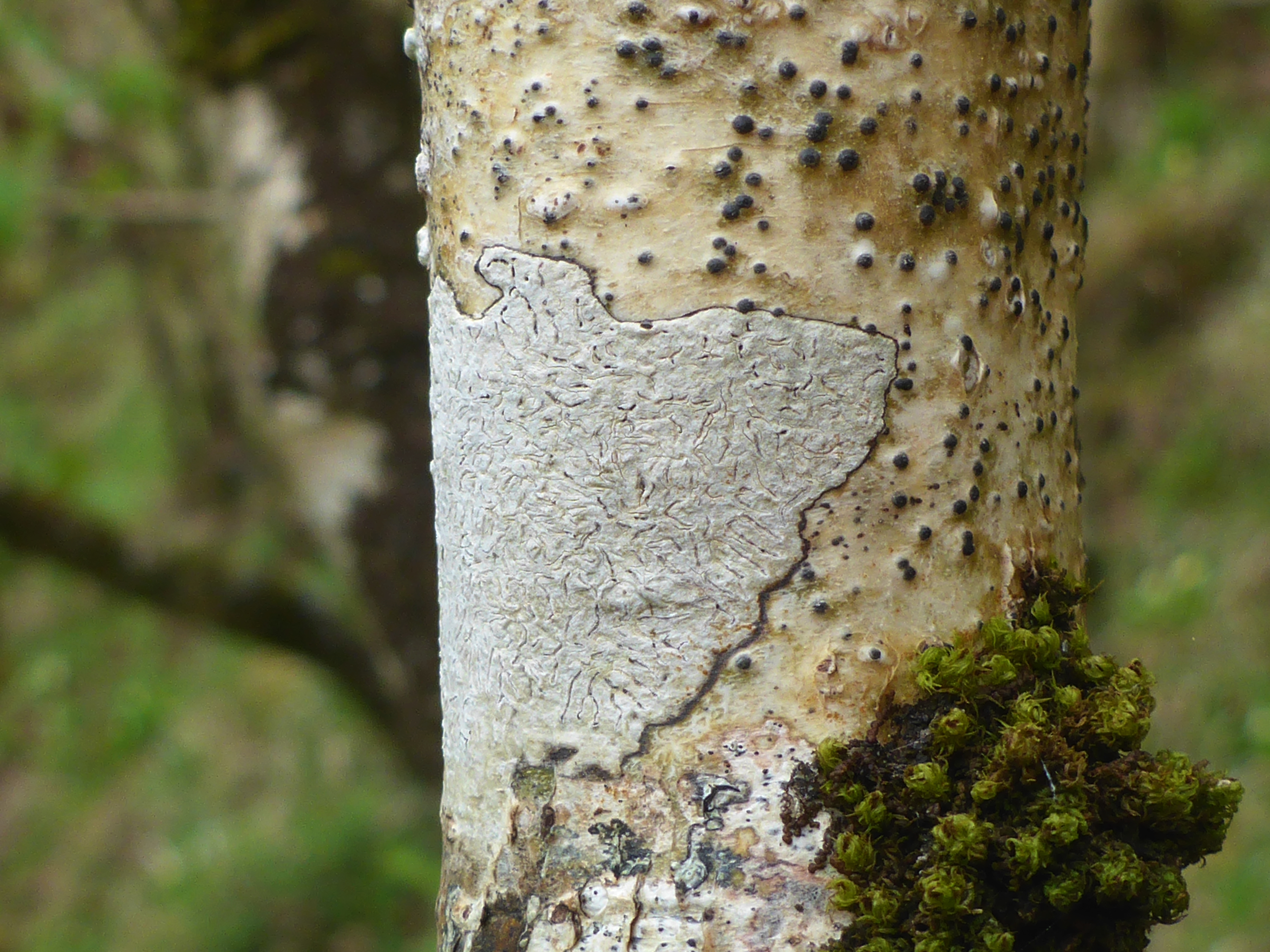
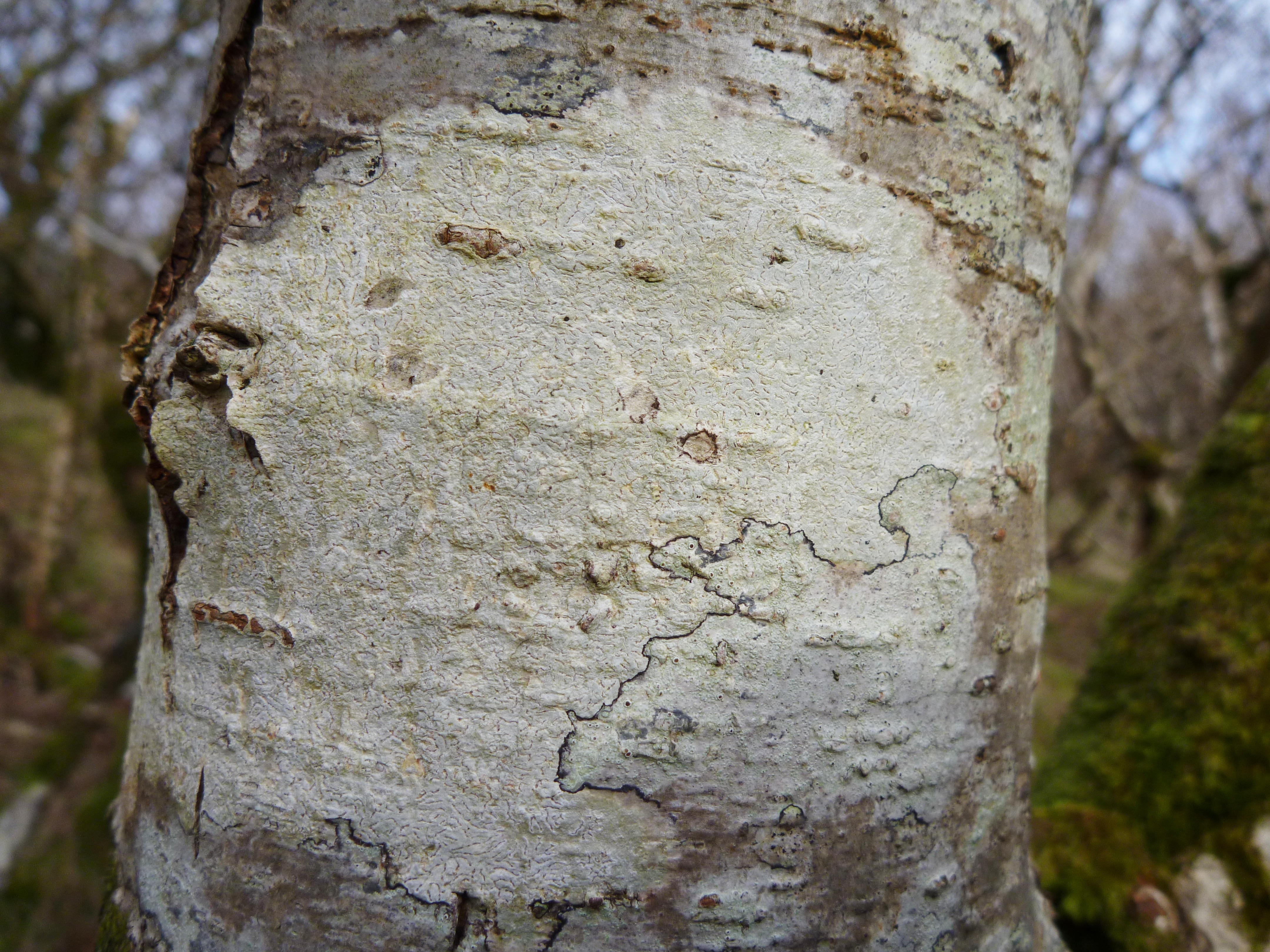
This species is an epiphytic lichen associated exclusively with atlantic hazelwoods, in the temperate rainforest zone. The vast majority of records are from hazels themselves, and a handful of specimens were found on ash and other trees. The habitat is characterized by hyperoceanic climate, experiencing high rainfall (more than 1500 mm) and mild temperatures. Some stands are estimated to be up to 10,000 years old, having established themselves after the last ice age and probably having persisted since then (Birks, 1989). If mostly undisturbed and unmanaged, hazel can from pure stands with a closed canopy (Coppins & Coppins, 2003). Hazel will continuously form young shoots for rejuvenation, even if uncoppiced. Fissurina alboscripta is restricted to growing on the bark of these hazel regeneration shoots in old-growth, unmanaged stands. It is part of the Graphidion, a community of crustose lichens growing on smooth bark of the young hazel shoots. As described (see Geographia Range), the atlantic hazelwoods in Britain and Ireland are highly fragmented. They are at permanent risk because of unsuitable grazing regimes, invasive species and other threats (see Threats), an thus we infer a continuing decline of this habitat.
Threats
In the Atlantic hazelwoods, Fissurina alboscripta and other species from the Graphidion are dependent on the continuous cover of old-growth stands and continuity and regular supply of young, smooth bark. Overgrazing is a major threat to the persistence of temperate rainforests, with 41% of it showing the impact of high or very high grazing pressure (Alliance for Scotland’s Rainforest, 2019). High or very high grazing pressure restricts or impairs the regeneration of these forests. Under these conditions, the hazels cannot rejuvenate, thus not forming young shoots and become tree-shaped. The bark becomes exposed and young bark supply, which is needed for the establishment of the Graphidion, is low, and old stems collapse and die (Coppins & Coppins, 2012). Appropriate management of the remaining old-growth, intact woodlands is key for the survival of F. alboscripta. This involves restricting deer and cattle grazing. However, Interestingly, undergrazing also poses a threat to this species: When left completely undisturbed, understory woody species can invade the stands. The Welsh sites show signs of undergrazing.
Another threat to this species is excessive coppicing, which can have negative effects on these ancient woodland stands. Outside Scotland, coppicing is used to rejuvenate hazel and encourages it to from new shoots, but this practice was not used across traditional managed stands on the west coast. Hazel plants will continue to form new shoots throughout their lifetime, and allowing old stems to persist alongside young ones promotes short-distance colonization within stools. Coppicing therefore breaks the ecological continuity which promotes the epiphyte diversity in these stands. In addition, hazels are pioneer plants, which do not thrive under closed canopy cover. Coppicing an entire stand will limit competitiveness against other woody species in the stand and can lead to hazel becoming an understory shrub. This will risk it being shaded out and will limit its ability to reproduce, leading to a decline of hazel population. Since hazel is the primary habitat of F. alboscripta, management practices that harm its abundance and the quality of habitat it provides for crustose lichens pose a threat to F. alboscripta (Coppins & Coppins, 2003, 2012).
Rhododendron ponticum is invasive in Scottish rainforests. Threatening the integrity of the atlantic temperate rainforest ecosystems as a whole, this also poses a threat to the habitat of Fissurina alboscripta, since it can colonise the woodland and outcompete native tree species (Alliance for Scotland’s Rainforest, 2019; Woodland Trust Scotland, 2021).
Another threat to this lichen is the ash dieback. There are only a few records known from ash, but since the entire population is likely to be small, substrate trees dying will have a negative impact.
Climate change will likely have an impact on the persistence of F. alboscripta, especially when the high fragmentation of habitat is taken into account. The climatic suitability of ancient forest habitats in Scotland was estimated to decrease by 42% for ancient forest indicator species under projected climate change scenarios (Ellis, 2015). To persist, species highly specialised for this habitat and climate must partly shift their distribution. However, ancient woodland specialist species are thought to be limited in their ability to disperse or establish (Sillett et al., 2000), and thus to have trouble migrating to track changing climatic conditions. The dispersal problem is exacerbated by the fragmentation of Scotland’s ancient woodlands, making range shifts more difficult with larger gaps of unsuitable habitat that dispersal kernels have to traverse.
Conservation Actions
Around 60% of the known observations are located in protected areas, mostly Sites of Special Scientific Interest. However, this does not automatically imply that threats are absent. It is known that even amongst protected parts of the Scottish atlantic rainforest, around 50% are in undesirable condition (Alliance for Scotland’s Rainforest, 2019). Some of the treats mentioned above can be met with appropriate management. A restriction of deer and cattle grazing in hazelwood stands allows for young shoots to persist, which are the habitat of Fissurina alboscripta. Care must be taken however to avoid undergrazing; grazing pressure has to be balanced to an adequate amount. In addition to that, coppicing in old growth stands should be avoided; instead, selective cropping is advised (Coppins & Coppins, 2003). This allows the stands and its epiphytes to persist and the Graphidion community can develop in the shelter of a closed hazel canopy. Efforts should be made to control the invasive Rhododendron ponticum, not only to protect epiphyte flora, but the temperate atlantic rainforests as entire ecosystems.
Research needed
Little is known about the dispersal ability of this species. Especially interesting is the lack of disperal inside many suitable stands. Research regarding dispersal, but also population genetics, could inform us on the grade of fragmentation and the amount of genetic exchange of the subpopulations. The Distribution patterns and its habitat preferences are roughly known, and the most urgent work that needs to be done regarding this species is conservation.