- Proposed
- Under Assessment
- VUPreliminary Assessed
- 4Assessed
- 5Published
Heterodermia chondroidea W.A. Weber & D.D. Awasthi
- Scientific name
- Heterodermia chondroidea
- Author
- W.A. Weber & D.D. Awasthi
- Common names
- IUCN Specialist Group
 Lichens
- Kingdom
- Fungi
- Phylum
- Ascomycota
- Class
- Lecanoromycetes
- Order
- Teloschistales
- Family
- Physciaceae
- Assessment status
- Preliminary Assessed
- Preliminary Category
- VU VU A4c; VU C1
- Proposed by
- Jacob Watts
- Assessors
- Jacob Watts
- Comments etc.
- Rebecca Yahr
Assessment Notes
Justification
Based on Criterion A4c, and an estimated and projected (continued) decline in the quality of forest habitat in the southern Rocky Mountains and Himalayan Mountains due to climate change and the increasing frequency of catastrophic, unrecoverable disturbances, the species should be classified as Vulnerable (VU). Based on criterion C and the most conservative estimates of total population size (3,500 individuals) and habitat declines (>10% decline in 3 generations), H. chondroidea should be classified as VU.
Assessed against all Criterea:
VU A4c - see above
NT B2b - see Geographic range
VU C1 - see above
NT D1 - see Population and current trends
DD E - see Population and current trends
Taxonomic notes
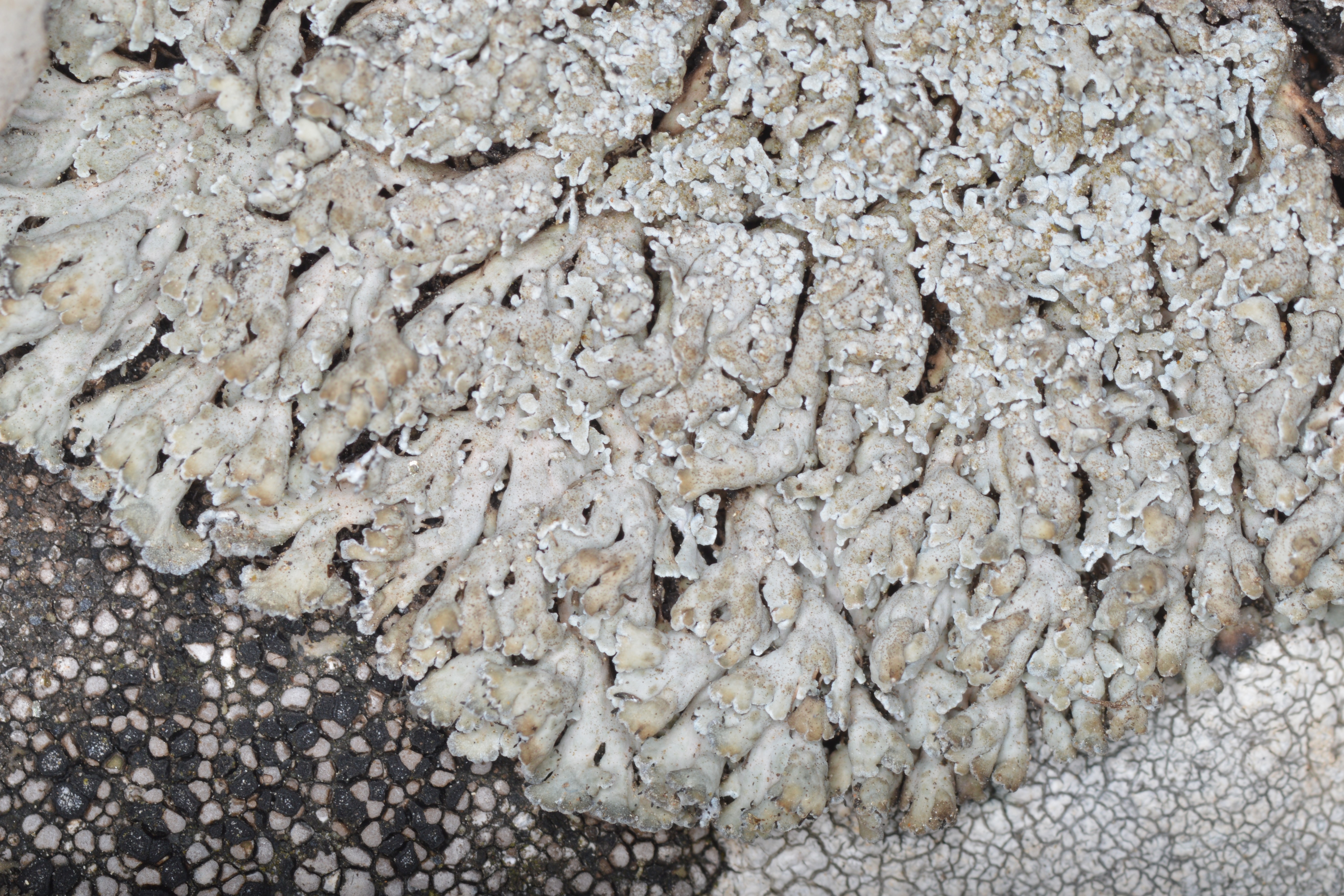
Heterodermia chondroidea is distinctive for its narrow-lobed, lobulate thalli (Weber & Awasthi 1971).
Why suggested for a Global Red List Assessment?
Heterodermia chondroidea should be considered for listing because it is rare in Colorado, India, and Nepal.
Geographic range
Heterodermia chondroidea is known from the southern Rocky Mountains of Colorado (type locality), USA, and is also reported from Nepal and India on the southern slope of the Himalayan Mountains. It is known from 35 collections, 27 historical and 8 modern (by Jacob Watts); 33 localities are in Colorado and New Mexico, 2 are in the Himalayan Mountains. Heterodermia chondroidea has an AOO of 108 km2, based on a 2x2 km grid size, and an EOO of 825,016.880 km2 (mostly over the Pacific Ocean because of its disjunct distribution in two mountain ranges, these shown by the original authority of the species to have botanical/floristic similarities (Weber 2003). Based on criterion B2b, H. chondroidea should be considered Near Threatened (NT) because its AOO is quite small and its habitat is facing numerous threats (inferred decline), but its populations are not severely fragmented, nor do they exhibit extreme fluctuations.
Population and Trends
While Heterodermia chondroidea is known from only 35 total specimens, the total population size and trends are uncertain. After extensive field work in suitable habitats in the southern Rocky Mountains, the species appears to be very rare on the landscape. Based on my field experiences and the experiences of my collaborators (Seth Raynor and Erin Manzitto-Tripp), who are the only actively collecting lichenologists in its suitable habitat in the southern Rocky Mountains, we have likely surveyed anywhere between 0.1% and 1% of its suitable habitat. We have always only seen 1 suitable rock (1 mature individual sensu Yahr et al. 2024) at each locality. From this, the total population size of Heterodermia chondroidea is estimated to be between 350 and 3,500 mature individuals. The current trends for the species are equally uncertain, but it is well-established that its habitat in the mesic subalpine forest of the southern Rocky Mountains is facing many threats and is projected to decline in extent and quality, so it can be inferred that the total population size of Heterodermia chondroidea, which is an obligate inhabitant of the highest quality, most mesic subalpine forests, will continually decrease, too (Abotzoglou et al. 2025; Chai et al. 2025; Urban 2015). Based on Criterion A4c, and an estimated and projected (continued) decline in the quality of forest habitat in the southern Rocky Mountains and Himalayan Mountains due to climate change and the increasing frequency of catastrophic, unrecoverable disturbances, the species should be classified as Vulnerable (VU). Based on expert opinion and field experience, Heterodermia chondroidea should be considered a long-lived lichen species, with a generation time of ~30 years (sensu Yahr et al., 2024). Over the next three generations (90 years), it is not unreasonable to expect an >= 30% decrease in suitable habitat for H. chondroidea. The causes of decrease in suitable habitat have not ceased and are likely not reversible. Based on criterion C and the most conservative estimates of total population size (3,500 individuals) and habitat declines (>10% decline in 3 generations), H. chondroidea should be classified as VU. Based on criterion D, the species should be considered Near Threatened (NT), due to great uncertainties in its inferred total population size (350-3,500). Finally, H. chondroidea should be considered Data Deficient (DD) based on Criterion E.
Population Trend: Decreasing
Habitat and Ecology
Heterodermia chondroidea grows on vertical, sheltered rock faces in mesic (riparian or steep, north-facing) upper montane and lower subalpine forests of the southern Rocky Mountains. In the southern Rocky Mountains, has only ever been collected from near-pristine, very old, intact forests dominated by either Pseudotsuga menziesii or Picea engelmannii / Abies lasiocarpa. Its habitat in the Himalayan Mountains is unknown.
Threats
The greatest threats to Heterodermia chondroidea are commercial logging (5.3.4) and resourse extraction (3.1, 3.2), habitat degradation (11.1), increased wildfire frequency and intensity (7.1.1), droughts, floods, and extreme temperatures (11.2, 11.3, 11.4) and outbreaks of the native Spruce Beetle (Dendroctonus rufipennis) (8.2.2).
Conservation Actions
Most collections are from land managed by the United State Forest Service, including “multi-use” forests and wildernesses. No special protections are currently given to Heterodermia chondroidea as it is not known or considered by the USFS as a species of concern. Conservation actions for the Himalayan populations is unknown, but likely non-existent.
Research needed
A better understanding of the ecological niche, commonality, and taxonomic status (conspecific with Colorado material?) of the Himalayan populations is required to build a better understanding of the species’ rarity and risk of extinction.
Use and Trade
None.