- Proposed
- Under Assessment
- Preliminary Assessed
- Assessed
- ENPublished
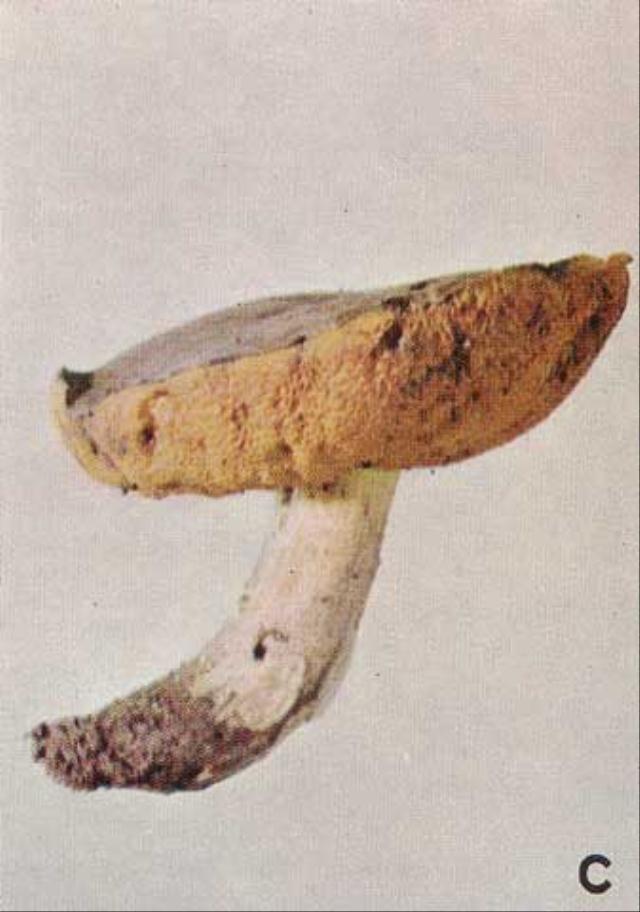
Xerocomus griseo-olivaceus McNabb
- Scientific name
- Xerocomus griseo-olivaceus
- Author
- McNabb
- Common names
- IUCN Specialist Group
 Mushroom, Bracket and Puffball
- Kingdom
- Fungi
- Phylum
- Basidiomycota
- Class
- Agaricomycetes
- Order
- Boletales
- Family
- Boletaceae
- Assessment status
- Published
- Assessment date
- 2019-07-26
- IUCN Red List Category
- EN
- IUCN Red List Criteria
- C2a(ii)
- Assessors
- Jerry Cooper (Landcare Research, Lincoln, New Zealand)
- Reviewers
- Gregory Mueller (Chicago Botanic Garden / IUCN SSC Mushroom, Bracket and Puffball Specialist Group)
Assessment Notes
Justification
The estimated number of mature individuals is estimated as up to 1500 restricted to one subpopulation. The species is undergoing continuing decline in population size due to habitat quality decline. It is therefore assessed as Endangered C2a(ii).Geographic range
This species is a New Zealand endemic, known only from Waitakere Ranges, near Auckland.Population and Trends
It is known with certainty only from three records all from the same general area. All known locations are in areas of bush directly adjacent to pasture farmland.
Considering that a number of related boletes are restricted to northern North Island, it is reasonable to suppose that this one is similarly restricted. Taking into account the distribution of this habitat, 100 sites is thought to be a likely maximum to account for sites at which it is so far unrecorded. We infer the presence of 3 genotypes per site each representing 5 mature individuals, to convert to an estimate of 1500 mature individuals, all within one subpopulation.
Given the historic extent of the host (tea tree) we infer a decrease of at least 20% of suitable habitat (area and quality) during the last 50 years, which is causing a continuing decline in population size.
Population Trend: Decreasing
Habitat and Ecology
Xerocomellus griseoolivaceus is ectomycorrhizal with tea-tree (myrtaceae). It appears to be restricted to areas with mature stands of tea-tree, and has a northern distribution.Threats
The known area for this species is subject to increasing tourism from nearby Auckland city with a consequent increase in disturbance in the immediate areas. The populations are also likely to decrease over the next 20 years as the impact of Kauri die-back on Kauri forest alters the surrounding forest structure. Areas may also be disturbed because of future disease management actions. The impact of changing farming practices with increase in nutrient run-off from adjacent areas may have some impact on the quality of mycorrhizae.Conservation Actions
A number of ectomycorrhizal species associated with tea-tree (myrtaceae) in New Zealand are potentially impacted by changing agricultural practices, in particular the clearing of remnant bush fragments to accommodate large-scale irrigation machinery, and the direct impact of fertilizers and irrigation on soil chemistry and mycorrhizae extent and function.The ectomycorrhizal fungi associated with tea-tree in northern parts of New Zealand require greater survey and characterisation.