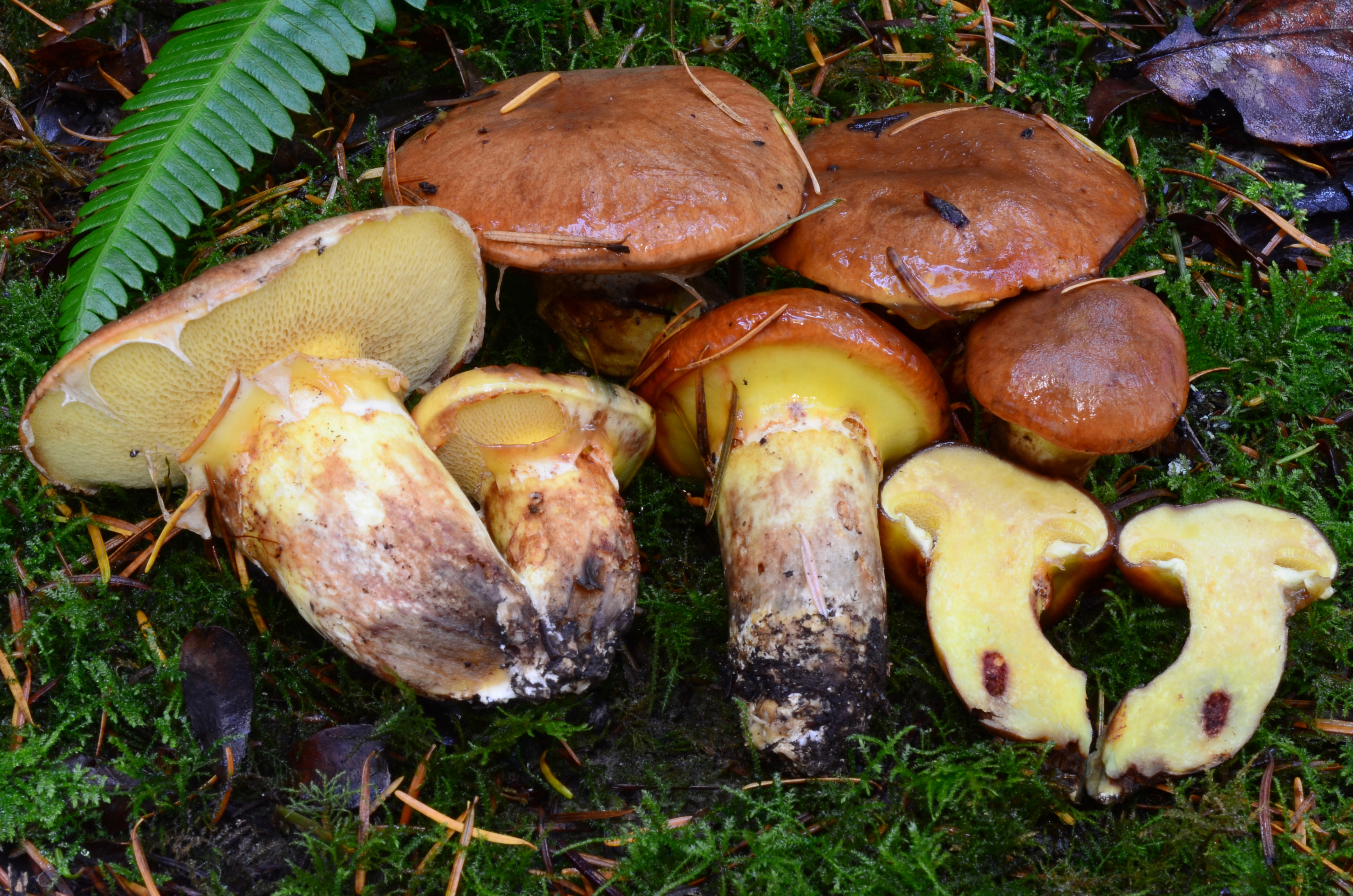
- Proposed
- Under Assessment
- Preliminary Assessed
- Assessed
- LCPublished
Suillus ponderosus A.H. Sm. & Thiers
Search for another species...
- Scientific name
- Suillus ponderosus
- Author
- A.H. Sm. & Thiers
- Common names
- IUCN Specialist Group
 Mushroom, Bracket and Puffball
- Kingdom
- Fungi
- Phylum
- Basidiomycota
- Class
- Agaricomycetes
- Order
- Boletales
- Family
- Suillaceae
- Assessment status
- Published
- Assessment date
- 2021-03-17
- IUCN Red List Category
- LC
- Assessors
- Noah Siegel (25 Prospect Hill Road, Royalston, MA 01368, US / Global Fungus Assessment)
- Reviewers
- Anders Dahlberg (Swedish Species Information Centre, Uppsala / IUCN SSC Cup-fungus, Truffle and Ally Specialist Group)
Assessment Notes
The content on this page is fetched from The IUCN Red List of Threatened Species: https://www.iucnredlist.org/species/198479245/198490186
Justification
Suillus ponderosus is a common and widespread species in western North America, growing with young to mature Douglas Fir from central California into southern British Columbia. The population is stable; and not subject to any threats. It is listed as Least Concern (LC).Taxonomic notes
Described from western North America (Smith and Thiers 1964). Suillus imitatus var. viridescens is a synonym (Nguyen et al. 2013).Geographic range
This species is widespread in the Pacific States of North America, from southern British Columbia, Canada, south from coast to Cascade Range in the Pacific Northwest, and coast to Coast Range south to central California, USA.Population and Trends
The population occurs over a wide area, and locally is very common. There is no indication of any decline.
Population Trend: Stable