- Proposed
- Under Assessment
- Preliminary Assessed
- Assessed
- LCPublished
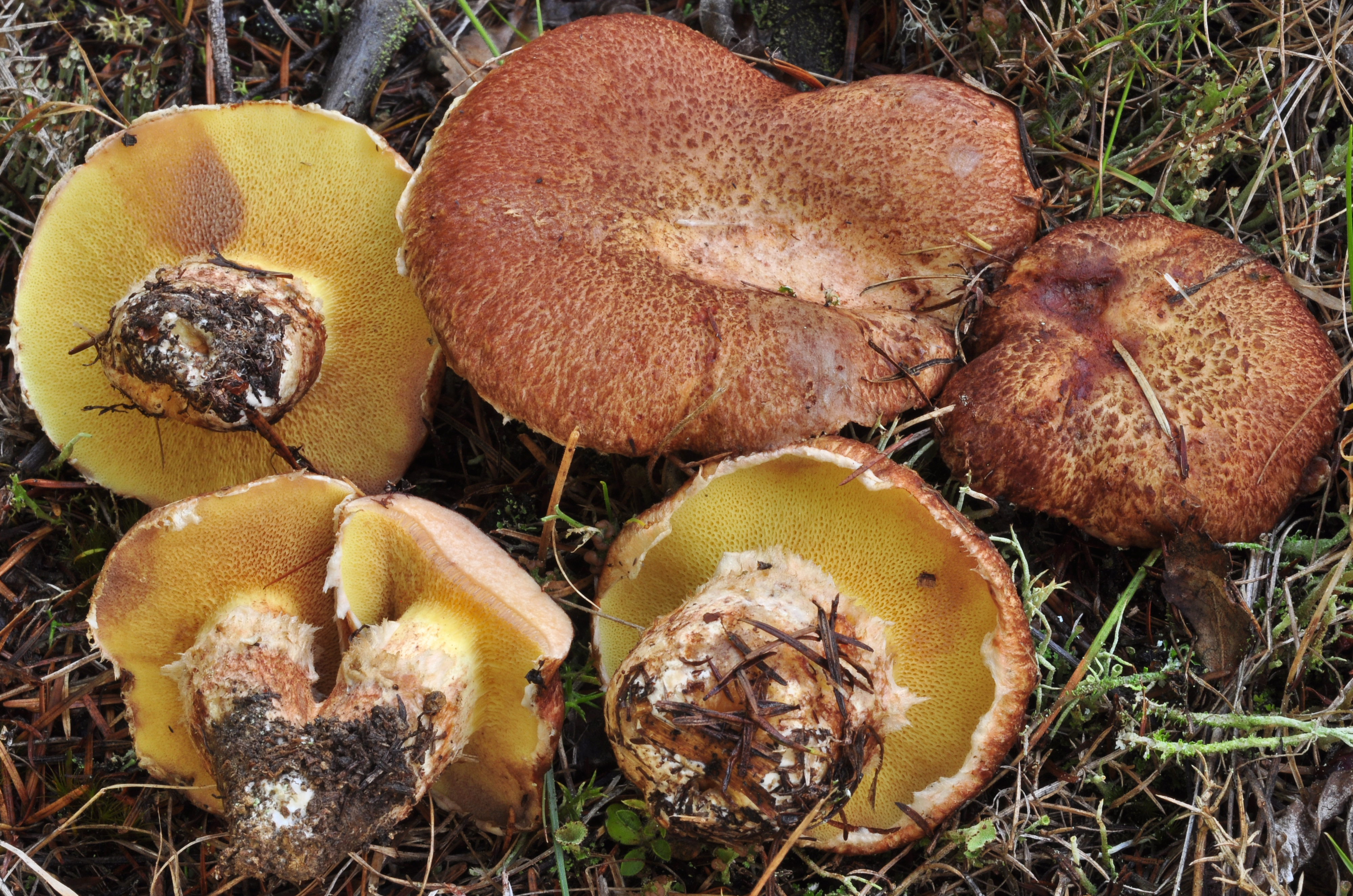
Suillus lakei (Murrill) A.H. Sm. & Thiers
Search for another species...
- Scientific name
- Suillus lakei
- Author
- (Murrill) A.H. Sm. & Thiers
- Common names
 Western Painted Suillus
 - IUCN Specialist Group
 Mushroom, Bracket and Puffball
- Kingdom
- Fungi
- Phylum
- Basidiomycota
- Class
- Agaricomycetes
- Order
- Boletales
- Family
- Suillaceae
- Assessment status
- Published
- Assessment date
- 2018-11-01
- IUCN Red List Category
- LC
- Assessors
- Noah Siegel (25 Prospect Hill Road, Royalston, MA 01368, US / Global Fungus Assessment)
- Reviewers
- Anders Dahlberg (Swedish Species Information Centre, Uppsala / IUCN SSC Cup-fungus, Truffle and Ally Specialist Group)
Assessment Notes
The content on this page is fetched from The IUCN Red List of Threatened Species: https://www.iucnredlist.org/species/138330030/138330361
Justification
Suillus lakei is a common ectomycorrhizal fungus, associated with Douglas Fir (Pseudotsuga menziesii) in western North America. There is no evidence of decline: it can be locally abundant where suitable habitat exists. Therefore, it is assessed as Least Concern (LC).Geographic range
Widespread across western North America, roughly following the coastal and Sierra Nevada distribution of Douglas Fir (Pseudotsuga menziesii var. menziesii) in California, USA, north through Oregon and Washington into southern British Columbia, Canada. It also occurs in the Rocky Mountains in southern British Columbia and Alberta, Canada, south through Idaho and Montana, and scattered through the mountains in Colorado, Utah, New Mexico and Arizona with Rocky Mountain Douglas Fir (Pseudotsuga menziesii var. glauca). Distribution records in the Rocky Mountains are sparse in comparison to pacific state collections. Non-native populations with introduced Douglas Fir occur in at least Bosnia and Herzegovina, Bulgaria, Czech Republic, Denmark, Germany, Hungary, Italy, Slovakia, and United Kingdom (2018, boletales.com), the Netherlands, Australia, New Zealand, Argentina and Chile.Population and Trends
The population size is large, occurring over a widespread area, and is stable. There is no indication of any decline.
Population Trend: Stable