- Proposed
- Under Assessment
- VUPreliminary Assessed
- 4Assessed
- 5Published
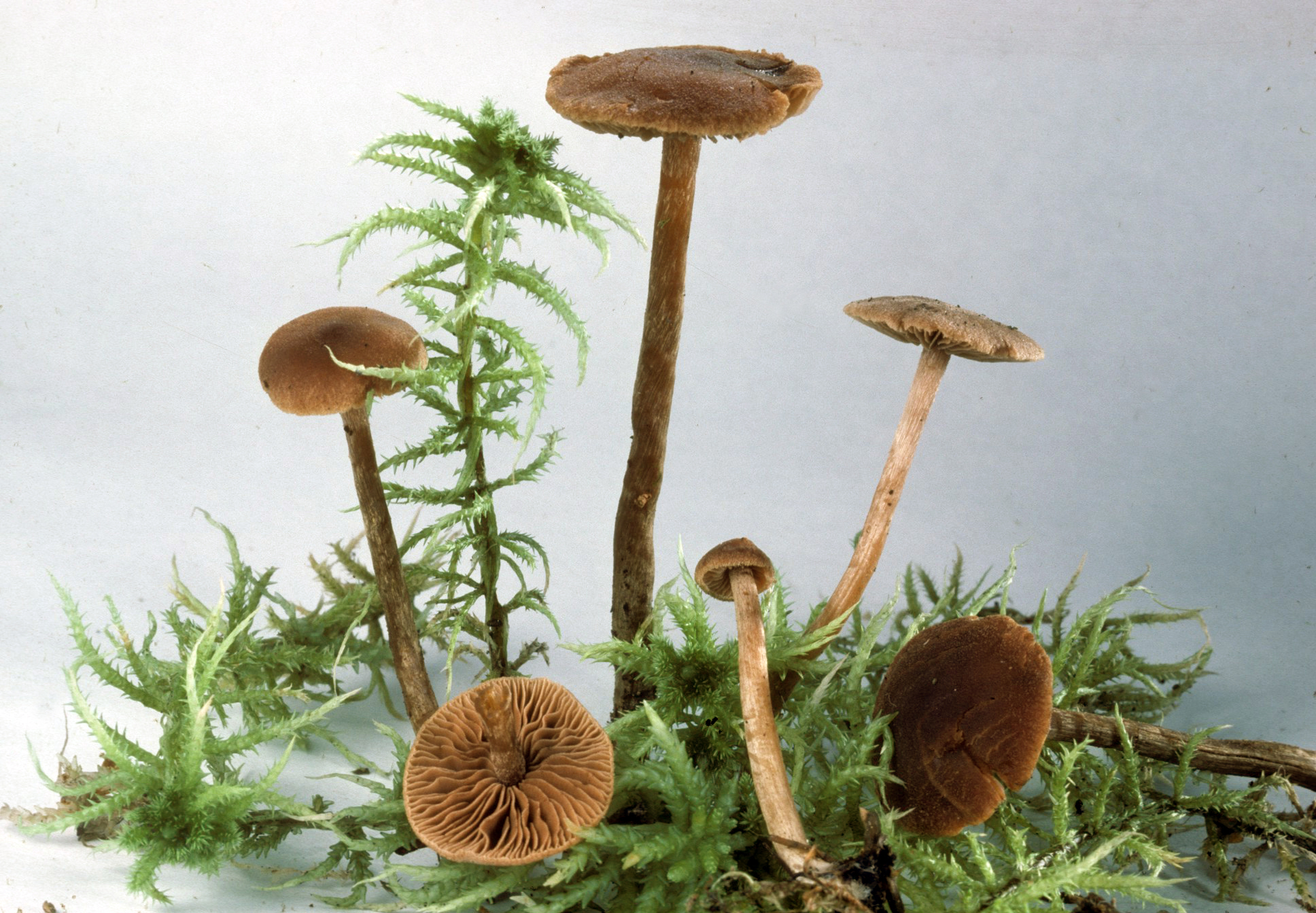
Naucoria sphagneti P.D. Orton
- Scientific name
- Naucoria sphagneti
- Author
- P.D. Orton
- Common names
 Sfagnu riekstenīte
 Rotbrauner Torfmoor-Erlenschnitzling
- IUCN Specialist Group
 Mushroom, Bracket and Puffball
- Kingdom
- Fungi
- Phylum
- Basidiomycota
- Class
- Agaricomycetes
- Order
- Agaricales
- Family
- Strophariaceae
- Assessment status
- Preliminary Assessed
- Preliminary Category
- VU VU A2(c)
- Proposed by
- Irmgard Krisai-Greilhuber
- Assessors
- Irmgard Krisai-Greilhuber
- Comments etc.
- Inita Daniele, Anders Dahlberg, Jan Merta
Assessment Notes
Justification
The ectomycorrhizal Naucoria sphagneti is a very rare species exclusively growing among Sphagnum and associated with Alnus species. There are only few localities known and thus number of subpopulations is very small. It is threatened by habitat loss and management changes, e.g. drainage and conversion into agricultural land use. The estimate of the habitat loss for Naucoria sphagneti probably is around 10 to 20 %. The rareness of this species and its dependence on the continuously declining habitat (both in the area and in quality) imply that Naucoria sphagneti subpopulations have decreased in a similar range. The habitat will continue to decline in the future, so will the population size of the species. Considering the rather small numer of known sites (150 occurrences in GBIF and databases), estimated to have approx. the tenfold number of sites in reality, i.e. ca. 1500, and the continuous decline the species is assessed as VU A2(c).
Taxonomic notes
In older literature it may have been identified as N. amarescens, e.g. by Favre (Ludwig 2001).
Why suggested for a Global Red List Assessment?
Geographic range
Population and Trends
Bogs and swamps are wetland habitats with a high water content governing many ecological processes that structure their characteristic communities, their hydrological balance is easily disturbed by increased drainage caused by human activities. Furthermore, raised bogs have been widely destroyed or greatly altered in many areas by the extraction of peat. Extraction of peat and conversion of natural mire habitats to productive agricultural and forestry land have been the main reasons for the decline of mire habitats during recent and more long-term historic times and this decline is still continuing. In the EU countries, all but two of the 13 mire habitat types (85%) are threatened and this is the highest percentage of threatened habitats in all terrestrial and freshwater groups (European Red List of Habitats 2016). These types of habitats are most vulnerable to hydrological system modifications, surface water and air pollution (eutrophication), natural succession and erosion, agriculture intensification, silviculture and forest management, mining (peat extraction) and urbanization. They are also very sensitive to climate change, especially to increasing droughts. According to the recent report by Barthelmes et al. (2015), in the Nordic-Baltic countries, the percentage of drained peatlands amounts to 44.0%, which is a rather low value compared to the total of Europe (almost 60%, Joosten 2009). Moreover, the rather positive picture compared to Europe is, however, attributable to only two countries, Norway and Sweden, in which less than 20% of the peatlands have been drained. The estimate of the habitat loss for Naucoria sphagneti probably is around 10 to 20 %. The rareness of this species and its dependence on the continuously declining habitat (both in the area and in quality) imply that Naucoria sphagneti subpopulations have decreased in a similar range. The habitat will continue to decline in the future, so will the population size of the species. Considering the rather small numer of known sites (150 occurrences in GBIF and databases), estimated to have approx. the tenfold number of sites in reality, i.e. ca. 1500, and the continuous decline the species is assessed as VU A2(c).
Population Trend:
Habitat and Ecology
The species is mycorrhizal, growing directly in Sphagnum and associated with Alnus species. Its habitats are swamps, swamp forests, also raised bogs and green alder bushes. At least in Central Europe these habitats are listed as endangered.
Threats
The species is threatened by habitat loss and management changes, e.g. drainage and conversion into agricultural land use.
Conservation Actions
Habitat and site protection.
Research needed
A monitoring of known sites and of suspected sites of occurrence would be desirable.
Use and Trade
The species is not in any use.
Bibliography