- Proposed
- Under Assessment
- Preliminary Assessed
- Assessed
- VUPublished
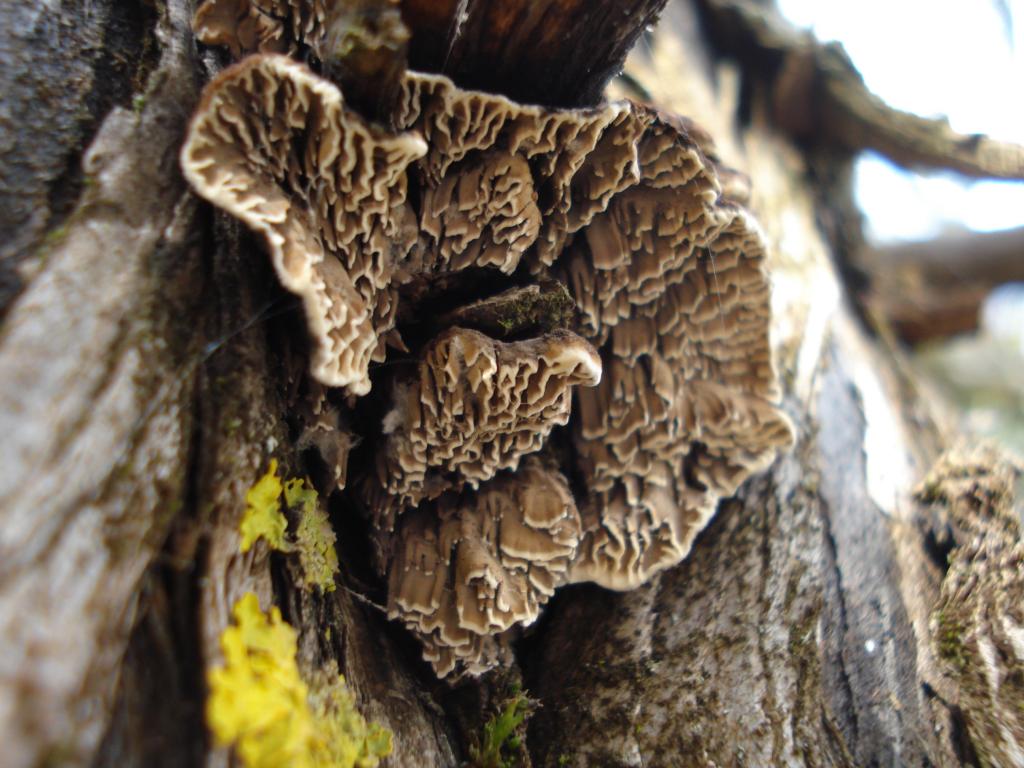
Lenzitopsis oxycedri Malençon & Bertault
- Scientific name
- Lenzitopsis oxycedri
- Author
- Malençon & Bertault
- Common names
- IUCN Specialist Group
 Mushroom, Bracket and Puffball
- Kingdom
- Fungi
- Phylum
- Basidiomycota
- Class
- Agaricomycetes
- Order
- Thelephorales
- Family
- Thelephoraceae
- Assessment status
- Published
- Assessment date
- 2017-03-28
- IUCN Red List Category
- VU
- IUCN Red List Criteria
- C2a(i)
- Assessors
- Mitko Karadelev (Mycological Laboratory, Institute of Biology, Faculty of Natural Science and Mathematics, Ss. Cyril and Methodius University, The Republic of Macedonia)
- Reviewers
- Anders Dahlberg (Swedish Species Information Centre, Uppsala / IUCN SSC Cup-fungus, Truffle and Ally Specialist Group)
Assessment Notes
Justification
Lenzitopsis oxycedri is a very rare wood-inhabiting species exclusively growing on very old Juniper trees, e.g. Juniperus foetidissima. In conformity with the ability of Juniper trees to become several hundred to thousand years old, established individual mycelia of L. oxycedri is considered to potentially be very old. It´s global distribution is confined to the Mediterranean region and it is only recorded in Morocco, Spain, Italy, Turkey and Macedonia. The small and scattered population size make the species very susceptible to local extinction due to random events such as fires, tourism, destruction of habitats and other human activities. There is an ongoing slow decline of appropriate habitat.The reported known number of trees occupied with L. oxycedri in Mediterranean region is less than 50 (2017). Considering its rareness, a conservative estimate suggest that the total number of colonized trees in the whole (i.e. including undiscovered trees) probably does not exceed 1,000 trees (= functional fungal individuals sensu Dahlberg and Mueller 2011). Accordingly, the mature fungal individuals (accounting for >1 genet/tree and individual genets potentially being fragmented into ramets), do not to exceed 3,000. The low number of mature individuals together together with the inferred slow continuing decline ongoing qualify this species for listing as Vulnerable (VU).
Taxonomic notes
The original description of the species (Malençon & Bertault, 1963) is based on specimen growing on Juniperus oxycedrus L. in Morocco. The first European record is from Spain, province Guadalajara, growing as a saprobe on Juniperus thurifera L. (Garcia-Manjon & Moreno, 1981). Later, Ryvarden (1991) described a new genus Lenzitella Ryvarden to replace Lenzitopsis with the type species Lenzitella malenconii Ryvarden, a nom. nov. for L. oxycedri. However, Stalpers (1993) treated Lenzitella and L. malenconii as superfluous names and argued that “Lenzitopsis was published with one species only, which was newly described and thus the description of L. oxycedri meets the conditions for a descriptio generico-specifico (Art. 42.1) and thus both genus and species are validly published.” Lenzitopsis and L. oxycedri as the current names have been accepted here as in the other study (Dogan et al. 2007).Lenzitopsis was placed in Thelephoraceae because of brownish and echinulate spores (Malençon and Bertault 1963, Ryvarden and Gilbertson 1993, Stalpers 1993).
Geographic range
The species' distribution is restricted to a small number of localities in five Mediterranean countries. It is a very rare species, known only from Morocco, Spain, Italy, Macedonia and Turkey. The original description of the species is based on a specimen from Morocco, while the first European record is from Spain (province Guadalajara).Population and Trends
According to the present literature and personal communication with the authors this is a very rare species. There are 24 findings from 11 localities in Spain (Ávila, Cuenca, Guadalajara, Madrid, Salamanca, Soria, Teruel and Toledo provinces and one in Morocco - see MA-Fungi through http://161.111.170.202/herb/asp/). According to MT Telleria (pers. comm.) Lenzitopsis oxycedri grows on junipers in Spain, but easily overlooked because of growing in wood holes and it has wood juniper colour. A search of 50 sites in Turkey (Asian site)selected to have suitable old Juniper trees only yielded 11 occupied trees (H. Dogan pers. obs.) implying it to be a very rare species. In Macedonia it has been collected from two localities, both in Galichica national Park. A. Bernicchia (pers. comm.) also reported this species from two localities in Italy (Sardinia) in 2005, but it has not been recorded again after later visits to these.
The reported known number of trees with L. oxycedri in Mediterranean region is only 39 (i.e. <100 occupied trees 2017). A conservative estimate suggest that the total number of colonized trees (i.e. including undiscovered trees) probably does not exceed 1,000 trees in the whole region. Accordingly, the functional number of functional fungal individuals (= colonized trees) probably do not exceed 1,000 and the mature fungal individuals (accounting for >1 genet/tree and individual genets potentially being fragmented into ramets) not to exceed 3,000.
Population Trend: Decreasing