- Proposed
- Under Assessment
- Preliminary Assessed
- CRAssessed
- 5Published
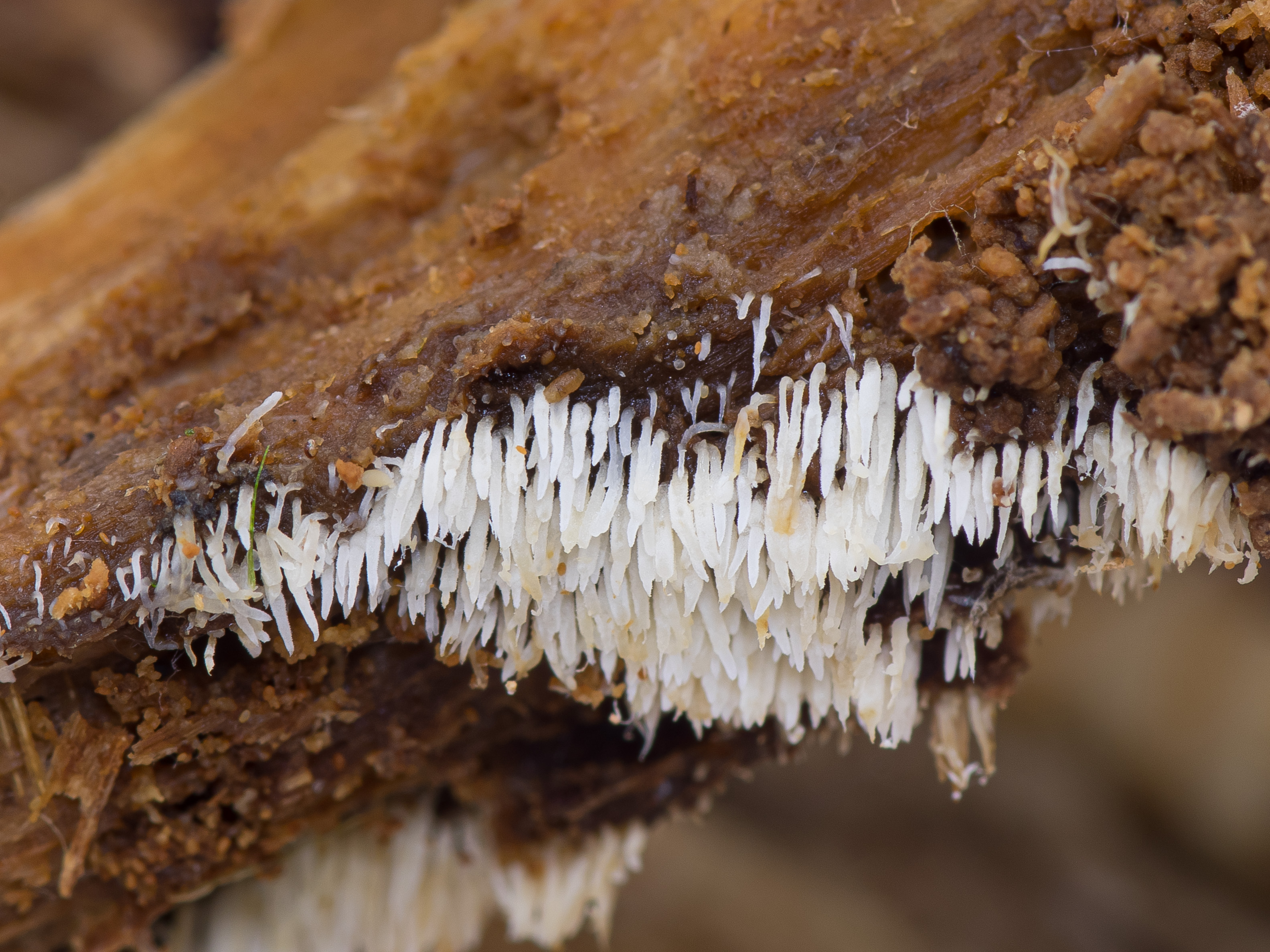
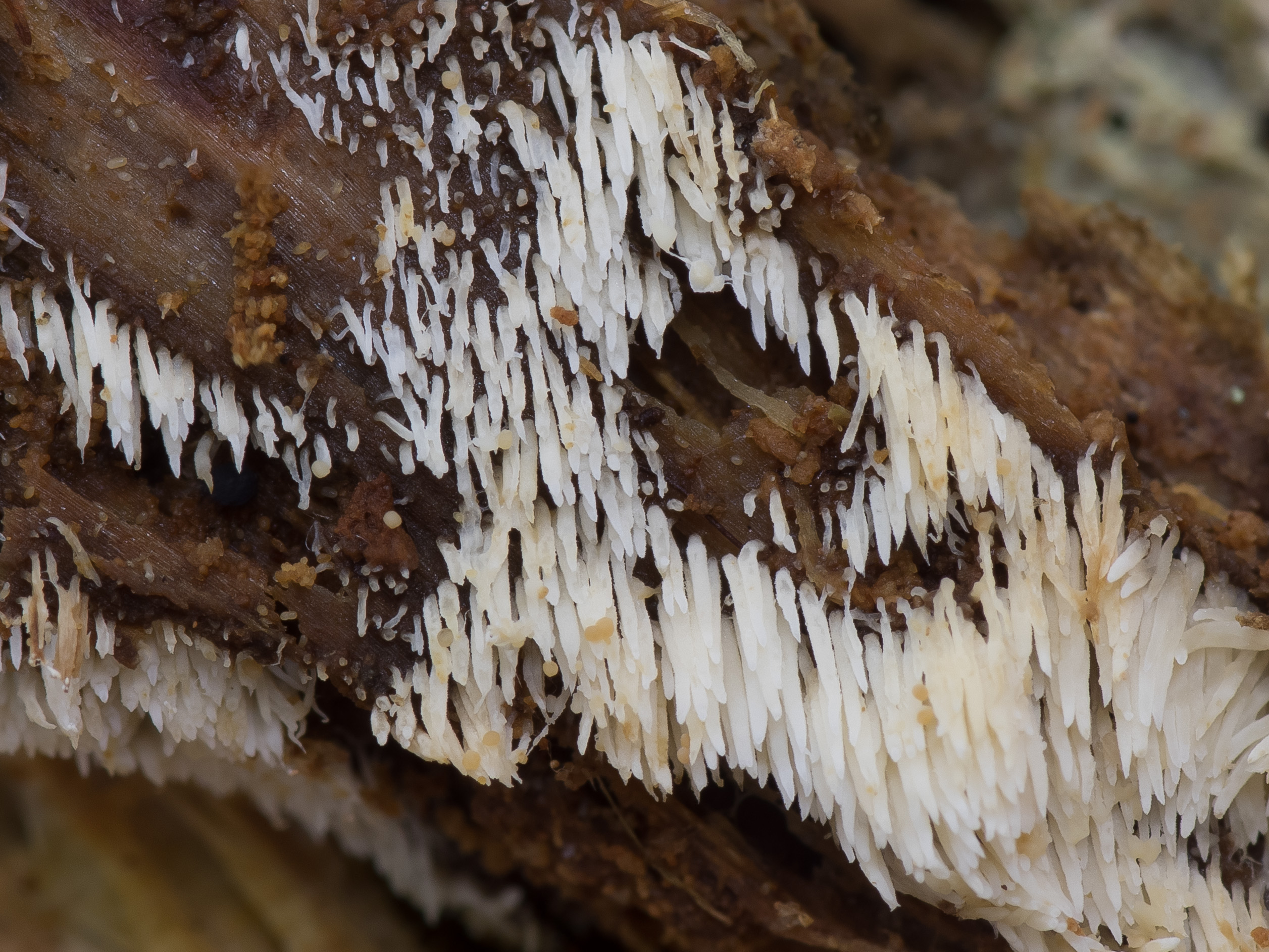
Dentipratulum bialoviesense Domański
- Scientific name
- Dentipratulum bialoviesense
- Author
- Domański
- Common names
 ostnička pralesní
- IUCN Specialist Group
 Mushroom, Bracket and Puffball
- Kingdom
- Fungi
- Phylum
- Basidiomycota
- Class
- Agaricomycetes
- Order
- Russulales
- Family
- Auriscalpiaceae
- Assessment status
- Assessed
- Preliminary Category
- CR C2a(i)
- Proposed by
- Petr Zehnálek
- Assessors
- Petr Zehnálek, Irmgard Krisai-Greilhuber, Matt Wainhouse, Inita Daniele
- Comments etc.
- Anders Dahlberg, James Westrip
Assessment Notes
Justification
Dentipratulum bialoviesense is a a very rare saprotrophic wood inhabiting fungus. It is restricted to large fallen spruce logs in natural forests. Yet it is only known from three isolated populations in Poland and Czechia.This habitat has and continues to be declining due to mainly forestry, hence also the potential total population of D.bialoviesense.The estimated total number of mature individuals is not expected to exceed 250. The potential localities, hence the potential total global population, is inferred to be declining. Therefore, Dentipratulum bialoviesense is assessed as Critically Endangered.
Taxonomic notes
Described by Domański 1965 from Białowieża forest.
Why suggested for a Global Red List Assessment?
A species closely tied to the best primeval forests in temperate Europe, where it occurs on decaying spruce trunks. Threatened by its own rarity, the loss of suitable habitats, and forestry management.
Geographic range
Dentipratulum bialoviesense is only known from three primeval forests of high quality in two countries in Europe; Poland in Białowieża National Park and Czechia - primeval forest Boubínský prales (Holec et al 2021). Other still unknown potential localities are expectable in well preserved forests in mountains although there is no analogy for lowland forest like Białowieża. Carpathians, Alpes, Balkan mountains etc., sites with natural occurrence of Picea abies unaffected by human with long-term continuity of dead wood of larger fallen trunks availability. Such sites are generally very rare and usually protected. However, the actual distribution may be underestimated, as the species may be overlooked due to inconspicuousness or misidentification with the genus Mucronella.
Population and Trends
There are only three localities (Poland and Czechia) where the species has been confirmed. Other occurrence data (GBIF) are uncertain (possible misidentification with Dentipratulum crystallinum/khuranae or Mucronella spp. The fruiting bodies of D. bialoviesense are very tiny and can easily be overlooked or mistaken for a common species from the genus Mucronella. On the other hand, natural and semi-natural forests are relatively well-studied habitats among mycologists. Current knowledge of this species occurrence indicates a very close association with the best-preserved primeval forests in Europe, both lowland and montane. There are very few such potential localities in Europe, so the populations of this species appear very small, fragmented, and with isolated subpopulations. All known localities are strictly protected, but the long-term outlook for spruce at the Czech locality is unfavourable, as it is being displaced by the more competitive beech. Further localities of this species could potentially be hidden in insufficiently mapped Balkan primeval forests. The estimated total number of mature individuals is not expected to exceed 250 (cf Dahlberg & Mueller 2011). Potential potential localities, hence the potential total global population, is inferred to be declining. On this basis it is assessed as C2a (I)
Population Trend: Decreasing
Habitat and Ecology
Dentipratulum bialoviesense is a saprotrophic wood inhabiting fungus (Holec at al. 2021). It appears confined to fallen spruce trunks in medium to advanced stage of decay in forests with no or minimal human influence in the past. For basidioma producing the species probably requires high stable wood moisture. During the dry period 2015 - 2020 it was not found despite very intensive monitoring of wood inhabiting fungi on spruce trunks including those with later findings of Dentipratulum.
Threats
The species is threatened by forestry management, the removal of wood from the forest, specifically large, naturally dead spruce trunks. Forest management can also negatively affect the microclimate of the location, causing the trunks to dry out more. Another potential threat is climate change and more pronounced weather fluctuations and the associated droughts, negatively affecting the spruce population, which is then more susceptible to bark beetles. At the same time, the weakened spruce is being outcompeted by stronger tree species (beech). The threat is also the small and isolated population of the species and the small number of potentially suitable sites. So the probability of successfully colonizing a new location is low. In addition, the experience so far with this species is that it forms fruiting bodies relatively rarely, thereby the production of spores is not high.
Conservation Actions
It is a species that typically prefers a no-intervention regime in the location. So what is important is rather what not to do, do not remove dead wood, do not cut down on the location or in the surroundings. It is necessary to remove potential newly arriving invasive plant species that would tend to change the vegetation conditions in the location. Long-term trends in the location, e.g. the gradual decline of spruce at the expense of beech (example of the Boubín Forest). They may be negative for Dentipratulum in the long term, but any interventions in favor of spruce would disrupt the extremely valuable long-term continuity of natural development. It might be useful to consider a sufficiently large protection zone around the protected area where the species occurs, so that it is not possible to get close to it by cutting, which could disrupt the sensitive microclimate of the site.
Research needed
More intensive monitoring at suitable locations to better understand the real distribution of this species is needed. But not only at locations, but also in herbarium collections, where Dentipratulum bialoviesense material can be expected to be found, possibly misclassified to the genus Mucronella. More occurrence data could also provide more information about the ecology of the species.
Use and Trade
The species is inedible.