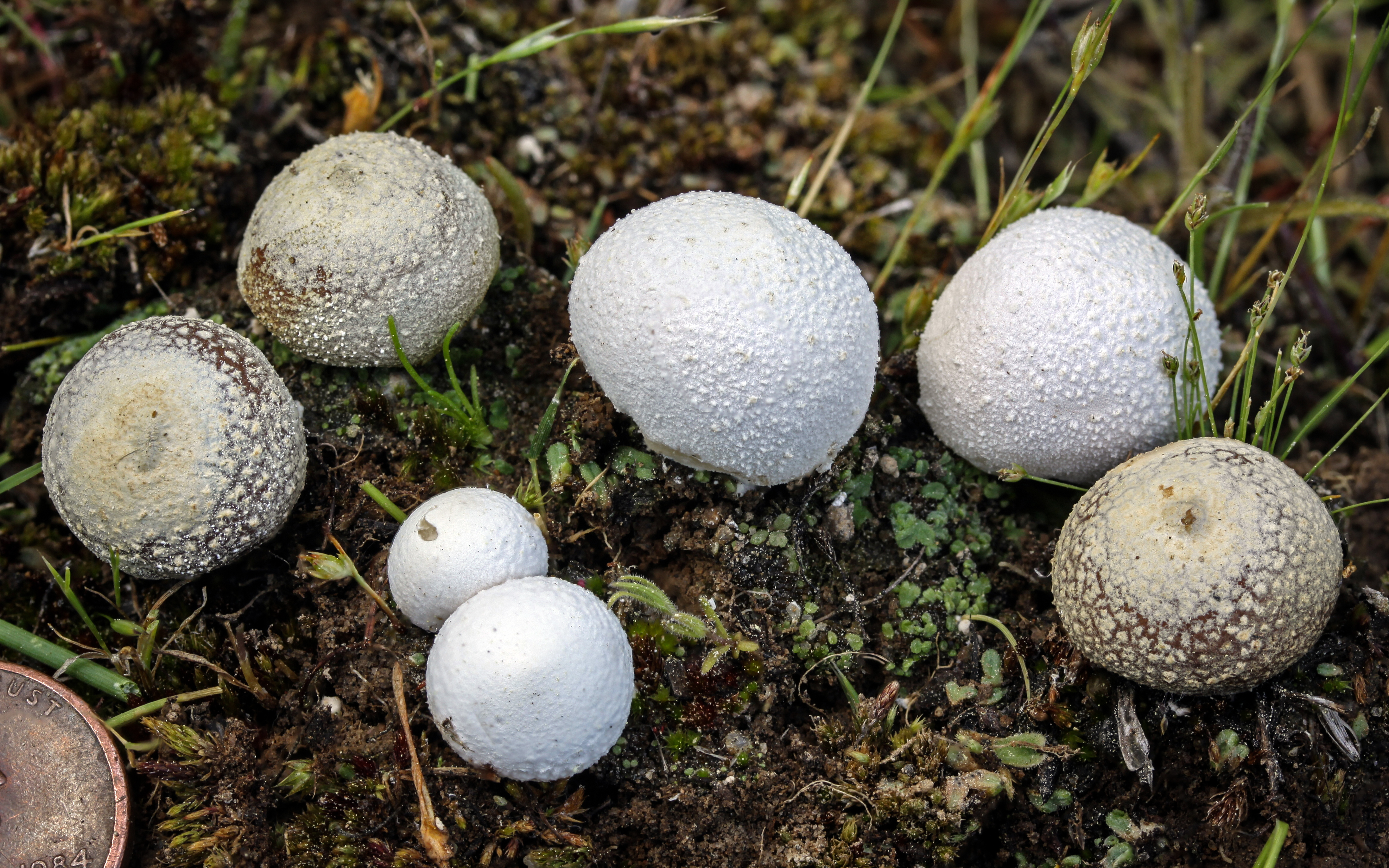
- Proposed
- Under Assessment
- Preliminary Assessed
- Assessed
- NTPublished
Bovista californica Kreisel
- Scientific name
- Bovista californica
- Author
- Kreisel
- Common names
- IUCN Specialist Group
 Mushroom, Bracket and Puffball
- Kingdom
- Fungi
- Phylum
- Basidiomycota
- Class
- Agaricomycetes
- Order
- Agaricales
- Family
- Agaricaceae
- Assessment status
- Published
- Assessment date
- 2024-12-05
- IUCN Red List Category
- NT
- IUCN Red List Criteria
- C2a(i)
- Assessors
- Gregory Mueller (Chicago Botanic Garden / IUCN SSC Mushroom, Bracket and Puffball Specialist Group); Noah Siegel (25 Prospect Hill Road, Royalston, MA 01368, US / Global Fungus Assessment)
- Reviewers
- Anders Dahlberg (Swedish Species Information Centre, Uppsala / IUCN SSC Cup-fungus, Truffle and Ally Specialist Group)
Assessment Notes
Justification
This species is currently only known from a small number of disjunct sites in the mountains of western USA, most of which are in California. While its distribution is large, the very small number of records, even in well sampled areas, suggest that is a rare species. Given its apparent rarity over a large geographic area it is tentatively estimated that it occurs in up to 100-200x the number of known sites or 900-1,800 sites with an estimated population size between 9,000-27,000 (with a best estimate of 10,000-15,000) mature individuals occurring in scattered subpopulations of 1,000-1,500 mature individuals. While it is not possible to infer precise population trends due to the small number of records, based on changes in habitat quality across its distribution range it is suspected that the population is undergoing some decline. Given the wide population estimate and need for further sampling to better document its abundance and distribution it is assessed as Near Threatened C2a(i) .Taxonomic notes
Bovista californica was described from a collection made at Hat Lake in Lassen National Park (Kreisel 1967). Jarvis (2014) noted that B. californica and the European B. limosa are very closely related, based on ITS phylogenetic data and suggested that they may be synonymous, while noting slight morphological differences. More work is needed to confirm that B. californica is a distinct species. It is considered as a distinct species for this assessment pending data from other DNA markers that may provide additional resolution.Geographic range
The species is endemic to western USA. It is only known from isolated subpopulations in the Sierra Nevada and San Bernardino Mountains of California, USA, plus single sites in Oregon, Idaho and Washington and Wyoming.Population and Trends
The species is currently only known from a small number of disjunct sites in the mountains of western USA, most of which are in California. While its distribution is large, the very small number of records, even in well sampled areas, suggest that is a rare species. Given its apparent rarity over a large geographic area it is tentatively estimated that it occurs in up to 100-200x the number of known localities or 900-1,800 sites. If there is an average of 10-15 mature individuals at each site the estimated population size rages between 9,000-27,000 (although the best estimate is 10,000-15,000 mature individuals) occurring in scattered subpopulations of c. 1,000-1,500 mature individuals. While it is not possible to infer precise population trends due to the small number of records, based on changes in habitat quality across its distribution range it is suspected that the population is undergoing some decline.
Population Trend: Decreasing