- 1Proposed
- 2Under Assessment
- 3Preliminary Assessed
- 4Assessed
- 5Published
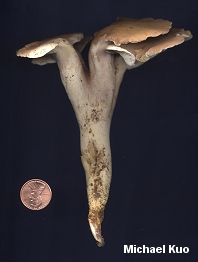
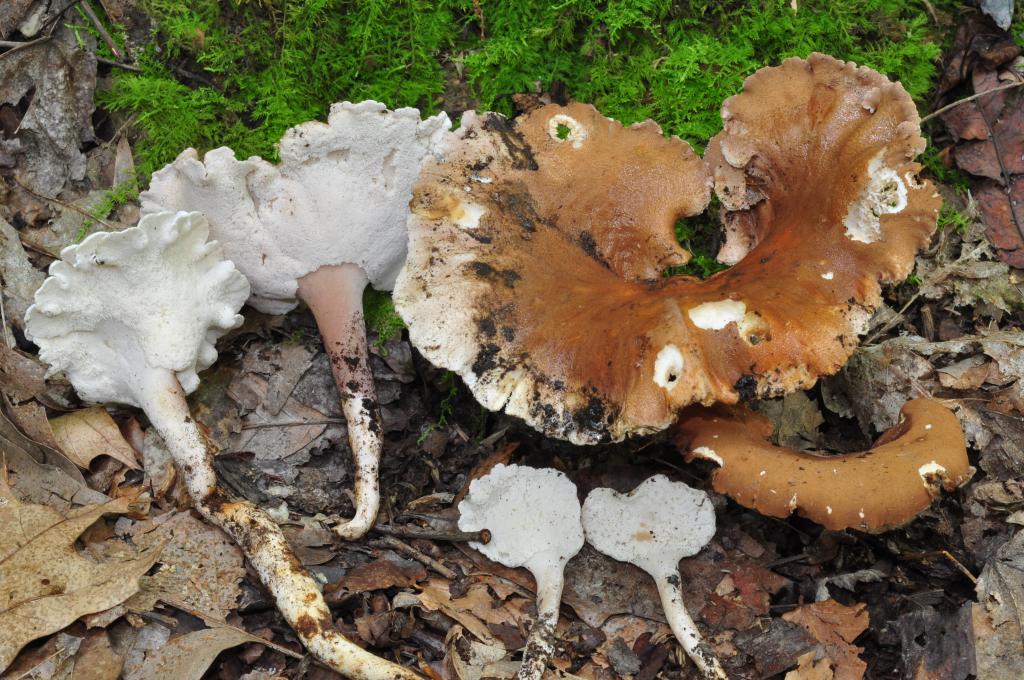
Pseudofistulina radicata (Schwein.) Burds.
- Scientific name
- Pseudofistulina radicata
- Author
- (Schwein.) Burds.
- Common names
- IUCN Specialist Group
 Mushroom, Bracket and Puffball
- Kingdom
- Fungi
- Phylum
- Basidiomycota
- Class
- Agaricomycetes
- Order
- Agaricales
- Family
- Fistulinaceae
- Assessment status
- Not proposed
- Proposed by
- None
- Contributors
- Noah Siegel, Rick Van de Poll
Assessment Notes
It was determined by the review committee to be too frequent to warrant proposed listing, given its widespread range from the United States to Panama and the apparent consistency in sequenced material.
Taxonomic notes
Pseudofistulina radicata (Schwein.) Burds., 1971
Boletus radicatus Schwein., 1822 (synonym)
Boletus radicatus Schwein., 1822
Fistulina radicata (Schwein.) Schwein., 1832 (synonym) Fistulina radicata (Schwein.) Schwein., 1832
Melanopus radicatus (Schwein.) Pomerl., 1980 (synonym) Melanopus radicatus (Schwein.) Pomerl., 1980
Polyporellus radicatus (Schwein.) P. Karst., 1879 (synonym) Polyporellus radicatus (Schwein.) P. Karst., 1879
Scutiger radicatus (Schwein.) Murrill, 1903 (synonym)
Why suggested for a Global Red List Assessment?
Rarely collected, widely scattered records; interesting split range between sub-tropical and temperate occurrences
Geographic range
Collected in Chicago (1903), then much latter in scattered locales in the eastern US, Central America, and South America
MycoBank: 32 collections from GA, IA, IL, IN, KY, NC, NY, PA, TN, VI, WI, WV, ONT (York), Costa Rica (Chino, Guanacaste), Mex (Quintana Roo, Veracruz), El Salvador
Population and Trends
Widely scattered records in the U.S. - NH, OH, PA, IN, NY, CT, NC, SC, GA, AL; most authors agree that is it rarely collected; specimens listed in Central America are from specific locales (e.g. Ryvarden in C.R. and Guzman in Mex); records all Nearctic
Population Trend: Uncertain
Habitat and Ecology
on dead hardwood, noted from oak and chestnut, often on buried wood; mid to late summer and fall
Threats
Possible reduction from loss of chestnut in eastern United States in early 20th century
Conservation Actions
Research needed
More records need to be researched; taxonomy of proposed Pseudofistulina radicata in Central and South America (which lumps P. brasiliensis) appears to potentially involve two lectotypes based on very different ecologies
Use and Trade
Bibliography
Gilbertson & Rytvarden. 1986. North American Polypores. Oslo: Fungiflora. p. 261.
http://www.mushroomexpert.com/pseudofistulina_radicata.html