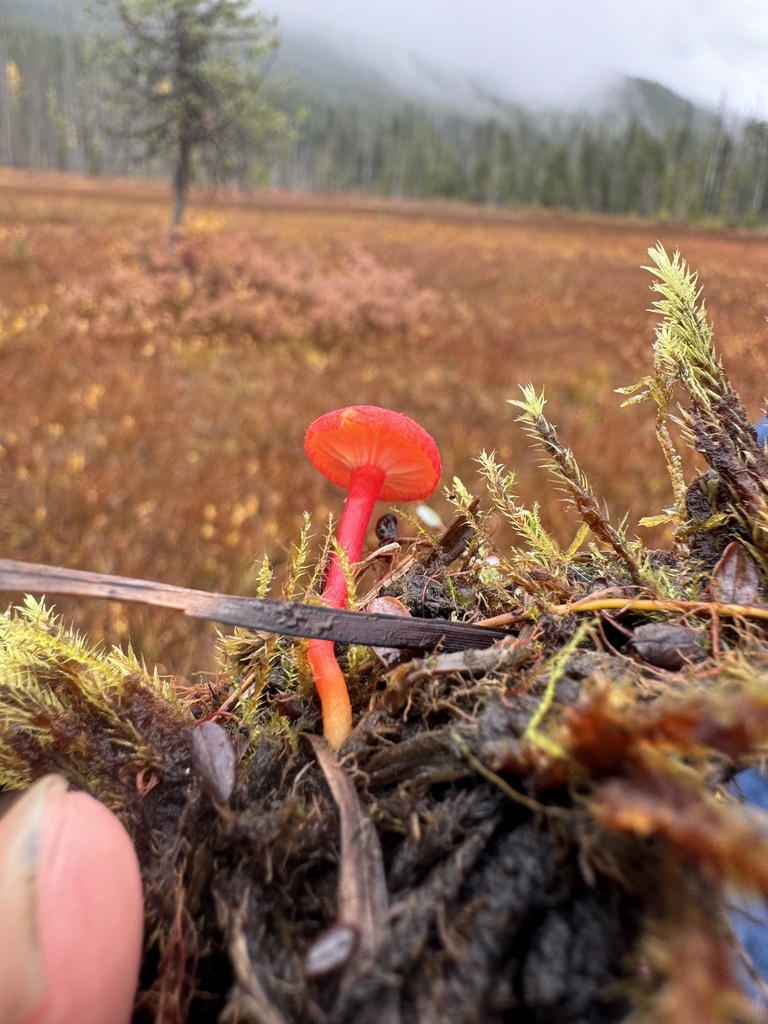
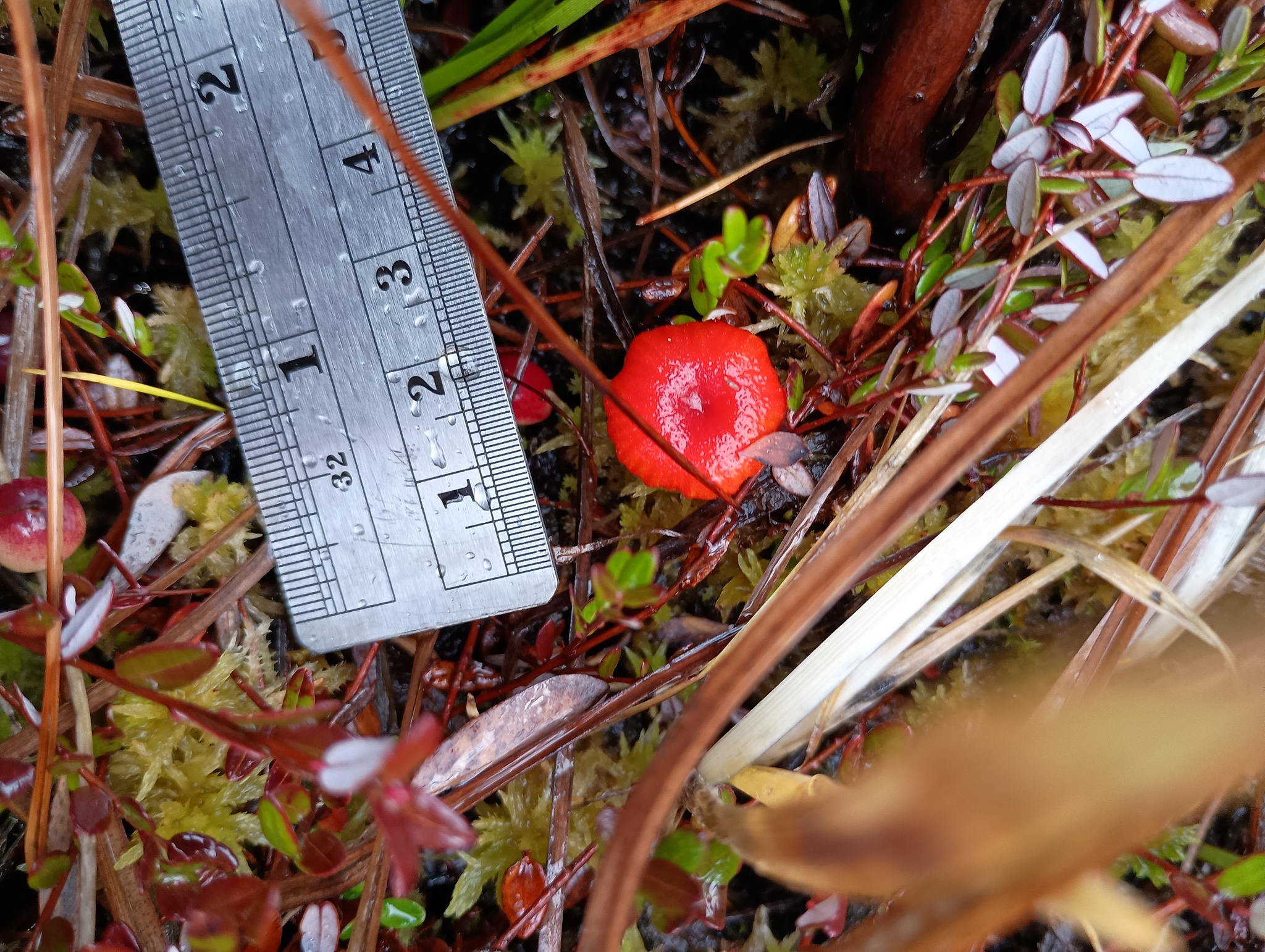
- Proposed
- 2Under Assessment
- 3Preliminary Assessed
- 4Assessed
- 5Published
Hygrocybe substrangulata (Peck) P.D. Orton & Watling
- Scientific name
- Hygrocybe substrangulata
- Author
- (Peck) P.D. Orton & Watling
- Common names
 Waisted Wax Cap
 Kær-vokshat
 Glad vuurzwammetje
 kurevahakas
 Fasteingeschnürter Moor-Saftling
 sumpvokssopp
 Wilgotnica piaskowa
 Großsporiger Filz-Saftling
- IUCN Specialist Group
 Mushroom, Bracket and Puffball
- Kingdom
- Fungi
- Phylum
- Basidiomycota
- Class
- Agaricomycetes
- Order
- Agaricales
- Family
- Hygrophoraceae
- Assessment status
- Proposed
- Proposed by
- Elizabeth Sage Jackson
- Comments etc.
- Elizabeth Sage Jackson, Irmgard Krisai-Greilhuber
Assessment Notes
Taxonomic notes
Note that this species was not identified in North America until 2001 , and is easily confused with H. miniata (Miller).
Why suggested for a Global Red List Assessment?
Hygrocybe substrangulata is restricted to wetland habitat in boreal, temperate, and montane regions. The species is threatened by habitat loss and has high habitat specificity leading to increased risk of endangerment/extinction. The species is currently classified as near threatened in Denmark.
Geographic range
This species is found in boreal bog habitats ranging from Northern Europe to North America, while it appears more common at northern latitudes. There are scarce reports of this species along the Northeastern coast of North America- although further genetic analysis of these finds would help to provide a fuller picture of this species genetic past. The west coast, from British Columbia to California west of the cascades, also has many occurrences- along with some outlying occurrences in the intermountain region of the Rockies. In Europe the species can be found across Scandinavia and the British Isles and The Netherlands (Checklist dataset https://doi.org/10.15468/39omei accessed via GBIF.org on 2025-02-23.), extending further south in range where mountain environments provide suitable climatic events (see figure 1.4). H. substrangulata was found to have an approximate geographic range greater than 28,000 square kilometers, but an area of occupancy at only 1,092 square kilometer.
Population and Trends
Tracking the population of this species is made difficult by several factors, but there are currently 272 individual occurrences (see Nature Serve occurrence definition) of this species with the majority of occurrences (59%) being in Nordic countries. Populations in Sweden, Finland, and Denmark are apparently secure. It can be speculated that this species could decline as areas with appropriate climate decrease (Zong et al.).
Population Trend: Uncertain
Habitat and Ecology
H. substrangulata is found in temperate, boreal, and subarctic areas across North America and Europe. It is found from sub-alpine areas into the lowlands– always associated with very wet habitats. At lower latitudes, the species is mostly found in association with higher altitude habitats that permit the formation of bogs. It is found in association with wet sand, peat, or sphagnum mosses. The ecology of this species is poorly documented (Borgen & Arnold), but it is believed to have some saprotrophic abilities .
Threats
Due to this species high environmental specificity, many threats affecting this species are related to habitat degradation and the effects of climate change on temperate and boreal ecosystems. This species is also wetland associated, making it more vulnerable to the effects of drought, temperature change, and development. As the climate warms and wetlands are threatened globally the habitat available for this species decreases. North Pacific Open Bogs are rated as vulnerable on a global level by NatureServe (G. Kittel, K. Boggs, T. Boucher, M. Reid). This species is also threatened by the development of wetlands for housing, commercial, or agricultural uses (Danish National Redlist). This is especially prevalent through habitat in The British Isles and The Netherlands where high population areas overlap habitat (United Kingdom Redlist of species). However, this species has a large amount of stable population in Norway, Sweden, and Finland.
Conservation Actions
This species demonstrates high habitat specificity, meaning that wetland protection could be an essential step in the conservation process for this species. Sphagnum bogs are diverse ecological communities that serve as carbon sinks holding significant amounts of carbon material as slowly decaying biomass (Ma et al.) Wetland protection is ongoing in many areas of the world—involving restriction on development and resource harvesting for wetland areas (Danish National Fungal Redlist). Preventing the development of bog and pasture land home to this species is essential to maintain its geographic range.
Research needed
Further research into the ecology of Hygrocybe spp. could reveal important life history information for this species. It is difficult to speculate about the impact of threats because there is much research to be done on this species’ ecology. Additionally, there are no reports of this species in The Netherlands despite the Danish National Red list report listing the species as endangered there. There is significantly more reporting of this species range and habitat in Europe than in North America, although further surveying of available habitat may reveal more populations.
Use and Trade
Not applicable.