- Proposed
- Under Assessment
- Preliminary Assessed
- Assessed
- NTPublished
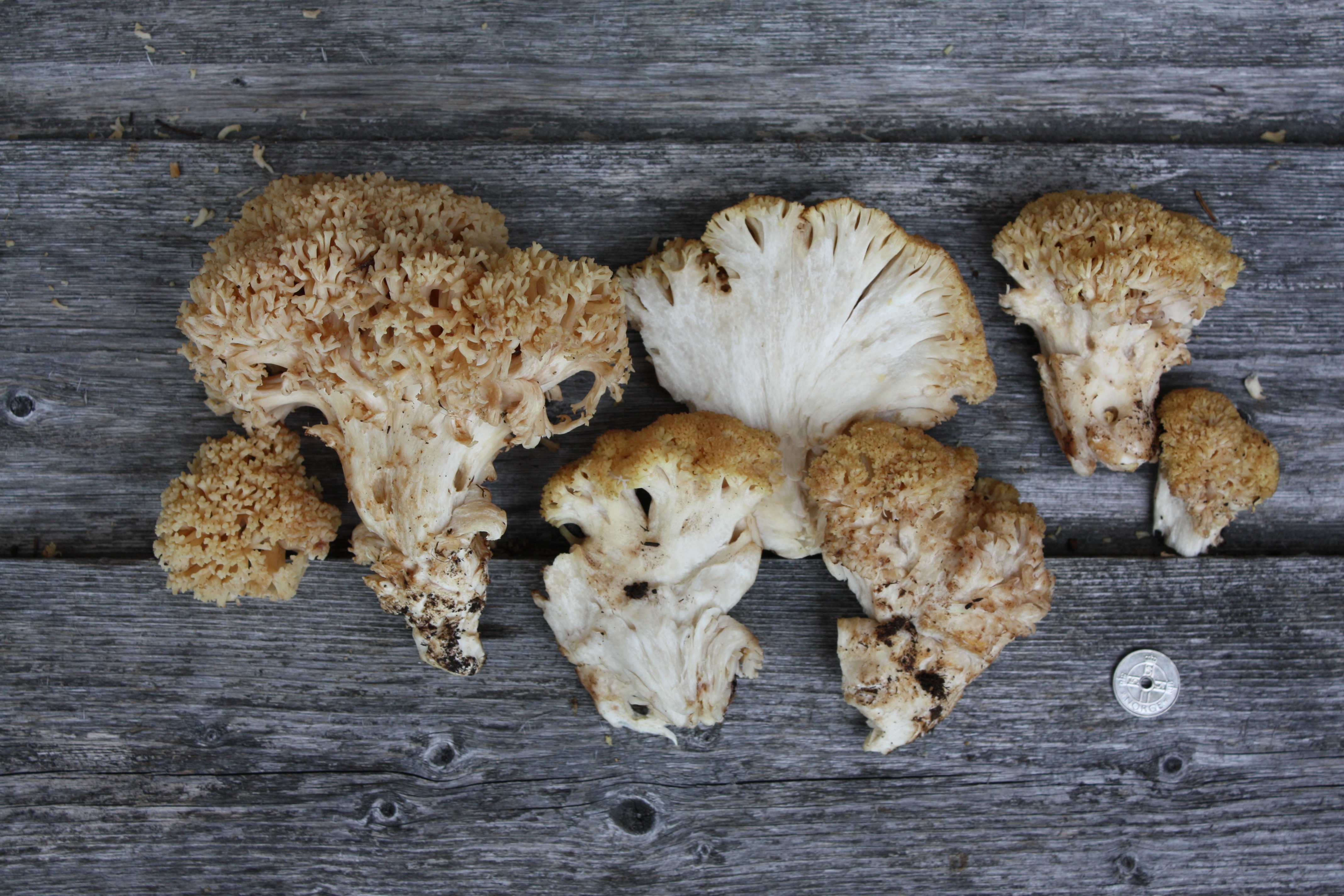
Ramaria rufescens (Schaeff.) Corner
- Scientific name
- Ramaria rufescens
- Author
- (Schaeff.) Corner
- Common names
- IUCN Specialist Group
 Mushroom, Bracket and Puffball
- Kingdom
- Fungi
- Phylum
- Basidiomycota
- Class
- Agaricomycetes
- Order
- Gomphales
- Family
- Gomphaceae
- Assessment status
- Published
- Assessment date
- 2019-03-27
- IUCN Red List Category
- NT
- IUCN Red List Criteria
- A2c+3c+4c; C2a(i)
- Assessors
- Tor-Erik Brandrud (Norwegian institute for nature research (NINA), Norway); Anton Shiryaev (Institute of Plant & Animal Ecology (IPAE) Ural Branch of the Russian Academy of Sciences (UrB RAS) Vegetation & Mycobiota Diversity Department)
- Reviewers
- Tea von Bonsdorff (Finnish Museum of Natural History); Tatyana Svetasheva
Assessment Notes
Justification
Ramaria rufescens is a mycorrhizal species associated with Picea abies and (more rarely) Pinus sylvestris, in calcareous, mossy spruce or pine forests of N and C Europe, also found in several regions in Russia (including Asian part). These forest types often occupy small and fragmented areas, and are declining both in N and C Europe, due to area loss and reduced ecological conditions.The species is known from approx. 75 localities in Scandinavia, C Europe, and European and Eastern Russia. The total population is estimated to approx. 800 localities, which is equivalent to approx. 16,000 mature individuals. The decline of the calcareous Picea-Pinus forests in the last 50 years (three generations) is estimated to be in the magnitude of 15-20% and is predicted to continue. Based on this, the species population size is inferred to undergo a similar decline, therefore being assessed as NT according to criterion A (A2c+3c+4c) (species/habitat decline >15%). According to criterion C, the species would also classify for NT C2a(i), based on a continuous decline, population size <20,000 (>10,000) mature individuals and very small/isolated subpopulations (less than 1,000 individuals per subpopulation). The species is, thus, assessed as NT A2c+3c+4c; C2a(i).
Taxonomic notes
The species has also been called Ramaria lacteobrunnescens, and some records/reports might be under this name.Geographic range
Ramaria rufescens as a number of other European species of calcareous Picea(-Pinus) forests, has a limited, bicentric distribution, restricted to calcareous spruce(-pine) forests in certain regions of N and C Europe. In N Europe the species is recorded from calcareous districts of SE Norway and SE Sweden, with a northern limit in Jämtland, C Sweden (Nitare and Brandrud 2012).In C Europe, the species is reported mainly from the Prealps of S Germany, Switzerland, Austria and N Italy, but probably the species follows the natural distribution of Picea abies in calcareous districts, also into the less investigated Carpathians and Balkan. The species is possibly reported also from Spain (as R. lacteobrunescens; Nitare and Brandrud 2012).
The species is also recorded from several regions in Russia: six from the European part, three from Ural, and two from Far East (Shiryaev et al. 2010, Isaeva and Khimich 2011, Shiryaev and Volobuev 2013, Shiryaev 2007, 2014).
Population and Trends
Ramaria rufescens is known from approx. 40 sites/localities in Scandinavia (20 in Norway, 20 in Sweden), according to data from national Red Lists (cf. also Nitare and Brandrud 2012), and from approx. 20 sites/localities of C Europe according to databases, plus approx. 15 sites/localities in Russia; altogether approx. 75 sites/localities known. The total population is estimated to approx. 750(-800) sites/localities, which is equivalent to approx. 15,000(-16,000) mature individuals (Dahlberg and Mueller 2011).
The decline of the calcareous Picea-Pinus forests in the last 50 years (three generations) is estimated to be in the magnitude of 15-20% (Artsdatabanken 2018) and is its predicted to continue in the future. The population size is inferred to decline at a similar rate.
Population Trend: Decreasing
Habitat and Ecology
Ramaria rufescens is associated with Picea abies and more rarely Pinus sylvestris. Its major habitats are calcareous, mossy, herb-rich Picea- or Picea-Pinus forests of N or C Europe, forest types with many habitat-specific taxa of Cortinarius, subgenus Phlegmacium. The species occurs mainly in old-growth forests. In Russia, it is also reported to grow in broad-leaved forest. The species can be found from sea level altitudes in Scandinavia and up to subalpine altitudes in the Prealp region.Threats
Ramaria rufescens and its habitats (calcareous Picea(-Pinus) forests) have been declining e.g. due to area loss (urbanization, including tourist resorts, road constructions, expansion of limestone quarries) as well as decreased habitat quality/ecological conditions due to modern forestry with clear-cuttings. Forest statistics from Austria indicates that forestry activity has been doubled the last 40 years in Picea-Abies forests, and according to a Habitat Red List in Austria (Essl and Egger 2010), the Picea-Abies forests are endangered in many regions of Austria. One of the major habitat in Norway, the calcareous pine(-spruce) forests of SE Telemark has declined by >50% due to areal loss since 1970 (Brandrud and Bendiksen 2018), and the calcareous Picea-Pinus forest types are listed as VU in Norway (Artdatabanken 2018).Conservation Actions
To prevent decline and further fragmentation of calcareous Picea(-Pinus) forests with good habitat quality, it is important to set aside reserves on calcareous hotspots, housing many rare/threatened, habitat-specific species. It is furthermore important to establish also sites with a less strict conservation regime, such as woodland key biotopes, where some non-destructive human activities are accepted (such as non-intensive forestry, with closed cutting).More mapping/surveying and monitoring of Ramaria rufescens is needed. The species is little documented from C Europe, where it probably has a wider distribution, probably also in the Carpathian-Balkan region. Finally, more documentation on the degree of decline of the habitats themselves is needed.