- Proposed
- Under Assessment
- LCPreliminary Assessed
- 4Assessed
- 5Published
Termitomyces schimperi (Pat.) R. Heim
- Scientific name
- Termitomyces schimperi
- Author
- (Pat.) R. Heim
- Common names
 m’piérou
 siber
siber- simire
- einihunto
- huntokba
- ndihunto
- nyihunto
 boua kaya
 namowe
- toromwe
- zumbukira
 zip alweta
- zoma
- ono
 scaly tap-root mushroom
 mbel mesil
 oluérin
 termitenpilz
- omajowa
- oluérin
- dare
- zhouchuru
- huve kuve
- nakasowu
- mbel mesil
- boua kaya
- inku aginaku
- oluérin
- osusu aginaku
- ikowa lesiduli
- ikowa elimhlope
- omajova
- omajowa
- huvhe
 kokossi ouro
- osousoun ajininkou
- IUCN Specialist Group
 Mushroom, Bracket and Puffball
- Kingdom
- Fungi
- Phylum
- Basidiomycota
- Class
- Agaricomycetes
- Order
- Agaricales
- Family
- Lyophyllaceae
- Assessment status
- Preliminary Assessed
- Preliminary Category
- LC
- Proposed by
- Georgina Pereira
- Assessors
- Georgina Pereira, Romuald Oba, Teteli Soloum Clement
- Contributors
- David Minter
- Reviewers
- Gregory Mueller, E. Ricardo Drechsler-Santos
Assessment Notes
Justification
Termitomyces schimperi has been reported from most of Sub-Saharan Africa. Data from Côte d’Ivoire and from community interviews from throughout Benin suggest that the species is under significant decline indicating the need for more country level research into population trends. Currently data indicate that the population likely is in decline as there are a number of threats affecting both the fungus and the Macrotermes species. But without further information it is not possible to estimate or infer the rate of decline. Based on current data the species is assessed as Least Concern with the caveat of the need for additional regional and national assessments .
Taxonomic notes
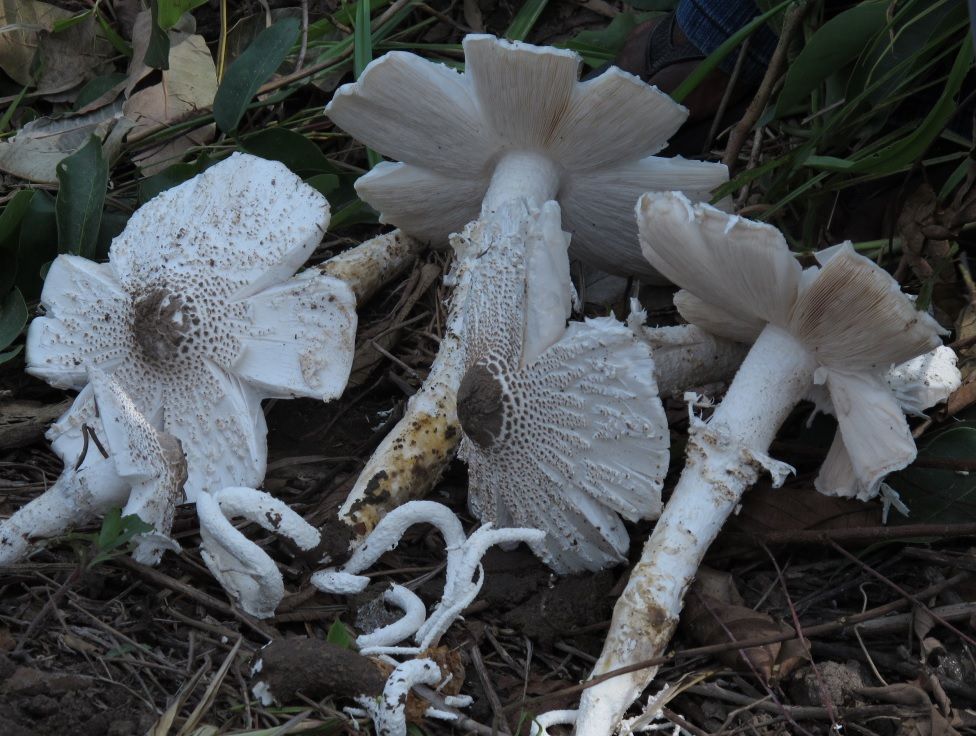
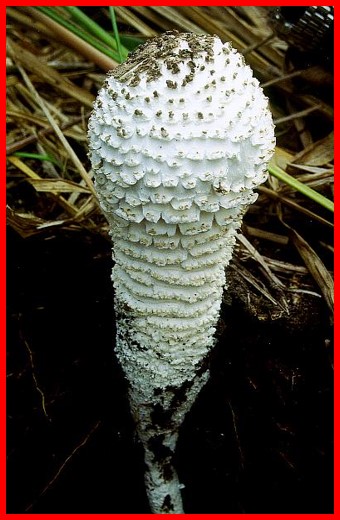
Termitomyces schimperi is one of the largest members of the genus. This species is edible and widely collected but can be confused with poisonous fungi such as Chrolophyllum molybdites. T.schimperi grows in small groups on or near termite colonies, with a ring present in young specimens, as a bright white cap with dark, flat scales concentrated at centre, and lacking a distinct umbo.
Why suggested for a Global Red List Assessment?
Geographic range
Recorded in most of Sub-Saharan Africa including Angola, Benin, Botswana, Burundi, Cameroon, Central African Republic, Cote d’Ivoire, Democratic Republic of the Congo, Ethiopia, Gabon, Ghana, Guinea, Guinea-Bissau, Kenya, Liberia, Malawi, Mozambique, Namibia, Nigeria, Republic of the Congo, Rwanda, Senegal, Sierra Leone, South Africa, Tanzania, Togo, Zambia and Zimbabwe.
The estimated area of occupancy (AOO) of this species is much larger than 204 km², and its estimated extent of occurrence (EOO) is much larger than 15.0 million km².
Population and Trends
The Marcotermes termite species with which this fungus is associated are generally common and found in diverse habitats.
The mushroom has been reported from much of Sub-Saharan Africa with 66 widely distributed records and observations on GBIF (November 2025). The fungi typically produces sporophores between September to March. The fungus is, however, under-recorded scientifically because sporophores are ephemeral and the peak fruiting period is at different months within different African countries (September in Cote d’Ivoire, September to November in Ghana, and December to March in Zimbabwe). Identification of the fungus is also often confused with poisonous fungi such as Chlorophyllum molybdites.
Data from Côte d’Ivoire and from community interviews from throughout Benin suggest that the species is under significant decline, but no other supporting data are available necessitating efforts to monitor population trends in other parts of its range. The population likely is in decline as there are a number of threats affecting both the fungus and the Macrotermes species.
Population Trend: Decreasing
Habitat and Ecology
Sporophores are found in large groups on and around the termite mound base and are associated with several species of Macrotermes including M. michaelseni, M. natalensis, M. subhyalinus, and M. ukuzii. Seasonality of sporophore production is dependent on timing of the rain. The termites with which this fungus is associated are generally common across a variety of habitats.
The habitats in which this species occurs include protected areas, old fallows, woodland (gallery forest, miombo woodland, moist-deciduous tropical forest), semi-green and evergreen tropical forests, and grasslands.
Threats
Relevant threats include climate variability, exploitation and habitat destruction. Change in annual precipitation and seasonal variability affect this species. Agricultural development has negative impacts as repeated destruction of termitaria occurs because of slash and burn agriculture that destroys the fungus and the use of pesticides. Being an edible species, exploitation of the fungus as a food source is an added threat. Over-exploitation of the termite mounds as a building material for brick houses is another threat to the fungus. The associated Macrotermes species are also the most commonly edible termite species across Sub-Saharan Africa. Another recorded threat is the hunting of various rodents (Rattus spp.) that use the termitaria as home, as hunters will destroy the whole termite nest in the process.
Conservation Actions
An important first step would be to have countries from which this species is known include fungi in their CBD national biodiversity strategies, action plans and reports. Reducing the pressure from harvesting by controlling the number and size of harvests per season could ensure sustainability of the fungus. Protecting the associated termite nest from destruction through slash and burn agriculture and brick making would also help.
Research needed
Fieldwork to better document fine scale distribution patterns, population size, and population trends. Data from Côte d’Ivoire and from community interviews from throughout Benin suggest that the species is under significant decline, but no other supporting data are available necessitating efforts to monitor population trends in other parts of its range. Priority must be placed on nationally assessing the species to better understand the rate of species decline. There could be economic benefits from bioremediation but this species is mostly unexplored within this respect and research is needed to explore the possibility.
Use and Trade
This is a choice edible species that is widely collected by foragers for being delicious. Members of this genus have both medicinal and veterinary values. Sale and trade of this species is an important component of the rural economy and supports livelihoods.