- Proposed
- Under Assessment
- Preliminary Assessed
- Assessed
- ENPublished
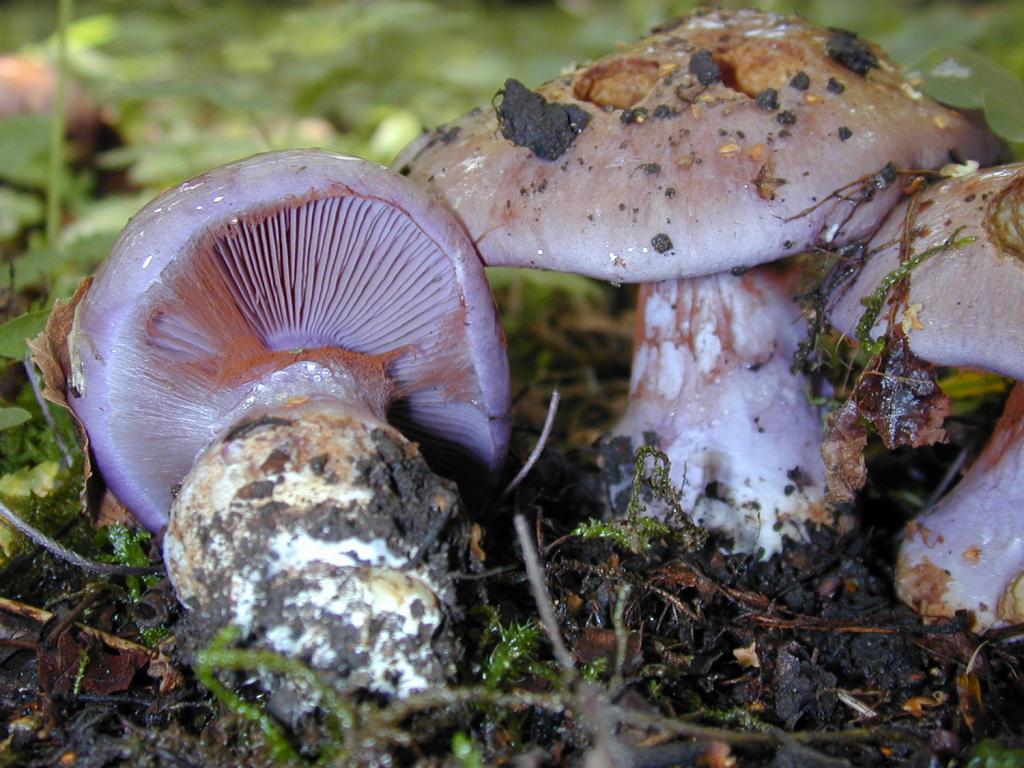
Cortinarius prasinocyaneus Rob. Henry
- Scientific name
- Cortinarius prasinocyaneus
- Author
- Rob. Henry
- Common names
- IUCN Specialist Group
 Mushroom, Bracket and Puffball
- Kingdom
- Fungi
- Phylum
- Basidiomycota
- Class
- Agaricomycetes
- Order
- Agaricales
- Family
- Cortinariaceae
- Assessment status
- Published
- Assessment date
- 2015-04-27
- IUCN Red List Category
- EN
- IUCN Red List Criteria
- C2a(i)
- Assessors
- Tommy Knutsson (Swedish Species Information Centre, Uppsala, Sweden); Tor-Erik Brandrud (Norwegian institute for nature research (NINA), Norway)
- Reviewers
- Tea von Bonsdorff (Finnish Museum of Natural History); Tatyana Svetasheva
Assessment Notes
Justification
Cortinarius prasinocyaneus is an extremely rare fungus forming ectomycorrhiza with hazel (Corylus) and lime (Tilia) in calcareous, broadleaved forest with long history of forest coverage in climatically favourable situations. The species seems to have high requirements and a very narrow ecological niche, only occurring on “hot-spot locations” widely dispersed in the landscape.Very few localities are known world-wide, and the subpopulations are very small and confined to a rare, fragmented and threatened habitat. The major threats to the species habitat are: 1) felling and other silviculture activities replacing the original vegetation with other forest-types or 2) abandonment of extensive grazing, cutting and other small-scale disturbances causing changes in trees/shrubs composition and “densification” of habitats, and 3) habitat loss caused by urban development.
Probably not more than 100 localities known in Europe/globally, less than 2,000 mature individuals, no subpopulations with more than 250 individuals and a decrease in area extension and quality of habitat the species is assessed as EN C2a(i).
Geographic range
This is a very rare species, only known from Europe. The species is known from southern Scandinavia and some parts of central Europe (France and Hungary). The area of occupancy (AOO) is very small and its distribution fragmented.Population and Trends
Easy to identify and relatively well looked after, this species is known from a handful of countries in Europe having a very small total population. It has a disjunct distribution with few isolated localities in each area (Norway 1 locality, Sweden 6, France approx. 5 and Hungary 2). The species appears on the national Red Lists (or is suggested to be included) in the countries where it occurs. It seems to have very narrow ecological niche in a habitat that is deteriorating.
Probably occurring in 100 sites/localities in total, the number of mature individuals according to template results in 2,000 mature individuals (Dahlberg and Mueller 2011). The habitat is much fragmented, so no subpopulations are suspected to have more than 250 mature individuals.
Population Trend: Decreasing
Habitat and Ecology
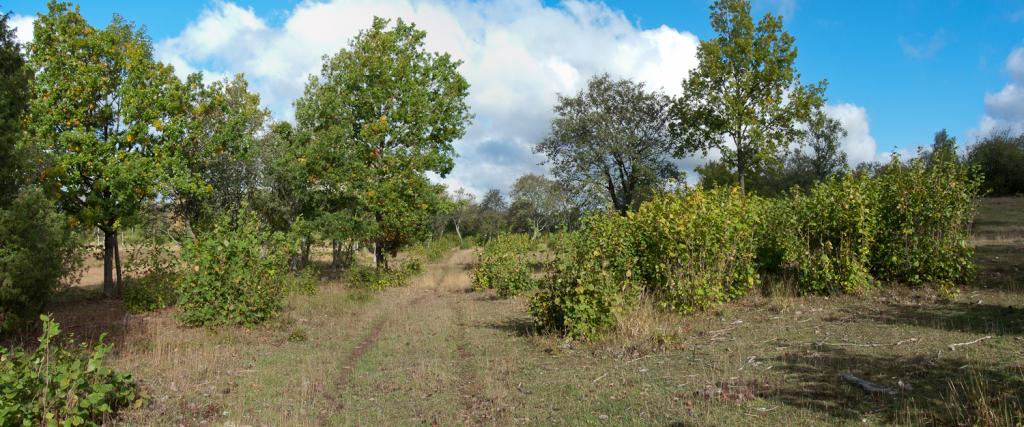
This mycorrhiza-species is associated with Corylus and Tilia in S Scandinavia, apparently also with Quercus and Carpinus (France and Hungary). In Sweden, it is confined to calcareous, xerothermic forests with long history of semi-open forest coverage. It occurs in shallow soils over rocky calcareous bedrock (leptosols) and warm and favourable situations. The most characteristic habitat is semi-open and more or less mosaic Corylus-stands (often together with Quercus robur) in extensively grazed areas with warm local climate and extremely high pH in soil profiles. Often also close to forest edges, wetlands, streams etc. where plenty of sunlight reaches the sites for the mycelium. In Norway, it is recorded from a calcareous Tilia forest, whereas in France the species is occurring in calcareous Quercus-Carpinus forest. In Hungary, the species is found in Quercus and in Fagus-Carpinus.Threats
The felling of host trees and other forestry actions which results in changes of lignose composition, demography and denseness are the main threats to Cortinarius prasinocyaneus. Change of land use, i.e. abandonment from earlier use as extensive semi-natural grazing habitat and small scale cutting resulting in semi-open forest ecosystems, are also negative. The species and its habitat is also subjected to area loss. In Norway, its habitat (calcareous Tilia forest) has been reduced more than 30% in the last decades (Brandrud et al. 2011). The species is specially sensitive to changes due to the very small population size and fragmented population. Little is known the habitat in central Europe but the potential habitat (calcareous Quercus-Carpinus) forest is regarded to be declining (Hansen and Delatour 1999, Denman et al. 2014).Conservation Actions
Cortinarius prasinocyaneus could be considered an indicator species for a community of similarly rare and ecologically very demanding fungal species (mainly ectomycorrhiza but also some saprotrophic) with small populations and limited areas of habitats. Localities can be looked upon as sites of major importance for biodiversity and in need of conservation plans.The remaining habitats are also very fragmented across the total distribution area. This group of species needs a special conservation action plan including the following measures 1) Site/area protection 2) Management and restoration of habitats and 3) Awareness of mycorrhiza-species biology and importance in ecosystems.