- Proposed
- Under Assessment
- Preliminary Assessed
- LCAssessed
- 5Published
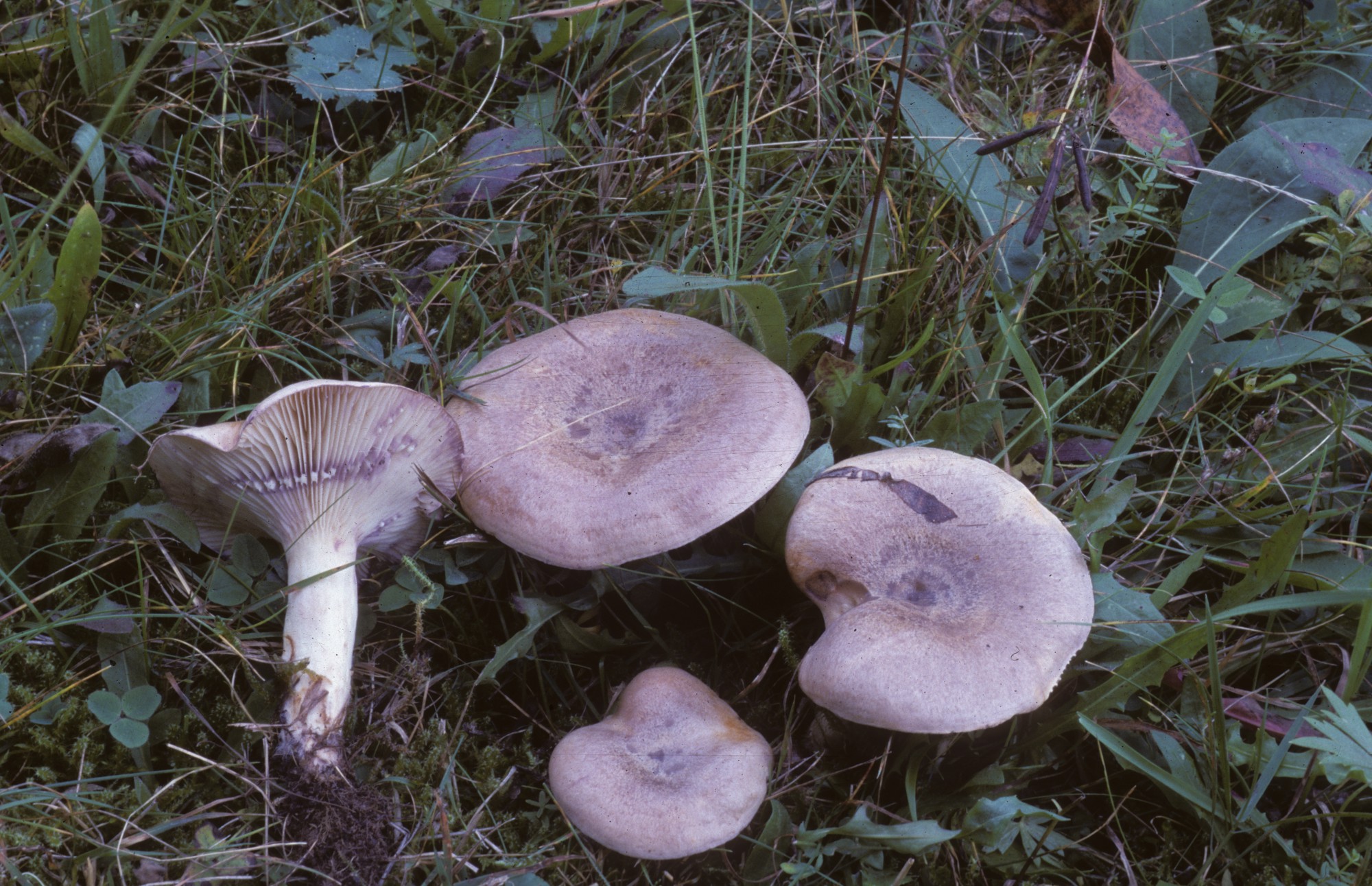
Lactarius violascens (J. Otto) Fr.
- Scientific name
- Lactarius violascens
- Author
- (J. Otto) Fr.
- Common names
 Körnigpigmentierter Violett-Milchling, Trockener Violett-Milchling
 Violet Milkcap
 Mleczaj fiołkowy
 Violetā pienaine
 ryzec fialovějící
- IUCN Specialist Group
 Mushroom, Bracket and Puffball
- Kingdom
- Fungi
- Phylum
- Basidiomycota
- Class
- Agaricomycetes
- Order
- Russulales
- Family
- Russulaceae
- Assessment status
- Assessed
- Preliminary Category
- LC
- Proposed by
- Irmgard Krisai-Greilhuber
- Assessors
- Irmgard Krisai-Greilhuber, Iris Fischinger, Matt Wainhouse, Petr Zehnálek
- Editors
- Anders Dahlberg, Gregory Mueller
- Comments etc.
- Izabela L. Kalucka, Inita Daniele, Slavica Tofilovska, James Westrip
- Reviewers
- Claudia Perini
Assessment Notes
Justification
Lactarius violascens is an ectomycorrhizal species primarily found in Europe with its main distribution centred around the Alps. Its main habitat birch, hornbeam, and to a lesser extent beech and oak forest. The global population is estimated to consist of at least 50,000 mature individuals. The total population is suspected to decline. However, over 50 years, the past, ongoing and future population decline is suspected to be less than 15%. Therefore, Lactarius violascens is assessed as Least Concern.
Taxonomic notes
Historically, Lactarius violascens was discussed as a variety of Lactarius uvidus. However, the two species currently are considered as separate species according to the main fungal taxonomy databaes (MycoBank, Index Fungorum, Fungal Names).
Why suggested for a Global Red List Assessment?
Lactarius violascens is an ectomycorrhizal species primarily found in Europe. Its main habitat are birch, oak, poplar, hornbeam and beech forest. On global scale, the habitat decline is ongoing and estimated to continue to decline in the future, so will the population size of the species. Considering the small population size (c.1400 records in GBIF) and the number of localities estimated not to exceed 5000. Assuming a maximum of 5000 localities and 10 mature individuals at each locality, the population size is estimated to be 50,000 mature individuals, so assessed as LC. Habitat decline is estimated to be 20-30% in some regions (e.g. alder forest), but expected to be lower across its range, so assessed as LC.
Geographic range
Lactarius violascens is distributed across Europe, from Scandinavia to the Mediterranean region It grows in birch, and hornbeam forests on moist soil. Its distribution pattern is continuous and without fragmentation, although it is restricted to the habitats of its host trees Outside Europe populations have been documented in North America and Asia, including Japan and South Korea. In Austria and Switzerland, it is primarily found in the Alps and surrounding areas (GBIF 2026).
Population and Trends
It has its main distribution around the Alps where its habitat and total potential size is estimated to be relatively stable. The known population size is limited small (c.1400 records in GBIF, 2026), the total number of localities estimated not to exceed 5000 and the total population size is estimated to consist of about 50,000 mature individuals.
Population Trend: Stable
Habitat and Ecology
Lactarius violascen´s main habitat are birch, poplar, hornbeam, beech and oak forest, where they form ectomycorrhiza with these trees. In the UK there are records from Helianthemum, though these are rare. The species is favoured by warmer climate.
Threats
Threats are mainly associated with loss of forest, though this is not considered a major threat at present. In the east of Austria the birch host is threatened though drought and this may increase in the future as a threat.
Conservation Actions
Conservation measures for L. violascens include the protection of natural forests. And monitoring the species across Europe should be integrated into national and regional conservation strategies.
Research needed
More precise data on occurrences and population dynamics need to be collected. Population monitoring should be established. Additionally, studies on the impacts of climate change and forestry practices on the populations could be conducted.
Use and Trade
The species is rarely used as an edible species.
Bibliography
just to remember to fill in:
Leonardi et al., 2021
Bjelke et al., 2016
pilzoek.de, n.d.-c
GBIF
Martín et al., 2024;
Bregant et al., 2023