- Proposed
- Under Assessment
- 3Preliminary Assessed
- 4Assessed
- 5Published
Uredo forsterae G. Cunn.
- Scientific name
- Uredo forsterae
- Author
- G. Cunn.
- Common names
- IUCN Specialist Group
 Rust and Smut
- Kingdom
- Fungi
- Phylum
- Basidiomycota
- Class
- Pucciniomycetes
- Order
- Pucciniales
- Family
- Incertae sedis
- Assessment status
- Under Assessment
- Proposed by
- Peter Buchanan
- Assessors
- Peter Buchanan
- Editors
- Tom May
- Contributors
- Peter Buchanan
- Reviewers
- Anders Dahlberg, Gregory Mueller
Assessment Notes
Taxonomic notes
The endemic New Zealand rust Uredo forsterae was described in 1924, based on a single holotype specimen (1923), and is known only from its uredinial stage.
Why suggested for a Global Red List Assessment?
Known only from Mount Taranaki in New Zealand. Found once by Cunningham (1924 protologue) and twice by McKenzie & Padamsee (2011, 2019) but their 2 collections were from the same plants on different years.
Geographic range
All 3 known collections were recorded on Mt Taranaki, North Island . The 2 most recent collections (2011, 2019) were recorded from the same group of plants at 1300m, while the 1923 specimen was reported to be from 1000m.
Population and Trends
Eric McKenzie reported that there was considerably less rust present on plants in 2019 compared with his collecting from the same group of plants in 2011.
Population Trend:
Habitat and Ecology
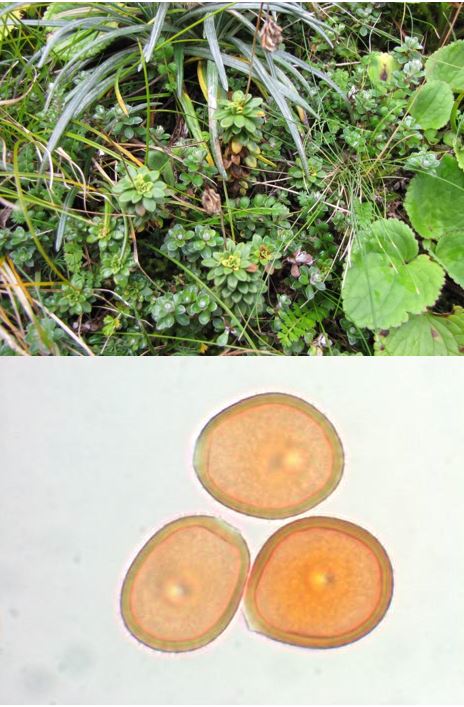
First recorded on Forstera bidwillii var. densifolia (1923), later on Forstera tenella (2011, 2019). These plant taxa are now considered as one variable species under the name Forstera tenella (Glenny 2009). The host is an endemic, perennial herb, widespread throughout New Zealand in montane to subalpine grassland, herbfield, scrub, forest margins or openings, and rocky places (McKenzie & Padamsee, in prep.). There is only one known present-day site for the rust.
Threats
From recently collected material, only known from single location on Mt Taranaki: track from carpark to Manganui Lodge. Vulnerable to human impact on host plant population at single site. For example, an extension of the carpark could reduce/remove local habitat. Rust-bearing plants are adjacent to a track that provides access to ski lodges. Plants are situated between track edge and base of a cliff. Widening of track to the cliff base could remove the habitat. Department of Conservation management on Mt Taranaki, a national park, have not been informed of the location of this threatened species, so track widening is a threat until notification can be provided. Alternatively, a rock fall could affect the habitat.
Conservation Actions
None as yet, but there is need to notify Department of Conservation management on Mt Taranaki of the location of U. forsterae, and importance to protect the host plants.
Research needed
Continued collecting, though host has been looked at repeatedly by rust specialist E. McKenzie for more than 3 decades.
Use and Trade
None
Bibliography
Glenny, D. 2009. A revision of the genus Forstera (Stylidiaceae) in New Zealand, New Zealand Journal of Botany, 47:3, 285-315, DOI: 10.1080/00288250909509811
McKenzie EHC; Padamsee, M. (in prep.) Rust fungi of New Zealand. Fungi of New Zealand Vol. xx.