- Proposed
- Under Assessment
- Preliminary Assessed
- Assessed
- NTPublished
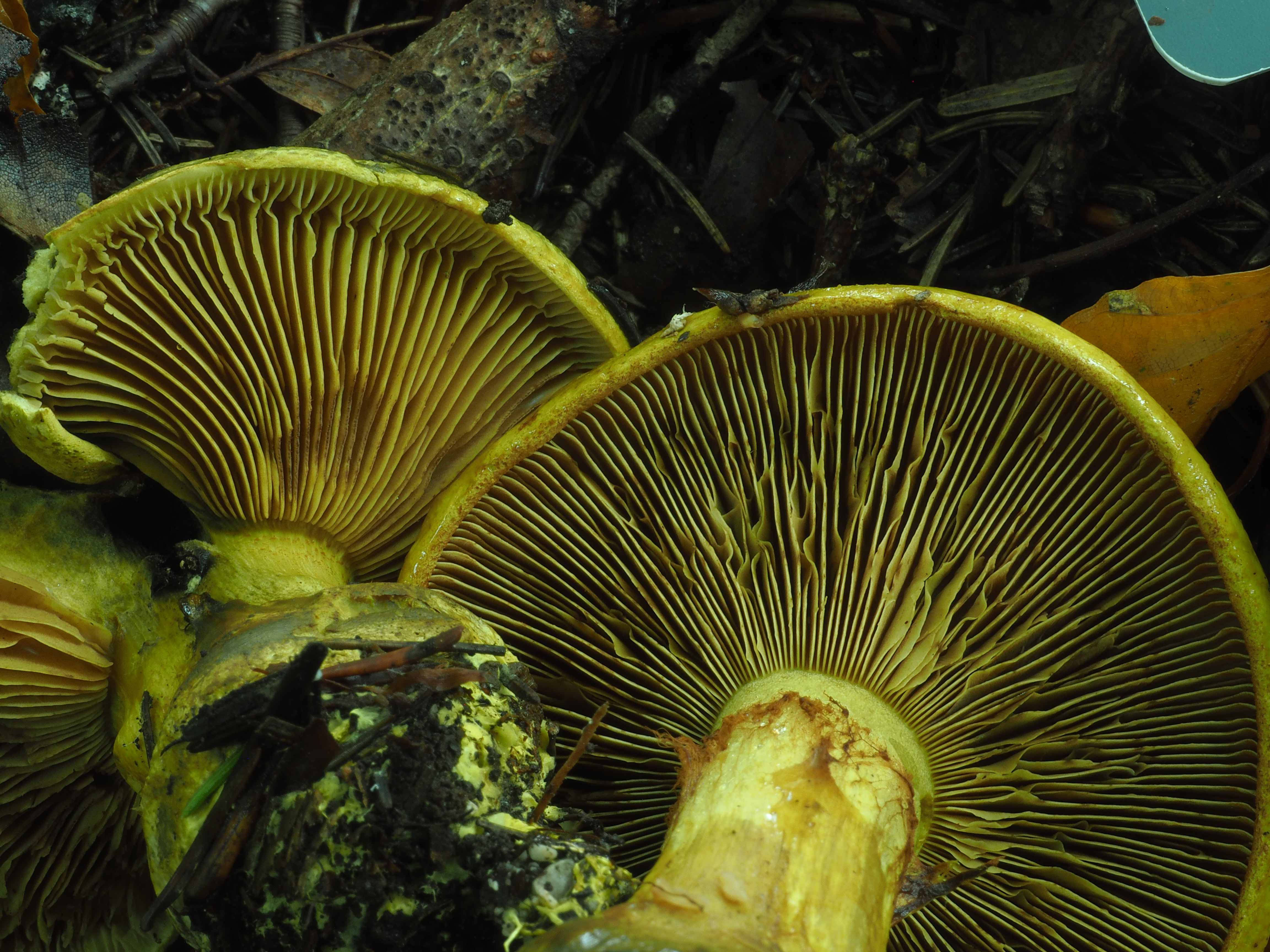
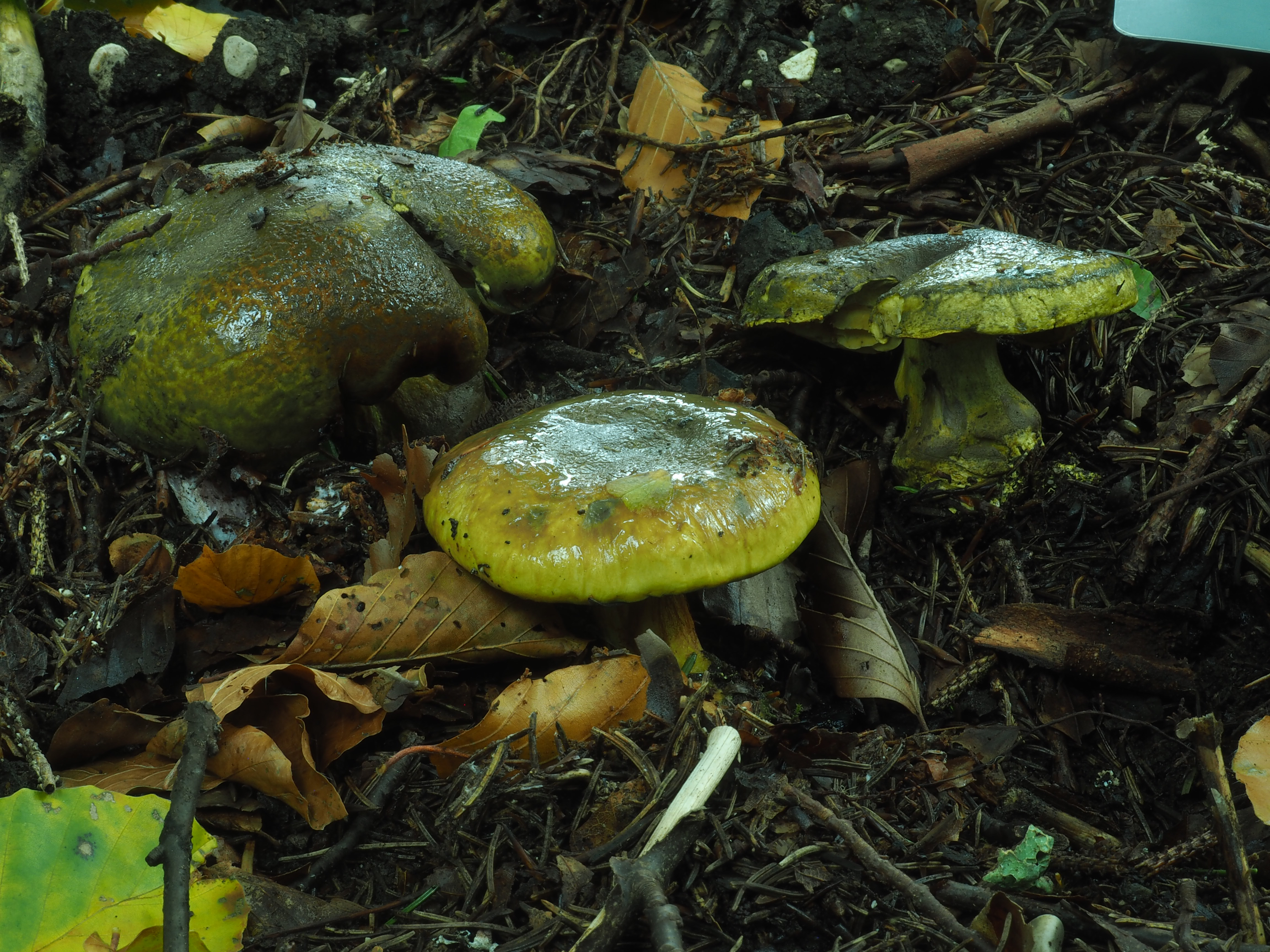
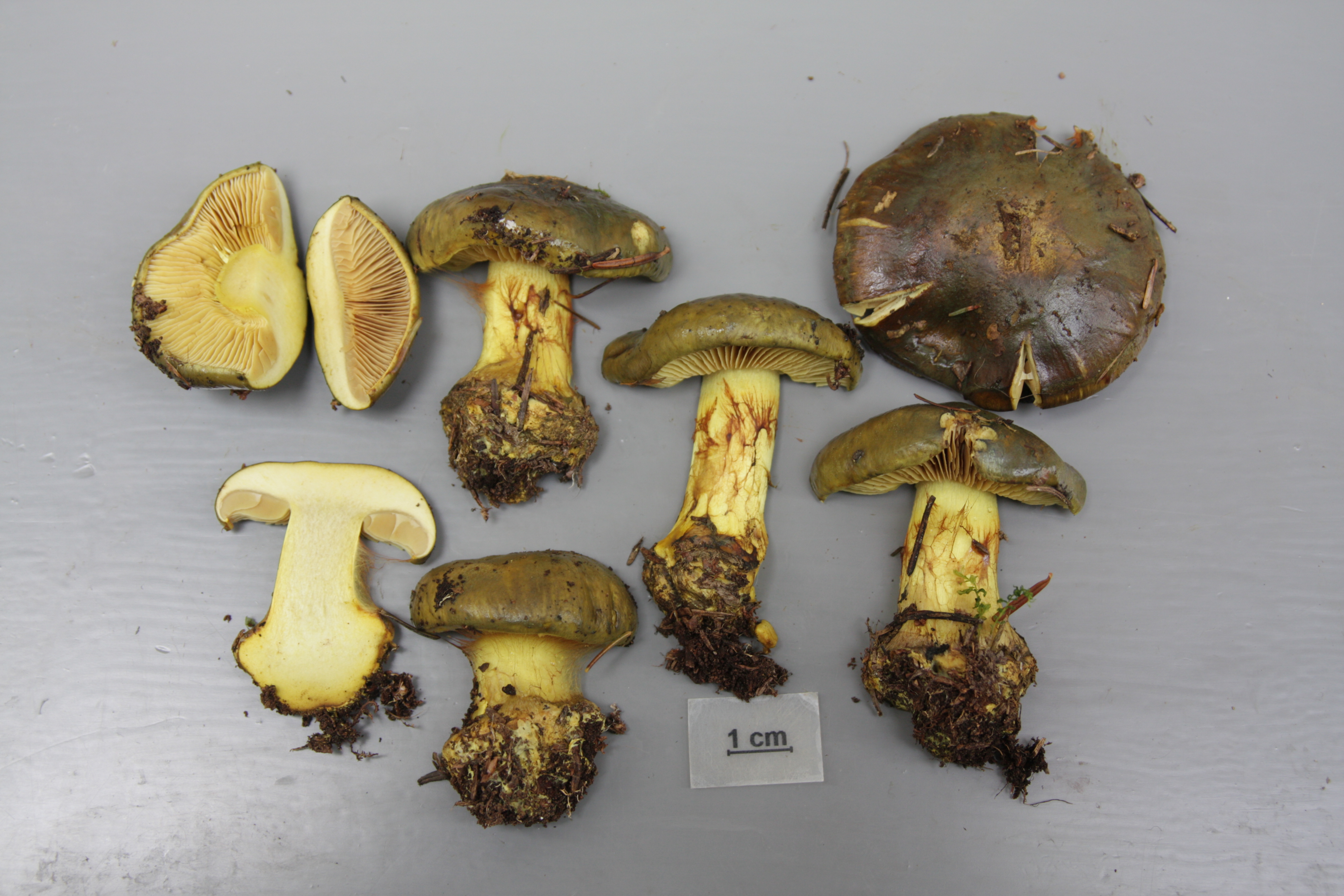
Cortinarius atrovirens Kalchbr.
- Scientific name
- Cortinarius atrovirens
- Author
- Kalchbr.
- Common names
 Olive Webcap
 Piparvöödik
 Schwarzgrüner Klumpfuß
- IUCN Specialist Group
 Mushroom, Bracket and Puffball
- Kingdom
- Fungi
- Phylum
- Basidiomycota
- Class
- Agaricomycetes
- Order
- Agaricales
- Family
- Cortinariaceae
- Assessment status
- Published
- Assessment date
- 2019-03-25
- IUCN Red List Category
- NT
- IUCN Red List Criteria
- A2c+3c+4c; C2a(i)
- Assessors
- Tor-Erik Brandrud (Norwegian institute for nature research (NINA), Norway)
- Reviewers
- Anders Dahlberg (Swedish Species Information Centre, Uppsala / IUCN SSC Cup-fungus, Truffle and Ally Specialist Group); Gregory Mueller (Chicago Botanic Garden / IUCN SSC Mushroom, Bracket and Puffball Specialist Group)
Assessment Notes
Justification
Cortinarius atrovirens is a mycorrhizal species associated with Abies alba and rarely with Pinus sylvestris and Fagus sylvatica. It is one of the more characteristic and well-known species of the rich fungus element of the (mixed) calcareous montane Abies alba forests of C and S Europe. These habitat specific species suffer from the fragmentation and decline of the small calcareous fir forests of e.g. Black Forest, the Jura, Prealps and Carpathians due to area loss and influence from modern forestry, including introduction of Picea plantations.The decline of the habitat-specific fungi of the calcareous Abies forest element is due to a long-term and persistent decline in mature/old silver fir forests, due to forestry. For instance the montane mixed Abies forests of the Prealps, where this species has a main area, has had increased forestry activity, with a doubling of annual felling in the last 40 years, according to forestry statistics (Austria), and these are now listed as endangered habitats in the habitat red list of Austria. In the same period, we have seen a shift from Abies stands to planting of Picea in many hotspot regions of Cortinarius atrovirens and allies. Furthermore, a habitat-loss is probably seen in many silver fir regions due to settlement/tourist resort expansion, road construction, ski tracks, etc. The narrow bands of Abies forests in the Alp valleys may also be vulnerable to climate change, including pathogen outbreaks. The mature, often grazed calcareous pine forests with Cortinarius atrovirens at Gotland, Sweden is also declining, due to forestry and the expansion of limestone quarries, as well as altered management practices with the loss of cattle grazing.
The decline in Central-South European old-growth, calcareous Abies or mixed Abies-Picea forests due to forestry and habitat-loss is estimated to be approx (10-)15-20% over 50 years (three generations length), resulting in a decline in host for the fungus at an equivalent rate. Based on this, the species becomes assessed as NT (“close to VU”) according to the A criterion (A2c+3c+4c). The species furthermore probably qualifies as NT (“close to VU”) according to the C-criterion based on an inferred continuing decline, combined with an estimated population size of <20,000 individuals, and very small subpopulations.
Taxonomic notes
Cortinarius atrovirens is phylogenetically very similar to C. ionochlorus (w/ e.g. identical ITS sequences). However, morphologically and eco-geographically these are clearly dissimilar, and should be treated as different taxa, either subspecies (C. atrovirens ssp. atrovirens and ssp. ionochlorus) or species. For practical reasons, we treat these as species in the present Red List assessment.Geographic range
Cortinarius atrovirens has a limited European distribution. It is rare to very rare, but locally more frequent in calcareous regions (The Jura, Black Forest, Gotland), sometimes forming large rows or fairy rings. More or less restricted to the natural Abies alba distribution area. It was historically recorded in northeast England (Scarborough, Cooke 1886-1888; apparently not recollected in recent decennia, cf. Orton 1955). It is found up to 1840 m asl in Switzerland. Not reported from the calcareous Abies nordmanniana forest of Caucasus-north Turkey, and not reported outside Europe.Population and Trends
At least in some regions, the species is not infrequent in Phlegmacium-rich, calcareous Abies forests. Approx 100 localities are indicated from national databases and literature (mainly from Germany, Austria and Sweden). The real/total number of sites/localities is estimated to be approx 1000 in Europe (=global population), corresponding with a total of approx 20,000 individuals.
According to sites seen and to literature, the species is mainly associated with older Abies(-Picea) stands, without influence of modern forestry with clear-cuts. At Gotland (Sweden) the species is associated with older, grazed Pinus forests. These forest types are now declining, the old Abies forests due to forestry including Picea plantations, and areal loss due mainly to settlement/tourist resort expansion, etc, now being regarded as a vulnerable forest type in the Prealp region. Suspected from this habitat trend, it is probable that also the populations of C. atrovirens are declining, at the same rate as the habitat. The Gotland populations are furthermore lost due to expansion of lime quarries (see rationale).
The decline in Central-South European old-growth, calcareous Abies or mixed Abies-Picea forests due to forestry and habitat-loss is estimated to be approx (10-)15-20% over 50 years (3 generation lengths), resulting in a decline in host for the fungus at an equivalent rate. Based on this, the species becomes assessed as NT (“close to VU”) according to the A criterion (A2c+3c+4c). The species furthermore probably qualifies as NT (“close to VU”) according to the C-criterion based on an inferred continuing decline, combined with an estimated population size of <20,000 individuals, and very small subpopulations.
Population Trend: Decreasing
Habitat and Ecology
The is a mycorrhizal species associated mainly with Abies alba, sometimes also with Pinus sylvestris (especially outside the natural distribution of Abies alba), sometimes apparently also with Fagus sylvatica. The species is a typical member of the Cortinarius subgenus Phlegmacium element more or less restricted to the calcareous, mossy Abies alba or mixed Abies-Picea-Fagus of montane Central Europe and the Appennines. Here the species occurs in typical hotspot sites with many other phlegmacia, such as C. haasii, C. odorifer, C. russeoides. According to own observations and literature from e.g. Black Forest and the Austrian Eastern Prealps, the species mainly occurs in older/old-growth Abies forests. In a few northern outposts, probably of relictual nature (mainly Gotland), the species occurs in calcareous Pinus forests, and in southwestern outposts in Spain, the species is also reported in Pinus forests.Threats
Cortinarius atrovirens is threatened by habitat-loss and reduced/depauperated habitat conditions. Its major habitat; older calcareous Abies alba forests or calcareous mixed Abies-Picea abies is apparently declining in the entirety of central Europe. The decline is documented e.g. in Austria where montane basiphilous Abies-Picea forests are regarded as endangered habitats, vulnerable e.g. to forestry, with a doubling of annual felling in the last 40 years, according to forestry statistics (Austria). Furthermore, according to own observations, a number of Abies stands become planted with Picea abies after clear-cutting. Moreover, habitat-loss due to road construction, settlements including tourist resort expansion are seen in many areas. The narrow bands of Abies forests in the Alp valleys may also be vulnerable to climate change and pest outbreaks. The calcareous Pinus sylvestris forests with Cortinarius atrovirens at Gotland, Sweden, are also declining, due mainly to lime quarry expansion and altered management practices, with the loss of cattle grazing.Conservation Actions
To prevent decline and fragmentation of calcareous Abies-Picea-Pinus forests with good habitat quality, it is important to set aside reserves on calcareous hotspots, i.e. in sites housing many rare/redlisted species such as C. atrovirens, C. citrinoolivaceus and C. haasii. It is furthermore important to establish woodland key biotopes or equivalent management regimes, where only a non-intensive, closed cutting is allowed, leaving much of the stand qualities intact, including a continuity of the fir (or pine) roots and their mycorrhizas. Control of excess deer populations in areas where they are preventing Abies forest regeneration, or exclusion of deer from these areas, would be beneficial.More research is needed to find out how much extensive forestry (selective cutting) the species can tolerate, and to what degree the species re-establishes in young (planted) forests after clear-cutting. More mapping is needed, especially in eastern-southeastern parts of the distributional range of Abies alba (the eastern Carphathians and the montane Balkans).
Genetic studies with more molecular markers are needed to find out more about the (subtle) phylogenetic differentiation between C. atrovirens and C. ionochlorus.