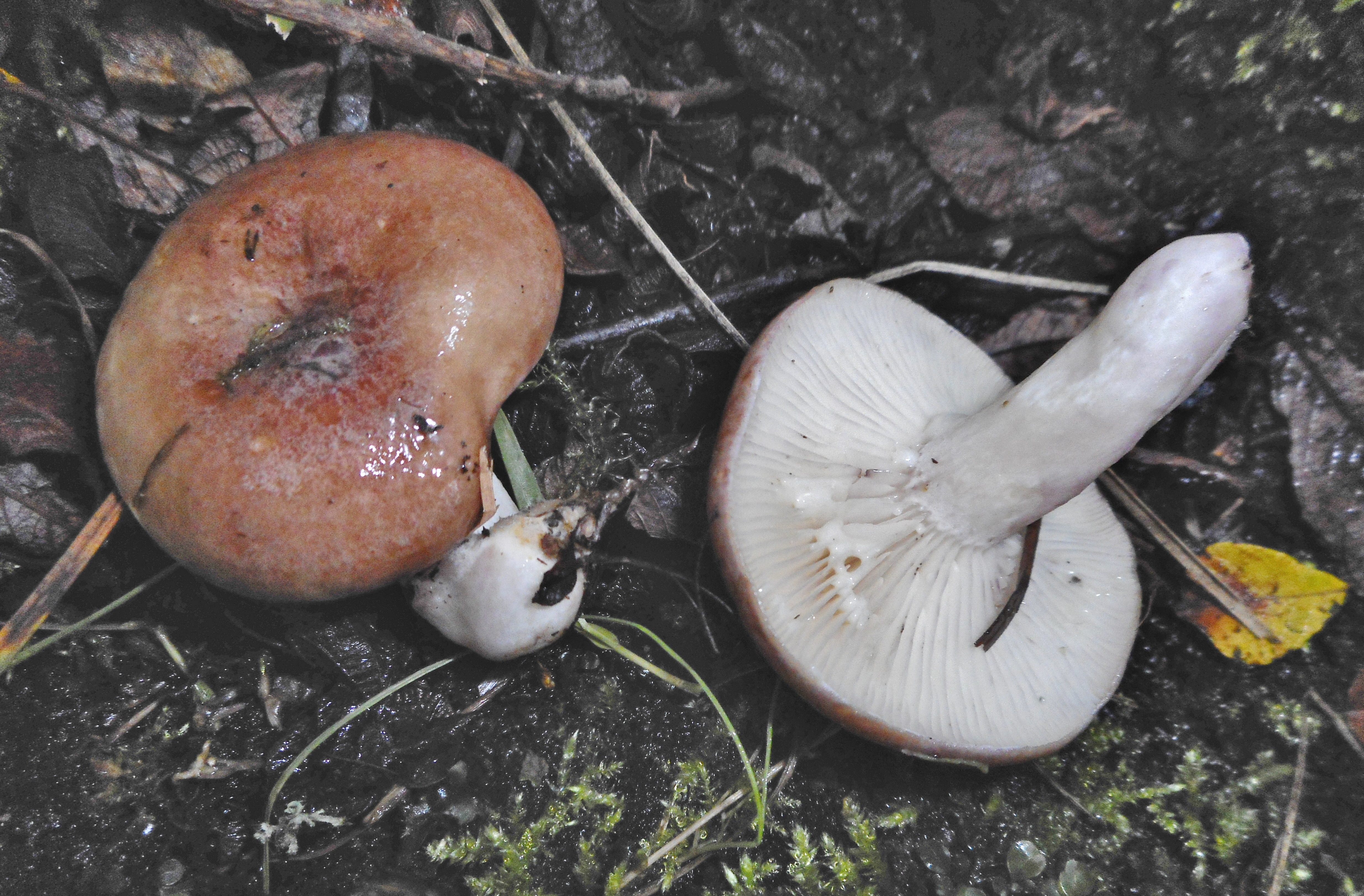
- Proposed
- 2Under Assessment
- 3Preliminary Assessed
- 4Assessed
- 5Published
Lactarius uvidus (Fr.) Fr.
- Scientific name
- Lactarius uvidus
- Author
- (Fr.) Fr.
- Common names
 Klebriger Violett-Milchling
 Shiner Milkcap, Shiner
- IUCN Specialist Group
 Mushroom, Bracket and Puffball
- Kingdom
- Fungi
- Phylum
- Basidiomycota
- Class
- Agaricomycetes
- Order
- Russulales
- Family
- Russulaceae
- Assessment status
- Proposed
- Proposed by
- Irmgard Krisai-Greilhuber
- Comments etc.
- Irmgard Krisai-Greilhuber
Assessment Notes
Taxonomic notes
Generally accepted species
Why suggested for a Global Red List Assessment?
Lactarius uvidus is not specialized on a specific tree species. Although it prefers birches and alders, it can associate with other deciduous trees. As a result, it is not very demanding regarding its habitat. The species is found throughout Europe in moist deciduous forests, as well as in swamp and riparian forests. It is also found in several Asian countries, including Russia and Japan, and is commonly observed in North America. It is widespread and common, making the status “Least Concern” (LC) appropriate. (gbif.org, n.d.-d; pilzoek.de, n.d.-b)
Geographic range
Lactarius uvidus is widely distributed across Europe and also found in several Asian countries, including Russia and Japan, and is commonly observed in North America.
Population and Trends
Globally, populations of Lactarius uvidus are widespread and common, with no evidence of a significant decline. However, regional red lists, such as in Germany, classify the species as threatened. Similarly, the Czech and Danish national red lists also list it as endangered, where habitat loss can become a significant issue. In Austria, it is categorized as Least Concern (gbif.org, n.d.-d; Leonardi et al., 2021)
Population Trend: Stable
Habitat and Ecology
Lactarius uvidus is an ectomycorrhizal fungus. Its habitats include moist deciduous and mixed forests, including swamp and riparian forests. It primarily forms symbiosis with birches, alders, and firs but can also associate with other tree species, making it an important general mycorrhizal fungus. (pilzoek.de, n.d.-b)
Threats
Globally, Lactarius uvidus has stable populations and is not considered threatened. However, local populations are often affected by climate change and drought. The drainage of swamp and riparian forests is also problematical. Additionally, the decline of its symbiotic partners—birch, alder, and fir—should not be underestimated.
Conservation Actions
To maintain stable populations of Lactarius uvidus, it is advisable to protect moist deciduous forests, as well as swamp and riparian forests.
Research needed
Research measures should include long-term monitoring and general studies on its adaptability to climate change.
Use and Trade
The species is inedible and not in use.
Bibliography
only to remember what to fill in:
gbif.org, n.d.-d;
Leonardi et al., 2021)