- Proposed
- Under Assessment
- 3Preliminary Assessed
- 4Assessed
- 5Published
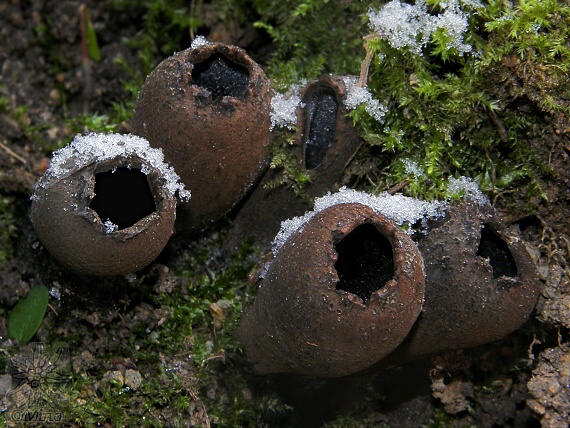
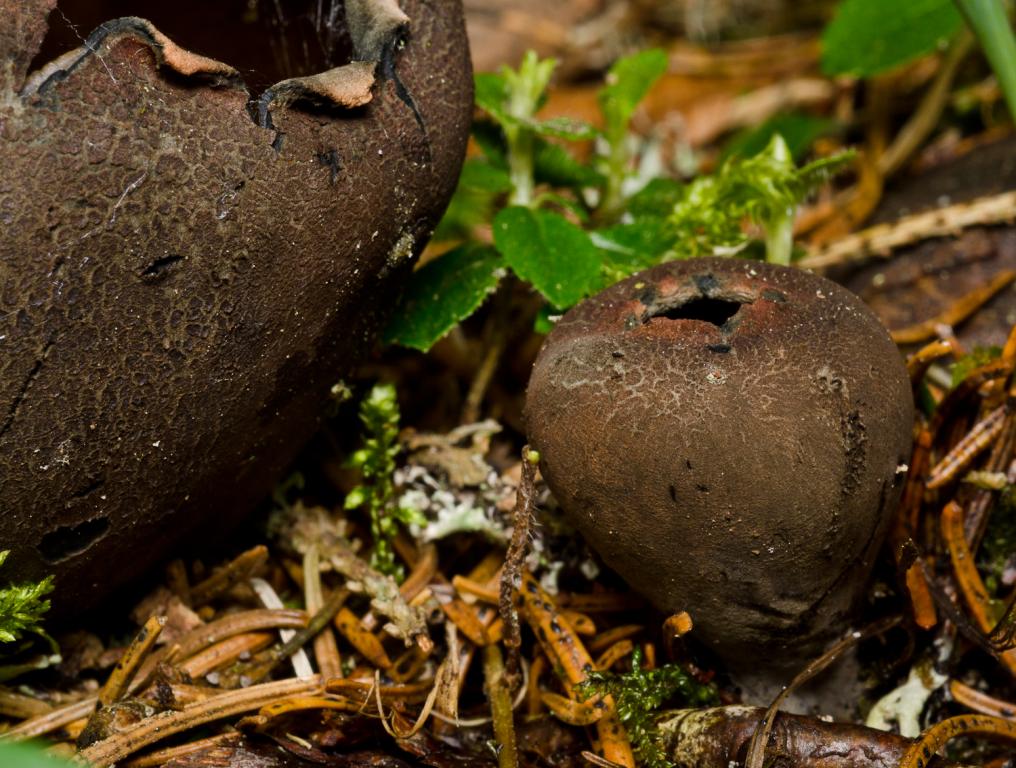
Urnula craterium (Schwein.) Fr.
- Scientific name
- Urnula craterium
- Author
- (Schwein.) Fr.
- Common names
 devil's urn
 urnička kráterovitá
 Krātera urnula
 crni pehar
 Pagana-urnseen
 urnička pohárová
 урнула бокаловидная
- IUCN Specialist Group
 Cup-fungi, Truffles and Allies
- Kingdom
- Fungi
- Phylum
- Ascomycota
- Class
- Pezizomycetes
- Order
- Pezizales
- Family
- Sarcosomataceae
- Assessment status
- Under Assessment
- Proposed by
- Tommy Knutsson
- Assessors
- Anders Dahlberg
- Contributors
- Inita Daniele, Ivona Kautmanova, Tommy Knutsson, Vera Hayova
- Comments etc.
- Thomas Læssøe, Michael Krikorev, Vladimír Kunca, Armin Mešić, Irja Saar, Reda Iršėnaitė, Daniel Dvořák, Eugene Popov, Irmgard Krisai-Greilhuber
Assessment Notes
Taxonomic notes
Why suggested for a Global Red List Assessment?
Saprotrophic fungi occuring on fallen stems of Corylus in mixed moist forests, mainly Picea/Corylus and broadleaved forests. Mainly in brooks, ravines, hillsides and close to springs with fresh water moving thru the soil keeping the logs moist. Often occuring on sites with rich flora and fauna incl other rare and threatened species and in some areas used as an indicator species of localities with high conservation values (Key habitats).
The species has a wide distribution but confined to a habitat that is heavily affected by forestry and changes of hydrology in forest ecosystems.
The species has an eastern geographical distribution in Europe, but is fairly common in North America. In many countries decreasing due to forestry and changes of hydrology and redlisted in most European countries where evaluated.
Geographic range
The species has an eastern geographical distribution in Europe, but is fairly common in North America (where collected and sold as afrodisiacum!). In Europe red-listed in almost all countries.
GBIF data from Norway wrong (species not found in Norway).
Population and Trends
It is most likely that the species has declined because of the decrease in suitable substrate. Virgin forests have been reduced and fragmented because of forestry. Many deciduous woods with hazel have been transformed into young spruce forests.
A criteria possible, non of the other applicable, for a European assessment.
Global scale LC considering N.Am. populations.
Population Trend:
Habitat and Ecology
Saprotrophic fungi occuring on fallen stems of Corylus in mixed moist forests, mainly Picea/Corylus and broadleaved forests. Mainly in brooks, ravines, hillsides and close to springs with fresh water moving thru the soil keeping the logs moist. Often occuring on sites with rich flora and fauna incl other rare and threatened species and in some areas used as an indicator species of localities with high biodiversity values.
I SC Europe (Slovak, Czech) also on Carpinus and Ulmus.“The ecology of the fungus is somewhat complicated. It mainly lives on dead hazel wood under old bushes of hazel in spruce woods, often near flows
of water or where there groundwater is close to the ground. The spruces gives shade to the hazels and reduce the formation of live stems but at the same time hazel stems die, which favours Devil`s urn. It is also good for the fungus if young or some few older spruces occur near the growing sites, because the moisture in the substrate is preserved. In sunny and/or windy locations the ground will dry up and the fungus will not be able to form fruiting bodies. Devil`s urn needs snow-covered ground in March that provides wet conditions at the site when the snow melts. In regions with only a thin layer of snow in late winter no fruit bodies will be found. ” (Rydberg 2008)
Threats
Conservation Actions
Research needed
Use and Trade
Bibliography
Rydberg, H. 2008. Åtgärdsprogram för rökpipsvamp 2007-2010. Link: http://www.lansstyrelsen.se/gavleborg/SiteCollectionDocuments/Sv/djur-och-natur/hotade-vaxter-och-djur/atgardsprogram-for-hotade-arter/Rokpipsvamp_atgardsprogramet.pdf