- Proposed
- Under Assessment
- 3Preliminary Assessed
- 4Assessed
- 5Published
Halecania rhypodiza (Nyl.) Coppins
- Scientific name
- Halecania rhypodiza
- Author
- (Nyl.) Coppins
- Common names
- IUCN Specialist Group
 Lichens
- Kingdom
- Fungi
- Phylum
- Ascomycota
- Class
- Lecanoromycetes
- Order
- Rhizocarpales
- Family
- Catillariaceae
- Assessment status
- Under Assessment
- Proposed by
- Beppo Fischer
- Assessors
- Beppo Fischer, Rebecca Yahr
- Editors
- Rebecca Yahr
Assessment Notes
Justification
This species was thought to have a very limited AOO and EOO. Its habitat, calcareous rocky outcrops at high elevations, is scarce in Scotland, where it was thought to be endemic. However, new records show that there is at least one subpopulation in the Austrian Alps. There is not enough data available to make claims about AOO and EOO or population sizes and trends. Research is needed to find out about the status of this lichen in mainland Europe. In the Scottish part of its range, Halecania rhypodiza is threatened by habitat loss because of climate change. Subpopulations are likely to be very small.
Taxonomic notes
Synonyms: Lecidea rhypodiza, Biatorina rhypodiza, Catillaria rhypodiza
Why suggested for a Global Red List Assessment?
This species was thought to have a very limited AOO and EOO. Its habitat, calcareous rocky outcrops at high elevations, is scarce in Scotland, where it was thought to be endemic. However, new records show that there is at least one subpopulation in the Austrian Alps. There is not enough data available to make claims about AOO and EOO or population sizes and trends. Research is needed to find out about the status of this lichen in mainland Europe. In the Scottish part of its range, Halecania rhypodiza is threatened by habitat loss because of climate change. Subpopulations are likely to be very small.
Preliminary assessment carried out by John Douglass.
Geographic range
This species is found in central Scotland and is limited to calcareous rocks at high altitudes. We estimate that there are less than ten sites that could be classified as a suitable habitat. The species is suspected to be very rare and is seldom found, with fewer than 30 records in total, all but two being from Scotland and from 1991 or older. Until recently, it was thought to be endemic to Scotland. The known Scottish subpopulations have an EOO of 1,251 km2 and an AOO of 32 km2 , and we suspect that the true AOO is below 200 km2. However, there are two records from the year 2014 from Hohe Tauern in the Austrian Alps. This suggests that the species has range much larger than previously known. Since calcareous rock is common in the Alps, we do not know whether habitat is restricted and cannot reasonably infer AOO and EOO for this species.
Population and Trends
Halecania rhypodiza has been found at eight sites in central Scotland. Because it is confined to calcareous rock outcrops, of which only a limited number occur in Scotland, we suspect that the number of unknown subpopulation in Scotland is limited. However, since this lichen is inconspicuous and can easily be overseen, a considerable amount of uncertainty needs to be applied. Subpopulations are likely to be very small. Scottish subpopulations should be considered one location threatened by climate change. No data are available on decline. The only information available on continental subpopulations are the two records from Hohe Tauern, Austria from 2014. While it is certainly not a common species in the Alps, there is not enough data available to make claims concerning the amount, state or trends of the subpopulations in the Alps.
Population Trend: Uncertain
Habitat and Ecology
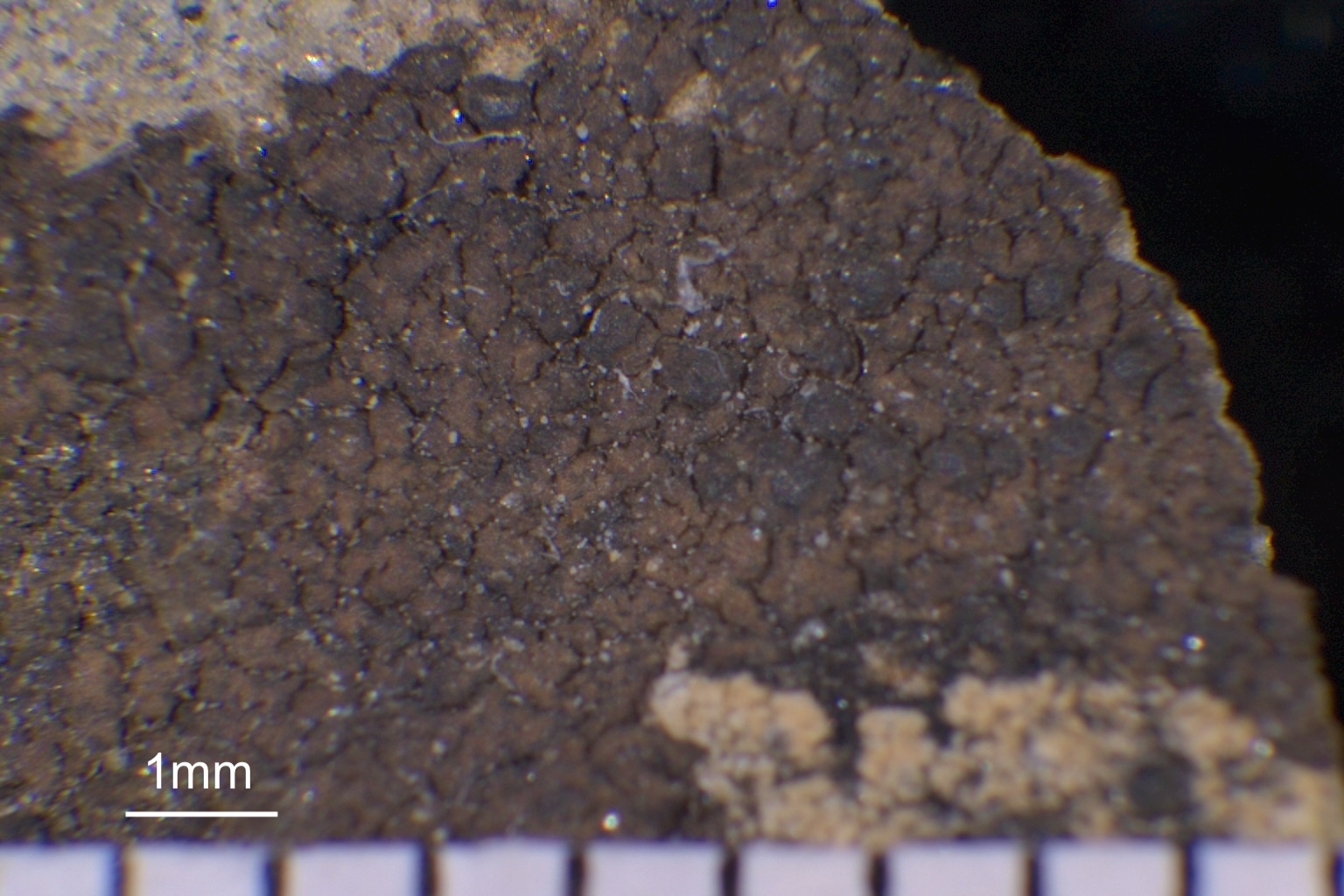
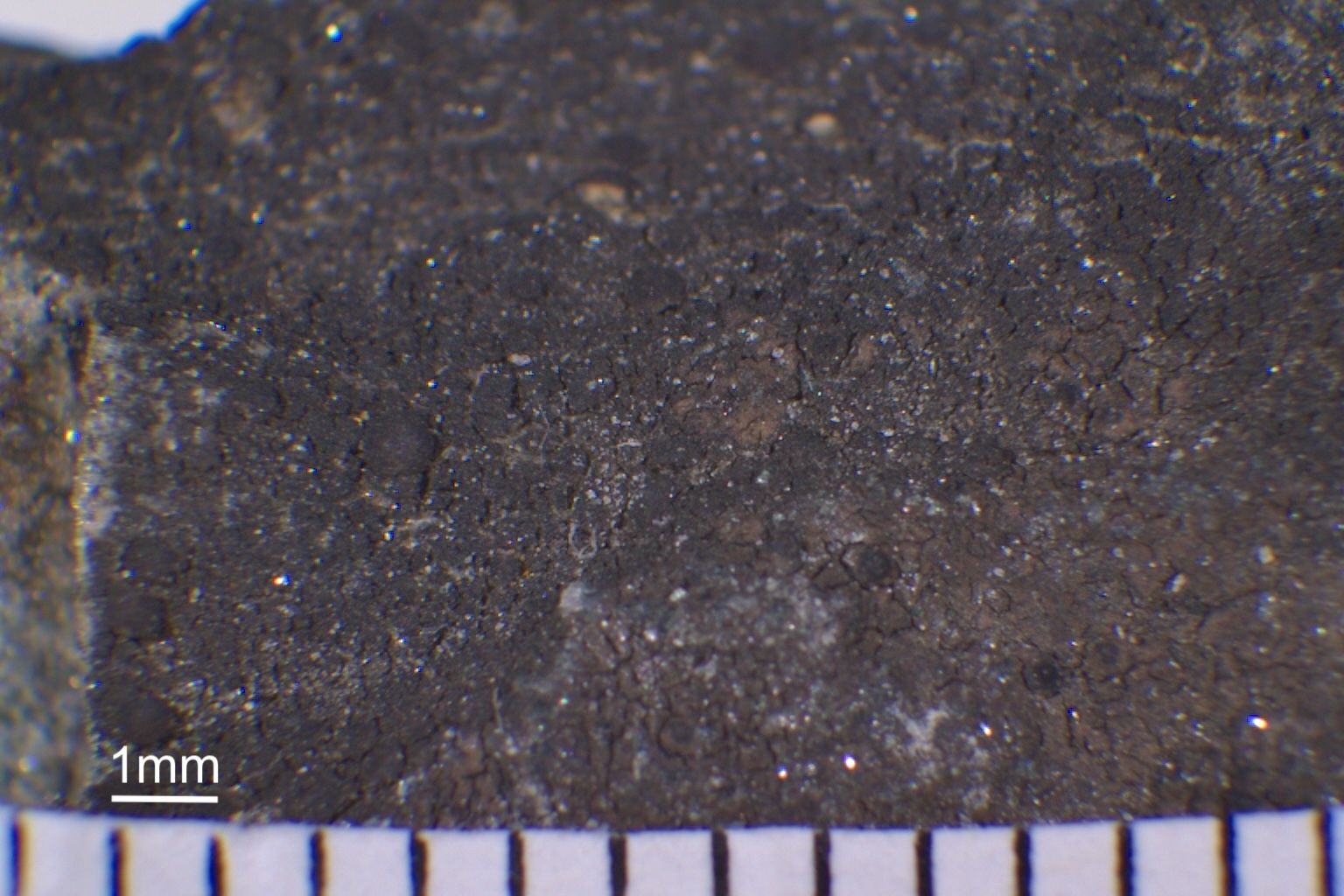
In Scotland, Halecania rhypodiza is restricted to calcareous (schistose) rock at high altitudes. In the Austrian Alps, it was found on a mica-schist boulder in a valley.
Threats
Climate change poses a threat to Halecania rhypodiza, because its exposed habitat is at risk of becoming overgrown by vascular plants, which would outcompete this slow-growing species.
Conservation Actions
Limit Climate Change
Research needed
Given the very limited amount of recordings, data acquisition should be the first priority when conducting further research on Halecania rhypodiza. Known sites in central Scotland could be revisited to see if the species is still extant there, as well as other and plausible sites where it is not known yet. Some calcareous rock outcrops in the area are known to harbour Halecania alpivaga, which has similar habitat requirements – it would be plausible that H. rhypodiza occurs there too. The most pressing question is about the species’ distribution in the Alps. Since it was thought to be endemic to Scotland until recently, the newer occurrences in Austria raise the question of how widespread it is in Central Europe, which habitats it occurs in and what the state of possible subpopulations is.
Use and Trade
Bibliography
Country occurrence
Regional Population and Trends
| Country | Trend | Redlisted |
|---|