- Proposed
- 2Under Assessment
- 3Preliminary Assessed
- 4Assessed
- 5Published
Arthonia cohabitans Coppins
- Scientific name
- Arthonia cohabitans
- Author
- Coppins
- Common names
- IUCN Specialist Group
 Lichens
- Kingdom
- Fungi
- Phylum
- Ascomycota
- Class
- Arthoniomycetes
- Order
- Arthoniales
- Family
- Arthoniaceae
- Assessment status
- Proposed
- Proposed by
- Beppo Fischer
- Comments etc.
- Beppo Fischer
Assessment Notes
Taxonomic notes
Why suggested for a Global Red List Assessment?
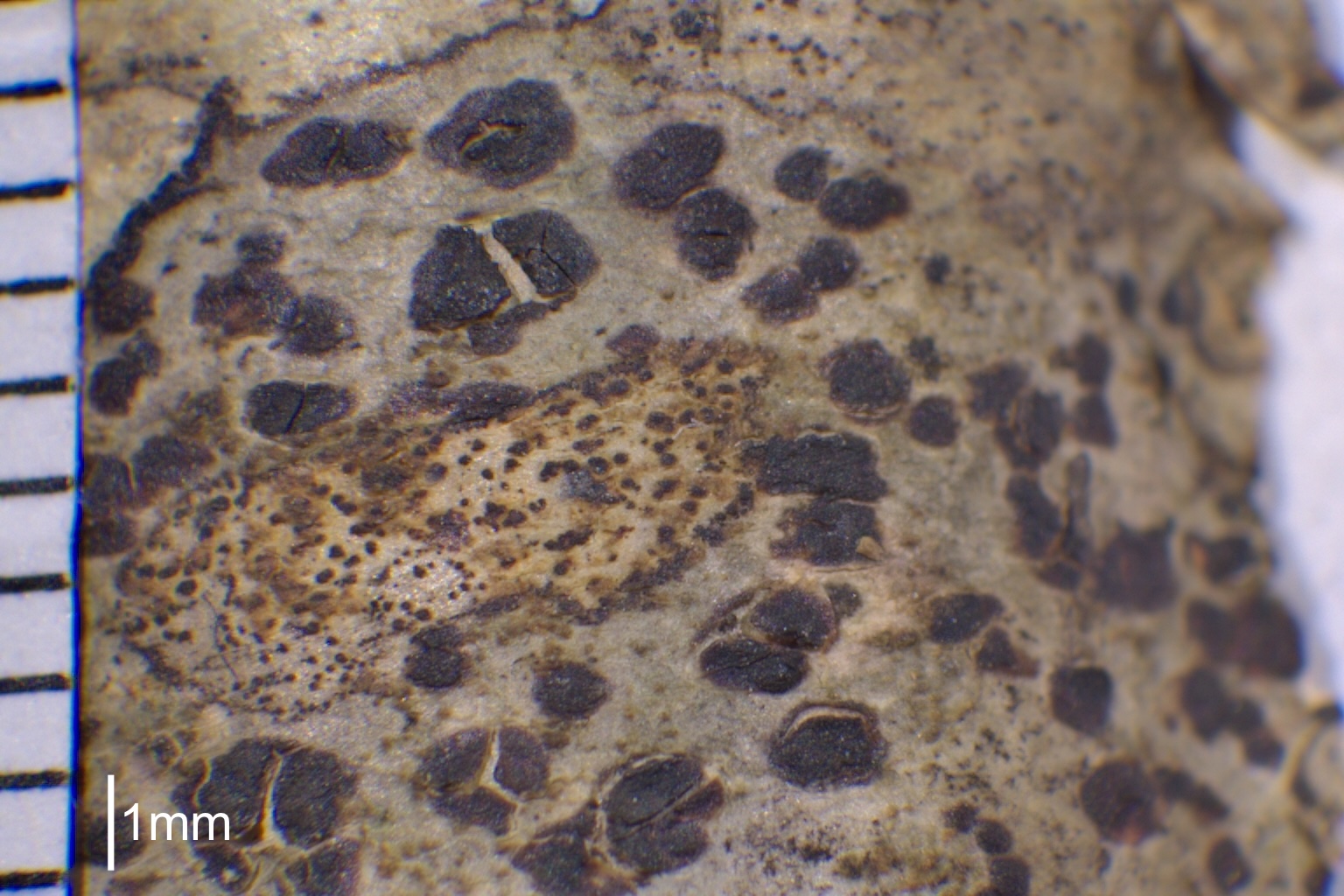
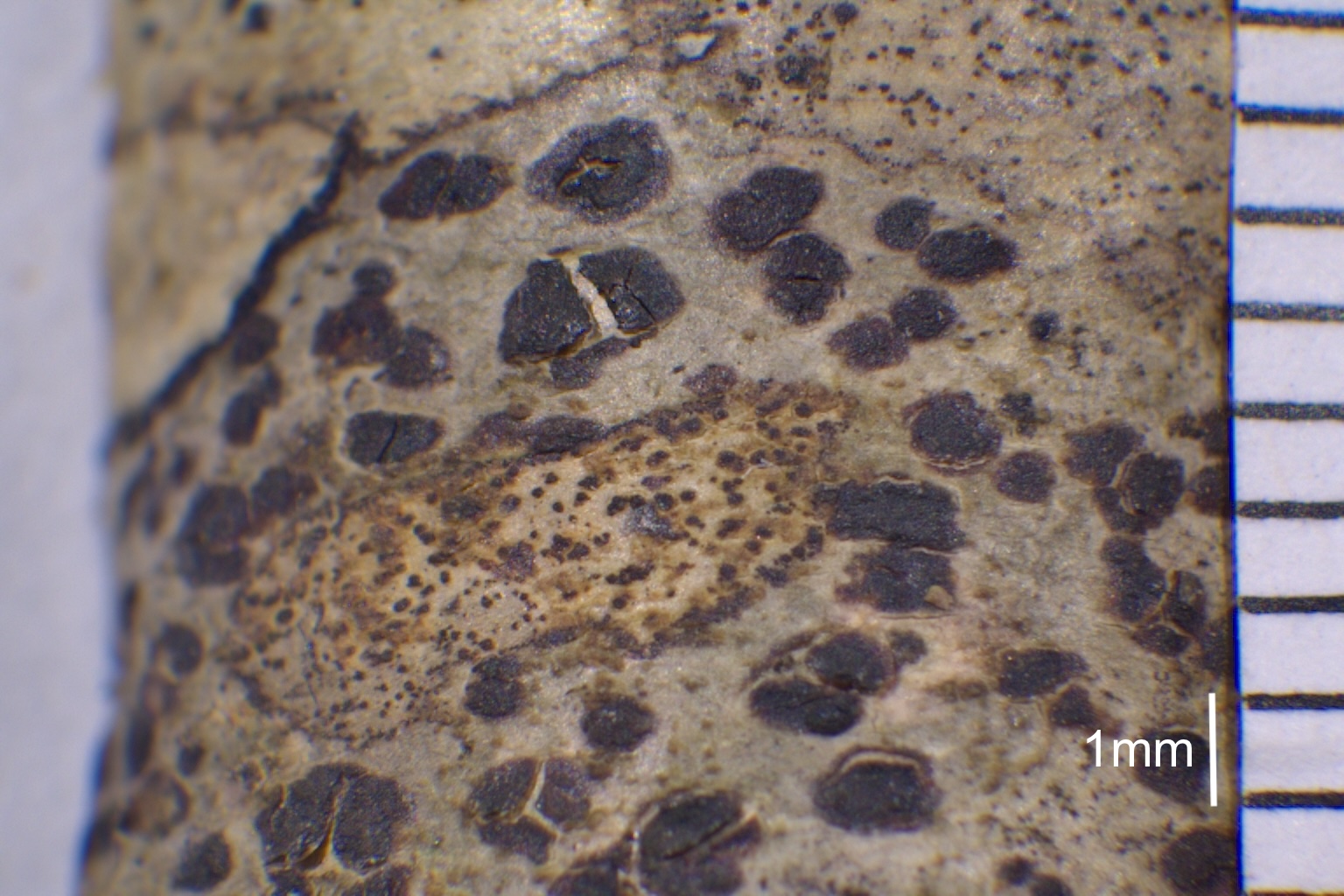
Arthonia cohabitans is a very inconspicuous lichenicolous fungus living on thalli of the crustose lichen Arthothelium macounii. It can easily be overlooked if not searched for specifically. There are fewer than ten records of this species in total, all being from three sites in western Scotland and in Atlantic hazelwoods, which are at risk because of several threats. The host is mainly found in the temperate rainforests in Scotland and on the northern Pacific coast of the USA and Canada. Although the true range and population size of A. cohabitans is likely larger than known today, the known subpopulations are very small (fewer than 50 functional individuals) and there is a continuing decline in habitat extent and quality. We propose this species to be classified as CR under criterion C2a(i).
Geographic range
Arthonia cohabitans has only been recorded at three sites in western Scotland, having a very small EOO (887 km2) and AOO (16 km2). However, because of its inconspicuous nature, it is very likely that other subpopulations exist and have not been found. Since this species lives on thalli of Arthothelium macounii, its range cannot exceed the range of its host and is almost certainly smaller than that. A. macounii itself is a specialist of temperate rainforests, with the bulk of its occurrences being in Atlantic hazelwoods in Scotland and rainforests in the seasonal and perhumid zone on the northern Pacific coast of the USA and Canada. One record is known from Norway and two from Papua New Guinea. The host has a known AOO of 148 km2, and we suspect that the true AOO is smaller than 2000km2, since its habitat is fragmented and degraded in the known range within Europe. Inferring the AOO of Arthonia cohabitans from its hosts’ distribution introduces a substantial degree of uncertainty, since it is not given that every record of the host has been checked for the presence of the A. cohabitans. There are no records of this species from the Americas, and we cannot make a certain statement whether that is because it is truly absent there or because it is not specifically searched for, and thus statements of suspected EOO would be very uncertain. There are significantly fewer records of it A. cohabitans than of its host, implying that it is more restricted. Considering the small AOO of the host and the very small AOO of A. cohabitans itself, together with the fact that seemingly not all available hosts are colonised, we infer that this species likely has an AOO of smaller than 100 km2, triggering the threshold for EN under criterion B2.
Population and Trends
Three subpopulations of Arthonia cohabitans are known, all being at a distance of fewer than 50 km from each other. All three subpopulations consist of only one or a few functional individuals (occupied hazels). As discussed above (Geographic range), we suspect that there unknown subpopulations due to the inconspicuous nature of this species. Whether it occurs on hosts on the Pacific coast of the USA and Canada is not known, but the host in this area appears relatively uncommon as well. A true population size of fewer than 250 individuals is likely, and of fewer than 2,500 individuals very likely. Data on poulation trends are not available and Criterion A can not be applied. The habitat in which this species occurs, Scottish Atlantic hazelwoods, is undergoing continuing degradation and decline due to over- and undergrazing, invasive species and climate change. We infer a continuing decline for the population of A. cohabitans from this information. Together with the number of functional individuals in each subpopulation being well under 50, and applying the precautionary principle for the suspected population size, this species meets all thresholds and requirements for CR under Criterion C2a(i) and EN under Criterion D.
Population Trend: Decreasing
Habitat and Ecology
Arthonia cohabitans is a lichenicolous fungus living as a commensal or weak parasite on its host, Arthothelium macounii, which is associated exclusively with old-growth temperate rainforests (B. J. Coppins, 1989). All known occurrences of A. cohabitans are from Atlantic hazelwoods in Scotland. The habitat is characterised by hyperoceanic climate, experiencing high rainfall and mild temperatures throughout the year. Some hazel stands are estimated to be up to 10,000 years old, having established themselves after the last ice age and probably having persisted since then (Birks, 1989). If mostly undisturbed and unmanaged, hazel can from pure stands with a closed canopy (A. M. Coppins & Coppins, 2003). Hazel will continuously form young shoots for rejuvenation, even if uncoppiced. The host, A. macounii, is restricted to growing on the bark of these hazel regeneration shoots in old-growth, unmanaged stands. Once abundant, the Scottish temperate rainforests, including the hazel stands, are now fragmented, the existing only in small patches with a median size of 0.25 km2 and a mean size of 0.92 km2 (Alliance for Scotland’s Rainforest, 2019). The woodland patches are often not connected and are degrading due to over- and undergrazing (A. M. Coppins & Coppins, 2012), invasive species (Woodland Trust Scotland, 2021) and climate change (Ellis, 2015).
Threats
In the Atlantic hazelwoods, Arthonia cohabitans and its host are dependent on the continuous cover of old-growth stands and continuity and regular supply of young, smooth bark. Overgrazing is a major threat to the persistence of temperate rainforests, with 41% of it showing the impact of high or very high grazing pressure (Alliance for Scotland’s Rainforest, 2019). High or very high grazing pressure restricts or impairs the regeneration of these forests. Under these conditions, the hazels cannot rejuvinate, thus not forming young shoots and become tree-shaped. The bark becomes exposed and young bark supply, which is needed for the establishment of host, is low, and old stems collapse and die (A. M. Coppins & Coppins, 2012). Appropriate management of the remaining old-growth, intact woodlands is key for the survival of A. cohabitans. This involves restricting deer and cattle grazing. However, Interestingly, undergrazing also poses a threat to this species: When left completely undisturbed, understory woody species can invade the stands. The Welsh sites show signs of undergrazing.
Another threat to this species is excessive coppicing, which can have negative effects on these ancient woodland stands. Outside Scotland, coppicing is used to rejuvinate hazel and encourages it to from new shoots, but this practice was not used across traditional managed stands on the west coast. Hazel plants will continue to form new shoots throughout their lifetime, and allowing old stems to persist alongside young ones promotes short-distance colonization within stools. Coppicing therefore breaks the ecological continuity which promotes the epiphyte diversity in these stands. In addition, hazels are pioneer plants, which do not thrive under closed canopy cover. Coppicing an entire stand will limit competitiveness against other woody species in the stand and can lead to hazel becoming an understory shrub. This will risk it being shaded out and will limit its ability to reproduce, leading to a decline of hazel population. Since hazel is the primary habitat of A. cohabitans, management practices that harm its abundance and the quality of habitat it provides for crustose lichens pose a threat to A. cohabitans (A. M. Coppins & Coppins, 2003, 2012).
Rhododendron ponticum is invasive in Scottish rainforests. Threatening the integrity of the atlantic temperate rainforest ecosystems as a whole, this also poses a threat to the habitat of A. cohabitans, since it can colonise the woodland and outcompete native tree species (Alliance for Scotland’s Rainforest, 2019; Woodland Trust Scotland).
One of the known occurrences of this species is threatened by a beaver release site at a loch close to the host hazel trees. Other hazels closer to the loch have been felled by the beavers.
Climate change will likely have an impact on the persistence of A. cohabitans, especially when the high fragmentation of habitat is taken into account. The climatic suitability of ancient forest habitats in Scotland was estimated to decrease by 42% for ancient forest indicator species under projected climate change scenarios (Ellis, 2015). To persist, species highly specialised for this habitat and climate must partly shift their distribution. However, ancient woodland specialist species are thought to be limited in their ability to disperse or establish (Sillett et al., 2000), and thus to have trouble migrating to track changing climatic conditions. The dispersal problem is exacerbated by the fragmentation of Scotlands ancient woodlands, making range shifts more difficult with larger gaps of unsuitable habitat that dispersal kernels have to traverse.
Conservation Actions
Of the three sites where subpopulations of this species are known to occur, one is protected and managed for nature conservation. The other two subpopulations are not located in protected areas, and since this species is known from so few sites, we recommend implying safeguarding measures for the existing subpopulations. These should include protecting the host hazels from beaver felling or coppicing, and implementing management strategies which allow these stands to continue being a suitable habitat for Arthothelium macounii and Arthonia cohabitans (see below).
Since we suspect this species to occur at other sites apart from the known ones, protection of its potential habitat, the Atlantic hazelwoods, is also crucial for its survival. These woodlands have been declining and are degraded at many sites. It is known that even amongst protected parts of the Scottish Atlantic rainforest, around 50% are in undesirable condition (Alliance for Scotland’s Rainforest, 2019). Some of the treats mentioned above can be met with appropriate management. A restriction of deer and cattle grazing in hazelwood stands allows for young shoots, which are the habitat of Arthonia cohabitans, to persist. Care must be taken however to avoid undergrazing; grazing pressure has to be balanced to an adequate amount. In addition to that, coppicing in old growth stands should be avoided; instead, selective cropping is advised (A. M. Coppins & Coppins, 2003). This allows the stands and its epiphytes to persist and the lichen communities can develop in the shelter of a closed hazel canopy. Efforts should be made to control the invasive Rhododendron ponticum, not only to protect epiphyte flora, but the temperate atlantic rainforests as entire ecosystems. Where needed, beaver activity should be controlled to prevent felling of hazels carrying A. cohabitans.
Research needed
There is a need for more survey work regarding this species. Since it was described (Coppins, 1989), probably only a handful of experts have actively looked for it. Given its minute appearance, there is reason to believe that existing subpopulations in Scotland have not been found. Given the unknown status of this species in other parts of its hosts range, it would be very interesting to check herbarium specimens and occurrences of the host from the temperate rainforests on the pacific coast of the USA and Canada regarding the presence of A. cohabitans.
Use and Trade
Bibliography
Country occurrence
Regional Population and Trends
| Country | Trend | Redlisted |
|---|