- Proposed
- Under Assessment
- Preliminary Assessed
- Assessed
- NTPublished
Laccaria maritima (Theodor.) Singer ex Huhtinen
- Scientific name
- Laccaria maritima
- Author
- (Theodor.) Singer ex Huhtinen
- Common names
 Sand Deceiver
 Duinfopzwam
 Dünen-Lacktrichterling
 Dynelakssopp
 Dynlaxskivling
 Klit-Ametysthat
 Luiterupik
 Hietikkolohisieni
 Lakówka nadmorska
- IUCN Specialist Group
 Mushroom, Bracket and Puffball
- Kingdom
- Fungi
- Phylum
- Basidiomycota
- Class
- Agaricomycetes
- Order
- Agaricales
- Family
- Hydnangiaceae
- Assessment status
- Published
- Assessment date
- 2019-03-28
- IUCN Red List Category
- NT
- IUCN Red List Criteria
- A2c
- Assessors
- Wim Ozinga
- Reviewers
- Anders Dahlberg (Swedish Species Information Centre, Uppsala / IUCN SSC Cup-fungus, Truffle and Ally Specialist Group)
Assessment Notes
Justification
Laccaria maritima is a very rare ectomycorrhizal fungus that is associated with Salix and restricted to shifting dunes on nutrient-poor sandy soils. It is largely confined to lowland parts of Europe, with a few records from North America. In most countries it is very rare resulting in a severely fragmented distribution pattern. The number of known sites in Europe is less than 100. Although the species is probably overlooked in some areas, the global population size is probably relatively small.For countries where national Red List documentation is available, the species is assumed to have declined and to be continuing to decline (Germany, the Netherlands, Norway and UK), while the trend is unknown in other countries. Based on the available information from national fungal Red Lists and the European Red List of Habitats, it can be suspected that the global population has declined by nearly 30% during the past 50 years (three generations). The future trend is uncertain. It is therefore assessed as Near Threatened.
Geographic range
This species is largely restricted to the coastal lowland areas of Europe, it is absent from the south-western parts. There are some records from Siberia (Russia) and North America (Greenland and eastern Canada). GBIF have 118 georeferenced records (https://www.gbif.org/species/2530913; accessed March 4th 2019).Population and Trends
Laccaria maritima is a very rare ectomycorrhizal fungus. Fraiture and Otto (2015) reported about 50 known sites in Europe and GBIF report 118 records (March 2019). In most countries it is very rare (<10 sites), resulting in a severely fragmented distribution pattern. Although the species is probably overlooked in some areas, the global population size will still be relatively small. Laccaria maritima is confined to dune landscapes with habitat mosaics, therefore we suspect changes in habitat will affect the population size of the species. Landscapes with such dynamic habitat mosaics have declined over the past 50 years in several countries in area and quality (e.g. Janssen et al. 2016, Houston 2016). The habitat of Atlantic and Baltic moist and wet dune slack and the Atlantic and Baltic coastal dune grassland (grey dunes) are both assessed as Vulnerable (VU) in the European Red List of Habitats (Jansen et al. 2016). The extent of habitat has been reduced by over 30% over the past 50 years and more than 50% since 1750. The latter habitat has a restricted geographic distribution and is in continuing decline. Causes for habitat decline include recreational activities, dams and water management and pollution such as nitrogen deposition (Ozinga et al. 2013, Janssen et al. 2016).
For countries where national Red List documentation is available, the species is assumed to have and to be declining (Germany, the Netherlands, Norway and UK), while the trend is unknown in other countries. Based on the available information from national fungal Red Lists and the European Red List of Habitats, it can be suspected that the global population has declined by nearly 30% during the past 50 years. The future trend is uncertain.
Population Trend: Decreasing
Habitat and Ecology
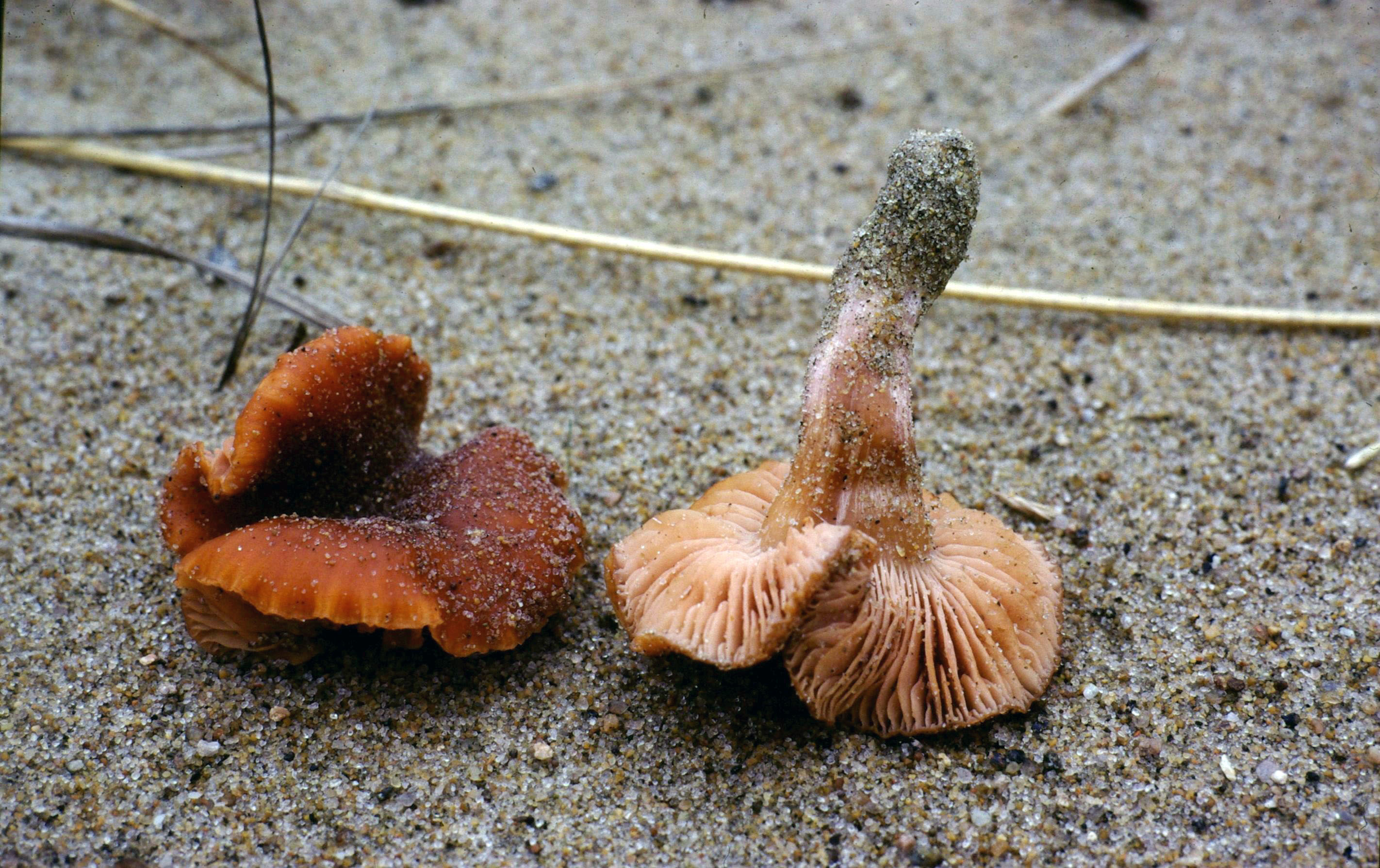
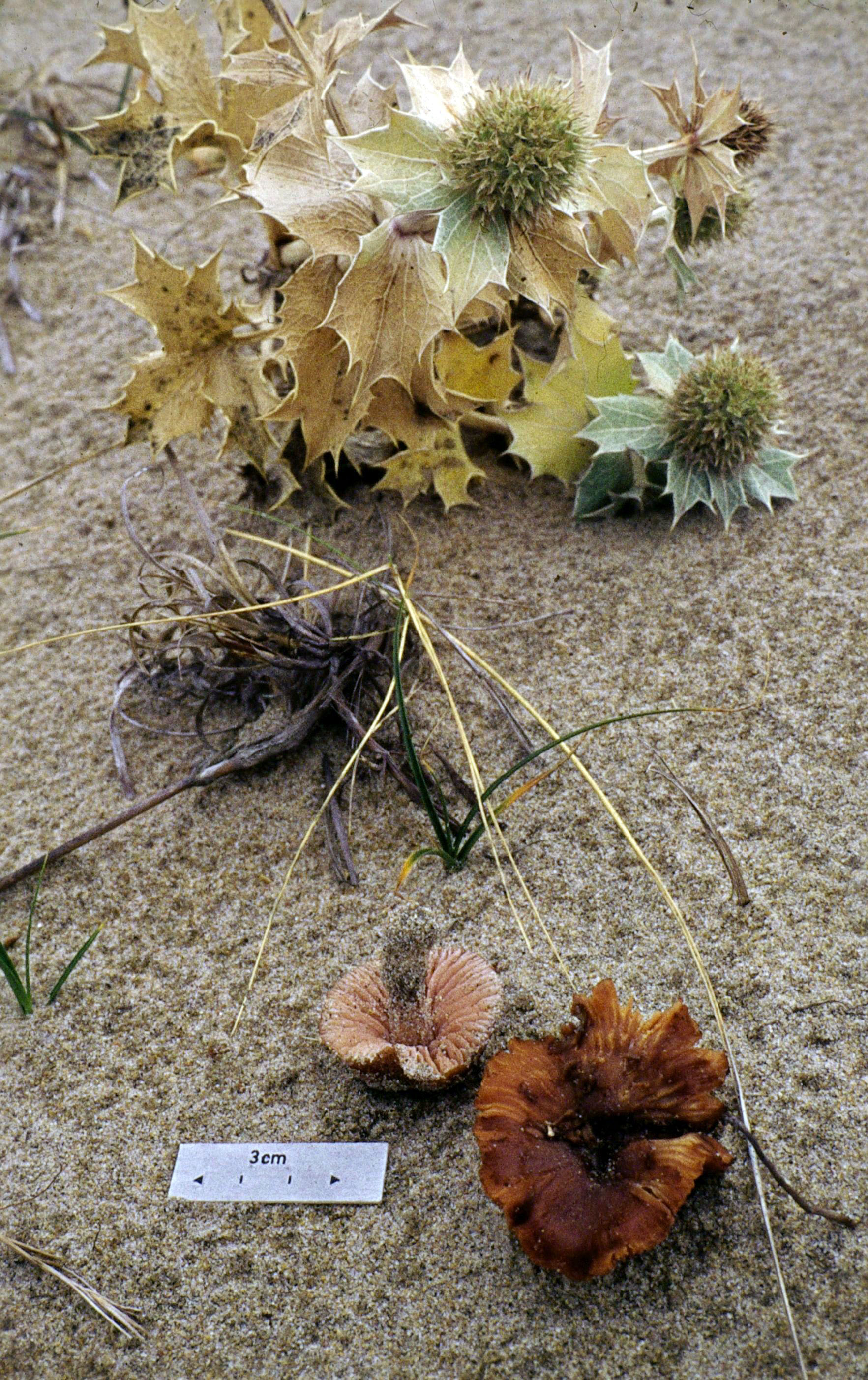
The Sand Deceiver (Laccaria maritima) is restricted specifically to landscapes with shifting (mobile) dunes on nutrient-poor sandy soils with no litter accumulation and a sparse vegetation with pioneer plants like Ammophila arenaria. The species forms ectomycorrhiza with Salix repens and Salix daphnoides, and possibly also with other species such as Pinus but this needs confirmation. It mainly occurs in sand dune landscapes along the shores of seas and large rivers and less often in inland dunes (Andersson 1950, Vellinga 1982, Huhtinen 1987, Elborne 1989, Watling 2005, Fraiture and Otto 2015). The soil can be dry (dry ‘white dunes’) to more or less wet (dune slacks). The stem of the fruitbodies is usually deeply buried in the sand and subsequently the cap height above the soil surface is very low (e.g. Høiland 2010). Although the species does not occur in very dry, highly dynamic dunes without vegetation, it is dependent on shifting sand generated in such habitats and it is therefore probably dependent on landscapes with shifting habitat mosaics. Landscapes with such dynamic habitat mosaics have become relatively rare (e.g. Janssen et al. 2016).Among the Natura 2000 habitat types (as used in EU’s Habitat Directive) it occurs mainly in the habitat types 2020 ‘Shifting dunes along the shoreline with Ammophila arenaria (white dunes)’ and 2170 ‘Dunes with Salix repens ssp. argentea (Salicion arenariea)’. In addition there are records in 2130 ‘Fixed coastal dunes with herbaceous vegetation (grey dunes)’, the latter often in the vicinity of more dynamic dunes.
Threats
The specific habitat of the species, shifting sand dunes with Salix repens or S. daphnoides, has experienced declines in extent and quality. Common threats include recreational activities, dams and water management and pollution such as nitrogen deposition (Ozinga et al. 2013, Janssen et al. 2016).A large part of the remaining dune systems across northwest Europe has become increasingly stable in the past 50 years and therefore the area of suitable habitat has declined. This is largely the result of practices to stop sand drift (stabilisation of shifting dunes), the plantation of forests, invasive alien species (e.g. Rosa rugosa, Cotoneaster spp., Campylopus introflexus, Berberis aquifolium, Pinus spec.) and vegetation succession (i.e. the overgrowth of grasses and scrubs). The latter is accelerated by eutrophication from atmospheric nitrogen deposition (Houston 2016).
In the European Red list of habitats (Janssen et al. 2016) all relevant habitat types were assessed as Near Threatened or Vulnerable, i.e. Atlantic and Baltic white dunes (B1.3a, NT), Atlantic and Baltic grey dunes (B1.4a, VU) and Atlantic and Baltic wet dune slacks (B1.8a,VU).