- Proposed
- Under Assessment
- Preliminary Assessed
- Assessed
- VUPublished
Amanita ristichii Tulloss
- Scientific name
- Amanita ristichii
- Author
- Tulloss
- Common names
 Amanite de Ristich
 Ristich's Caesar
- Ristich’s Little Caesars
- IUCN Specialist Group
 Mushroom, Bracket and Puffball
- Kingdom
- Fungi
- Phylum
- Basidiomycota
- Class
- Agaricomycetes
- Order
- Agaricales
- Family
- Amanitaceae
- Assessment status
- Published
- Assessment date
- 2016-04-27
- IUCN Red List Category
- VU
- IUCN Red List Criteria
- C2a(i)
- Assessors
- Annabelle Langlois (1006 chemin White, Hemmingford, QC J0L 1H0, CANADA / Global Fungus Assessment)
- Reviewers
- Anders Dahlberg (Swedish Species Information Centre, Uppsala / IUCN SSC Cup-fungus, Truffle and Ally Specialist Group)
Assessment Notes
Justification
Amanita ristichii is endemic to northeast North America. It has only been reported from eleven sites in northeastern North America, despite extensive surveys over numerous years by American forays and Canadian mycological groups since its description (Tulloss 1989). It is unlikely that the species has commonly been overlooked because it is easy to identify in the field due to its characteristic pinkish-cream gills and relatively small size. Most of the sites where the species has been reported are located in fragmented forest patches within suburban areas. These fragmented forest patches are impacted by urban development. The total number of sites of the species is probably probably 5-10 times more than the 11 sites where the species is known to grow. The estimated total number of sites is estimated not to exceed 100, the number of genetic distinct individuals is estimated at 200 and the number of mature individuals not to exceed 2,000. Hence, A. ristichii is assessed as Vulnerable (VU) under criterion C2a(i).Taxonomic notes
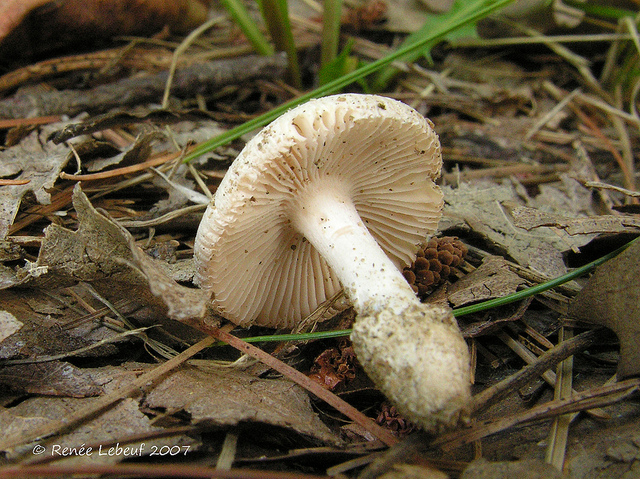
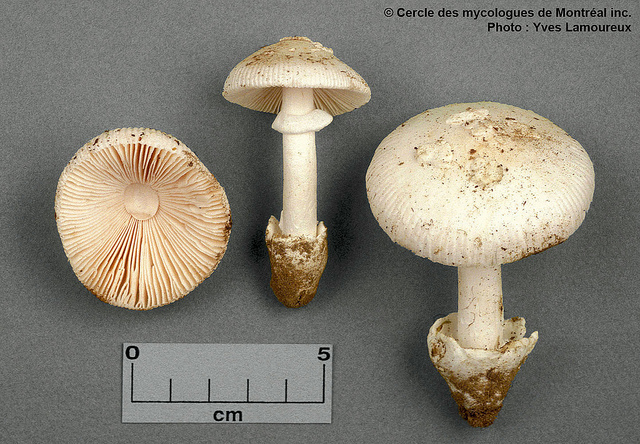
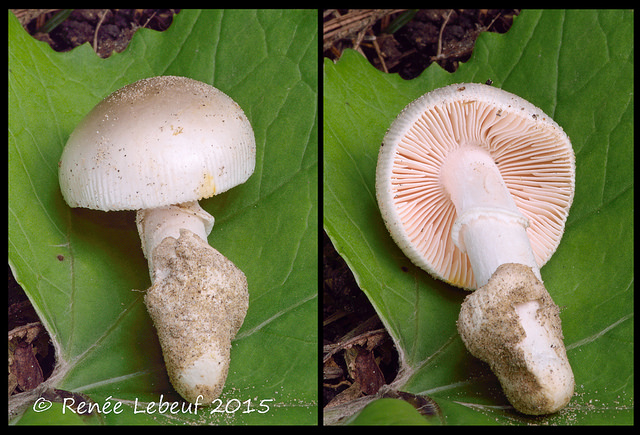
Amanita ristichii Tulloss (1989) is one of the small members of the North American group within section Vaginatae that have plentiful two-spored basidia, although, within that group, it is isolated by its unpigmented cap, sometimes pinkish gills, short marginal striations on the cap, and the more robust volva at the stipe base (Tulloss 2009).
Geographic range
Amanita ristichii is endemic to northeast North America. It has been found in southeastern Canada (Quebec: Laurentides, Monteregie, Outaouais and Capitale-Nationale regions; Labbé 2014 and R. Lebeuf (pers. comm.)) and in northeastern United States (Maine: Androscoggin Co., Cumberland Co., Oxford Co.; New Hampshire: Carroll Co., Hillsborough Co.; Tulloss 1989, 2009).Population and Trends
Amanita ristichii has been reported from 11 sites in northeast North America. Even though the species was described from southern Maine and New Hampshire, it is possibly more common further north in Canada (Tulloss 1989, 2009). Six out of 11 sites where the species has been found are located in Quebec province along the St. Lawrence River and we consider them part of the same subpopulation. Since the St. Lawrence River coincides with the highest human population density and growth in the province, urban development is impacting potential/actual habitat for A. ristichii. Despite extensive surveys over numerous years during northeastern American forays, A. ristichii has not been found in New Hampshire or Maine since respectively 1959 and 1988. The species might have been extirpated from these states.
USA: Three sites in Maine (1984//1984,1988 twice//1985), two sites in New Hampshire (1906//1959). See Tulloss (2009). Canada: Six sites in Quebec province along the St. Lawrence River (Laurentides, Monteregie, Outaouais and Capitale-Nationale regions; 1993//??//2003//2007//2015//2015). See Labbé (2014). Also Y. Lamoureux and R. Lebeuf pers. comms.
Given that A. ristichii is fairly easy to identify (its small size and pinkish-cream gills are characteristic in most specimens), grows often in suburban areas and is part of a popular group (Amanita), we believe this species is rarely overlooked and is usually correctly identified when found. However, it has to be noted that A. ristichii is relatively small and could be mistaken for other white Amanitas.
The total number of A. ristichii sites is estimated to be 5-10 times higher than the number of currently known sites, i.e. 50-100. Each site is thought to represent two genetically individual (functional) individuals, and each functional individual is expected to represent 10 mature individuals (Dahlberg and Mueller 2011). The total number of A. ristichii mature idividuals is estimated not to exceed 2,000 (cf. Dahlberg and Mueller 2011).
Population Trend: Decreasing
Habitat and Ecology
Amanita ristichii is a mycorrhizal fungus species associating with several broad-leaved and conifer tree species. It grows solitary to subgregarious in sandy soil and its sporocarps can be found from mid-July to September. In Quebec, this species is reported to be growing under Betula and Populus tremuloides (mycoquebec.org). In Maine, it was found under Tsuga canadensis and Acer rubrum in the floodplain of a river. It was also found under T. canadensis and Pinus strobus as dominant trees in mixed woods (Tulloss 1989). In New Hampshire, A. ristichii has been found under Pinus sp. (Tulloss 1989).Threats
In Quebec province (Canada), where most of Amanita ristichii sites are located, A. ristichii often grows in forests fragments within residential areas along the St. Lawrence River. Thus, many sites have been and are at risk of being negatively impacted by urban development. In Maine and New Hampshire, A. ristichii sites are located within floodplains. In these locations, A. ristichii could be periodically threatened by negative impact of intense flooding on its dependent mycorrhizal host plants.Conservation Actions
There are no current conservation actions for Amanita ristichii. The species distribution needs additional studies before a conservation plan can be created. Protection of Quebec suburban and urban forests is recommended as a precaution. Amanita ristichii has some fairly characteristic features, thus amateur mycologists could be of great help in data collection after learning where to find and how to identify A. ristichii.Amanita ristichii has been found in mixed forests containing Betula sp., Populus tremuloides, Pinus sp. and Tsuga canadensis. Ectomycorrhizal associations require additional study.
Amanita ristichii is an easily identified species due to its pinkish-cream gills and small size. In northeastern North America, where A. ristichii is found, there are numerous groups of amateur mycologists. These people can be recruited and instructed where to find and how to identify A. ristichii so they can target this species during forays. Data from amateur mycologists can be critical to define A. ristichii population size, distribution and trends, as well as its ectomycorrhizal associations.