- Proposed
- Under Assessment
- DDPreliminary Assessed
- 4Assessed
- 5Published
Skyathea hederae Spooner & Dennis
- Scientific name
- Skyathea hederae
- Author
- Spooner & Dennis
- Common names
- IUCN Specialist Group
 Cup-fungi, Truffles and Allies
- Kingdom
- Fungi
- Phylum
- Ascomycota
- Class
- Leotiomycetes
- Order
- Helotiales
- Family
- Helotiaceae
- Assessment status
- Preliminary Assessed
- Preliminary Category
- DD
- Proposed by
- Jeff Stallman
- Assessors
- Jeff Stallman
- Comments etc.
- Anders Dahlberg
Assessment Notes
Justification
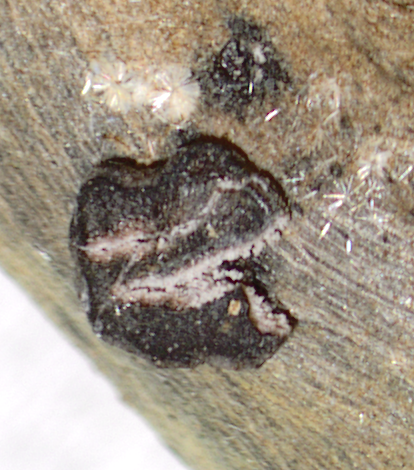
Skyathea hederae has only been found twice, in a single locality, on the branches of dead Hederae helix (common ivy) in Scotland in 1984 and 1985. It is the only known species in the genus Skyathea. Skyathea hederae occurs on a plant with a near-global distribution, the fungus is cryptic, and targeted searches to find this fungus have not been documented. Therefore, the population size, trend, and geographic distribution of S. hederae are poorly known. It could either be a least concern or threatened species with the current data available, so it is assessed as data deficient.
Taxonomic notes
The species is the only member of the genus Skyathea. The genus has been proposed to belong to Gelatinodiscaceae based on morphology (Jaklitsch et al. 2016), and more recently, phylogeny (Stallman et al. 2026).
Why suggested for a Global Red List Assessment?
The species has only been found twice, in a single locality, in Scotland. It has not been seen since 1985 and is monotypic.
Geographic range
The species has only been collected in one location from Aird on the Isle of Skye, Scotland, United Kingdom (Dennis 1986).
Population and Trends
The population and current trends of S. hederae are unknown. The species has only been confidently collected twice, from a single location, over 40 years ago.
Skyathea hederae may be a rare species, but it is unclear. Despite extensive collecting in the UK, it has not been rediscovered. Its only known substrate, Hedera helix, is common in the UK and many other countries. The fungus is small and cryptic and no known specific searches for this species have occurred, so its population size, trend, and the full extent of its range are unknown.
No nrITS sequences in the global metabarcoding datasets UNITE (Abarenkov et al. 2024) and GlobalFungi (Větrovský et al. 2020) share high pairwise similarity with sequences from the two known collections (PQ483788, PQ483789) as of April 13th 2026.
Population Trend: Uncertain
Habitat and Ecology
The ecology of S. hederae is unknown, although it is presumably saprotrophic, and potentially endophytic, as with other genera in Gelatinodiscaceae (Jaklitsch et al. 2016). The species was found near sea level on dead branches of Hedera helix (common ivy) in May. It was likely collected near a roadside adjacent to pastureland in a small village, but precise details are not recorded and no additional information is available on its habitat or ecology.
Threats
Not enough is known about the S. hederae to know if there are any potential threats.
Conservation Actions
Not enough is known about S. hederae to determine if any conservation actions would help it, or if these are even needed.
Research needed
The host of S. hederae, Hedera helix, is a widespread species in its native Europe and western Asia and has naturalized in many localities throughout the world (e.g., North America, Australia). Performing targeted searches for S. hederae on H. helix throughout its range would help determine its distribution and rarity, and would be a first step to learning more about this species.
Use and Trade
n/a