- Proposed
- Under Assessment
- Preliminary Assessed
- NTAssessed
- 5Published
Cortinarius caesionigrellus Lamoure
- Scientific name
- Cortinarius caesionigrellus
- Author
- Lamoure
- Common names
- IUCN Specialist Group
 Mushroom, Bracket and Puffball
- Kingdom
- Fungi
- Phylum
- Basidiomycota
- Class
- Agaricomycetes
- Order
- Agaricales
- Family
- Cortinariaceae
- Assessment status
- Assessed
- Preliminary Category
- NT A3c+4c
- Proposed by
- Tor Erik Brandrud
- Assessors
- Tor Erik Brandrud, Irmgard Krisai-Greilhuber, Artemis Treindl
- Editors
- Anders Dahlberg
- Reviewers
- Anders Dahlberg
Assessment Notes
Justification
Cortinarius caesionigrellus is an ectomycorrhizal fungal species associated with Salix herbacea in snowbed (-meadow) habitats. It is so far documented only from a few sites in the Alps and S Norwegian mountains. These habitats have been undergoing climate-driven decline in extent and quality through reduced snow cover, drying, and vegetation shifts during the last decades. Further deterioration is predicted with continued biodiversity loss and decline of specialized alpine mycorrhizal fungal communities under ongoing and future climatic conditions. Based on these observed and projected habitat trends and the species’ ecological specialization, an ongoing and future global population reduction of at least 15% over a 50-year assessment period is conservatively inferred. The species is therefore assessed as Near Threatened (NT) under Criteria A3c+4c.
Taxonomic notes
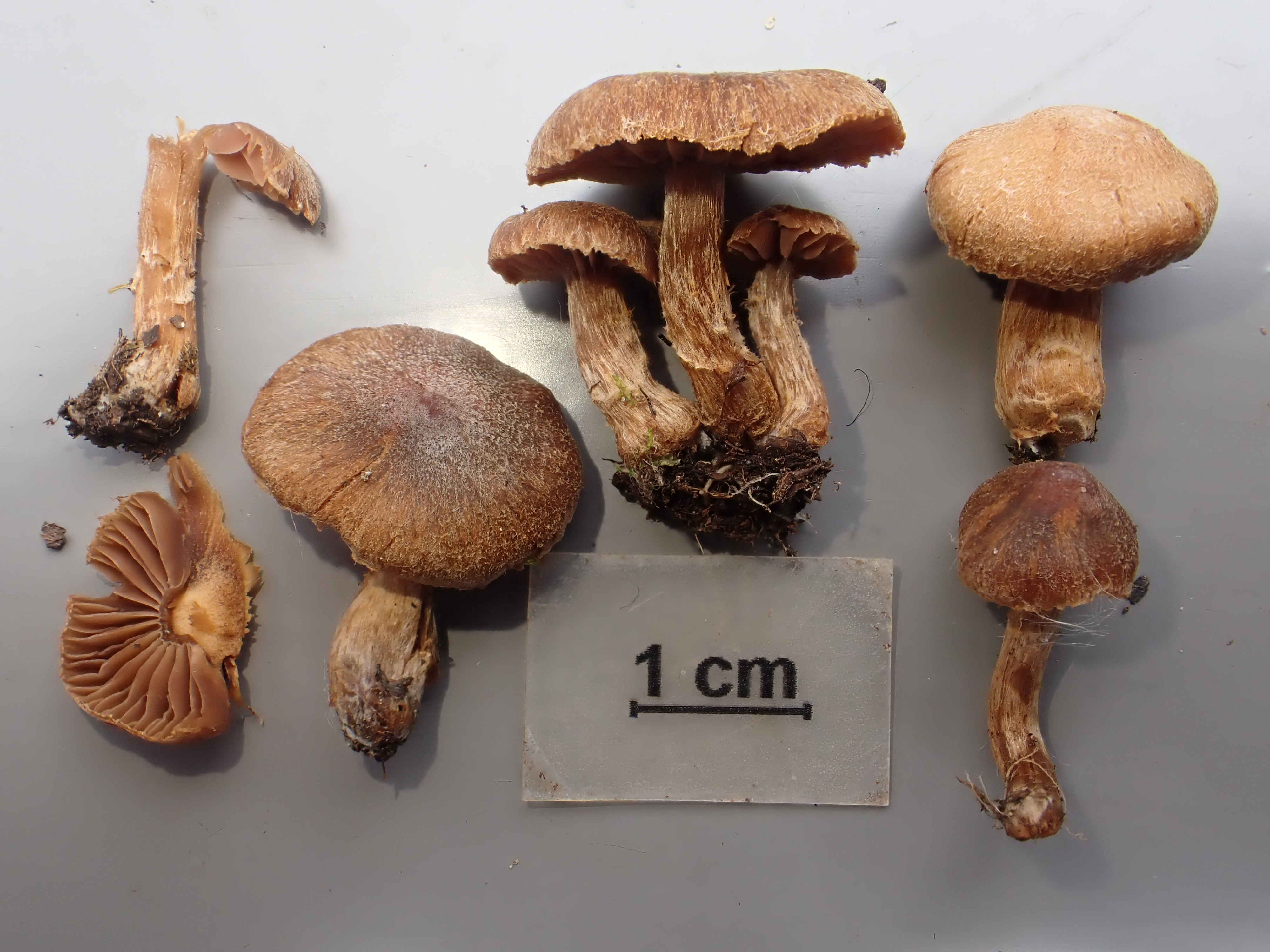
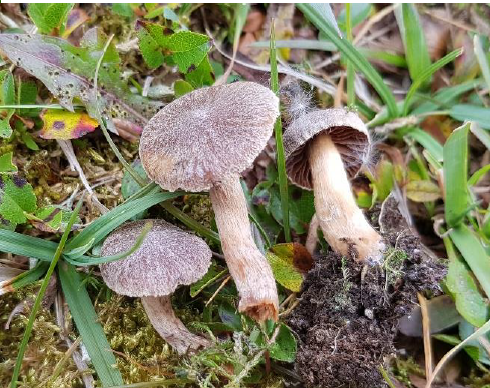
Cortinarius caesionigrellus belongs to sect. Flexipedes, and might resemble some other alpine species in this group such as C. comatus, and DNA-sequence might be needed for a certain identification (unless very young and fresh material with bluish lamellae). The type from France was sequenced and thus the name-use fixed by Bellanger et al. (2023).
Why suggested for a Global Red List Assessment?
Cortinarius caesionigrellus is an alpine species found in dwarf-Salix snow-beds that are now regarded as threatened due to climatic change.
Geographic range
The species, as circumscribed by Bellanger et al. (2023) who sequenced the type, is so far recorded and verified only from the type locality (Vanoise, French Alps), as well as a recent sequenced material from N Italy (Bellanger et al. 2024) and one site from Jotunheimen, Norway. The species also probably occur in Switzerland, based on sequence-match in an e-DNA spore trap study. There is no evidence that the species occur in arctic areas (based e.g. on the lack of finds from the rather well-investigated Svalbard).
Population and Trends
The species is sequence-verified just from three localities, one in France, Italy and Norway, respectively. In Norway the number of true/total localities is estimated to 600 (with high uncertainty), corresponding to approx 6000 individuals (assuming a standard of 10 individuals/well-delineated genets per site). An estimate for N Europe mountains would then be approx 10 000 individuals, and a similar estimate for C. Europe, summing up to a total of approx 20 000 individuals in Europe/globally.
The species seems connected to alpine calcareous snowbeds (and heaths), habitats that are declining and regarded as threatened due to recent years and ongoing climate change driven vegetation changes (cfr. Matteodo et al. 2016; Arraiano-Castilho et al. 2024). This affects especially the calcareous vegetation types, which hardly can move upwards (to adjust to warmer climate) due to lack of suitable sites in higher alpine zones. Consequently, we consider C. caesionigrellus to be in decline and conservatively estimate it to be declining >15% in the next 50 years, due majorly to climate change, but also loss of habitat due to tourism, including expansion of summerhouse areas, new roads, etc.
Population Trend: Decreasing
Habitat and Ecology
Cortinarius caesionigrellus is an ectomycorrhizal fungal species associated with Salix herbacea in calceareous snowbeds-meadows . All available sequence-verified samples (one from France, one from N Italy and three from same locality in Norway), are from such habitats.
Threats
Cortinarius caesionigrellus is threatened by climate-driven habitat loss and vegetation change in alpine habitats. Snowbeds, where the species and its major host (Salix herbacea) occur, are particularly sensitive to reduced snow cover, drying, and longer growing seasons, with pronounced vegetation change already documented (Sandvik & Odland 2014; Matteodo et al. 2016; Björk & Molau 2007). Increasing dominance of shrubs and graminoids reduce suitable habitat for low-growing Salix hosts, while predictive studies indicate that specialized alpine mycorrhizal fungal communities are expected to further decline under future climatic conditions (Niittynen et al. 2018; Arraiano-Castilho et al. 2024). Alpine zones are naturally restricted habitats, as populations have limited capacity to track suitable conditions and move upwards. Furthermore, although of minor importance but of local significance may be physical disturbance of alpine habitats through construction, e.g. for tourism negatively affect local populations.
Conservation Actions
Conservation should focus on maintaining the extent, quality, and ecological integrity of known and potential arctic and alpine habitats and preventing avoidable local degradation from infrastructure development, intensive recreation, and other physical disturbance. Although the broader impacts of climate change cannot be addressed through species-specific conservation measures, protecting intact and well-connected alpine habitats may increase the resilience of Cortinarius caesionigrellus and its host-plant communities to ongoing environmental change.
Research needed
The taxonomy of C. caesionigrellus and related species has only recently been revised, and only a few, sequence-verified records are available (formerly, the species may have been treated collectively, and older records should be regarded as unreliable). Targeted surveys in suitable habitats and molecular identification of specimens are therefore needed to clarify the species’ distribution, and improve baseline data on population status and trends. Without such data, declines may remain undetected and the severity of current threats difficult to assess.
Use and Trade
There is no use and trade known.