- Proposed
- Under Assessment
- Preliminary Assessed
- VUAssessed
- 5Published
Hygrocybe calciphila Arnolds
- Scientific name
- Hygrocybe calciphila
- Author
- Arnolds
- Common names
 Limestone Waxcap
 Kalkliebender Filz-Saftling
- IUCN Specialist Group
 Mushroom, Bracket and Puffball
- Kingdom
- Fungi
- Phylum
- Basidiomycota
- Class
- Agaricomycetes
- Order
- Agaricales
- Family
- Hygrophoraceae
- Assessment status
- Assessed
- Preliminary Category
- VU A2c
- Proposed by
- Armin Mešić
- Assessors
- Armin Mešić, Matt Wainhouse, Irmgard Krisai-Greilhuber, Inita Daniele, Petr Zehnálek
- Comments etc.
- Anders Dahlberg, John Bjarne Jordal, Simon Harding, Monika Kolényová
Assessment Notes
Hygrocybe calciphila is a distinctive orange-yellow agaric of calcareous soils. It is widely distributed in European lowland and subalpine areas in semi-natural calcareous grasslands and grey dune.
Its distribution in Europe extends from northern Norway, to southern Spain in the south and extending from Ireland in the west to Estonia in the east. The estimated EOO is 5,000,000 km2 (GBIF, 2026). Significant populations are found in Switzerland and Austria and in southwest Great Britain and coastal Scandinavia. There are an estimated 589 localities (tetrads) from c.1,200 occurrences with an estimated AOO of 2,356 km2. Given that the species is restricted to undisturbed grasslands and waxcaps, as a group, are generally well recorded, the number of unknown locations may be reasonably low. Up to twice as many unknown localities would be a reasonable assumption, which would give an estimated AOO of 4,712 km2 and comfortably< 10,000km2.
Criteria A
Hygrocybe calciphila is typically an indicator of old, extensively managed semi-natural calcareous grasslands. The loss of semi-natural grasslands across Western Europe has been estimated to be >90% in since the 1950’s (Griffith et al, 2013). According to the Food and Agriculture Organization of the United Nations (FAO 2006), the area of grasslands in the EU declined by 12.8% over 13 years (1990-2003). Furthermore, calcareous grasslands and dunes most associated with H. calciphila are assessed as VU in the EU Red List of habitats (Janssen et al. 2016). On this basis there has been a cautious estimated decline of 30-50% over the past 50 years, which is irreversible and suspected to continue into the future, albeit at a slower pace, and as such considered VU A2c.
Criteria B
AOO is< 4000 km2. There is a continuing inferred decline in AOO and the extent of habitat as a result of the loss of semi-natural calcareous grasslands. The population is widely dispersed, but not considered to be severely fragmented. The number of locations is most likely to be equivalent to the number of localities due to site-level threats being most prevalent. This leads to assessment of NT B2b(ii,iii).
Criteria C
10,000 mature individuals. It is plausible that the population could be <20,000 (NT), but >
It is assumed that there is an estimated 10-100 mature individuals at each locality and 1,178 localities, the number of mature individuals is expected to be 11,780 – 117,800. The population is estimated to be >20,000 (LC) is comfortable.
Criteria D
The population is expected to be >1500 mature individuals, so LC.
Justification
Hygrocybe calciphila is a distinctive orange-yellow agaric of calcareous soils. It is widely distributed in European lowland and subalpine areas in semi-natural calcareous grasslands and grey dune.
Its distribution in Europe extends from northern Norway, to southern Spain in the south and extending from Ireland in the west to Estonia in the east. The estimated EOO is c. 5,000,000 km2 (GBIF, 2026). Significant populations are found in the Alps, southwest Great Britain and coastal Scandinavia. There are 589 known localities (tetrads) from c.1,200 occurrences with an estimated AOO of 2,356 km2. Given that the species is restricted to undisturbed calcareous grasslands and waxcaps, as a group, are generally well recorded, the number of unknown locations may be reasonably low and the AOO expected to be<4,000 km2.
The loss of semi-natural grasslands across Western Europe has been estimated to be >
90% in since the 1950’s (Griffith et al, 2013). According to the Food and Agriculture Organization of the United Nations (FAO 2006), the area of grasslands in the EU declined by 12.8% over 13 years (1990-2003). Furthermore, the habitats most associated with H. calciphila are assessed as VU in the EU Red List of habitats, due to current and historic declines (calcareous grassland and grey dunes) and reduced abiotic quality (grey dunes) (Janssen et al. 2016). On this basis there has been a cautious estimated decline of 30-50% over the past 50 years, which is irreversible and suspected to continue into the future and as such assessed as VU A2c.
Taxonomic notes
An agaric forming bright orange-yellow sporophores. Generally well defined species. Four records of H. calciphila f. at Kew which are thought to be an undescribed species (pers. comms Simon Harding). A record in GBIF from west coast USA is excluded.
Why suggested for a Global Red List Assessment?
Hygrocybe calciphila is a distinctive orange-yellow agaric of calcareous soils. It is widely distributed in European lowland and subalpine areas in semi-natural calcareous grasslands and grey dune.
Its distribution in Europe extends from northern Norway, to southern Spain in the south and extending from Ireland in the west to Estonia in the east. The estimated EOO is 5,000,000 km2 (GBIF, 2026). Significant populations are found in Switzerland and Austria and in southwest Great Britain and coastal Scandinavia. There are an estimated 589 localities (tetrads) from c.1,200 occurrences with an estimated AOO of 2,356 km2. Given that the species is restricted to undisturbed grasslands and waxcaps, as a group, are generally well recorded, the number of unknown locations may be reasonably low. Up to twice as many unknown localities would be a reasonable assumption, which would give an estimated AOO of 4,712 km2 and comfortably< 10,000km2.
Criteria A
Hygrocybe calciphila is typically an indicator of old, extensively managed semi-natural calcareous grasslands. The loss of semi-natural grasslands across Western Europe has been estimated to be >90% in since the 1950’s (Griffith et al, 2013). According to the Food and Agriculture Organization of the United Nations (FAO 2006), the area of grasslands in the EU declined by 12.8% over 13 years (1990-2003). Furthermore, calcareous grasslands and dunes most associated with H. calciphila are assessed as VU in the EU Red List of habitats (Janssen et al. 2016). On this basis there has been a cautious estimated decline of 30-50% over the past 50 years, which is irreversible and suspected to continue into the future, albeit at a slower pace, and as such considered VU A2c+3c+4c.
Criteria B
There is a continuing inferred decline in AOO and the extent of habitat as a result of the loss of semi-natural grasslands. The population is widely dispersed, but not considered to be severely fragmented. The number of locations is most likely to be equivalent to the number of localities due to site-level threats being most prevalent. This leads to assessment of NT B2b(ii,iii).Criteria C
<20,000 (NT), but >
It is assumed that there is an estimated 10-100 mature individuals at each locality and 1,178 localities, the number of mature individuals is expected to be 11,780 – 117,800. The population is estimated to be >10,000 mature individuals. It is plausible that the population could be20,000 (LC) is comfortable.
Criteria D
The population is expected to be >1500 mature individuals, so LC.
Geographic range
H. calciphila is widely distributed on calcareous soils in lowland and subalpine areas of Europe. Its distribution in extends from northern Norway in the north, to southern Spain in the south and extending from Ireland in the west to Estonia in the east. Estimated EOO is 5,000,000 km2 (GBIF, 2026). Significant populations are found in the Alps (Switzerland and Austria) and in southwest Great Britain and coastal Scandinavia. There are 2 subpopulations: one small population in southern Spain and another, comprising >99% of the population, the rest of its European Distribution from northern Spain to northern Norway.
There are 589 known localities (tetrad) from 1,193 occurrences with an estimated AOO of 2,356 km2. Given that the species is restricted to undisturbed grasslands and waxcaps as a group are generally well recorded, the number of unknown locations may be reasonably low. Up to twice as many unknown localities would be a reasonable assumption, which would give an estimated AOO of 4,712 km2 and comfortably < 10,000km2.
Population and Trends
The species is an indicator of old, extensively managed semi-natural calcareous grasslands, dunes and rarely woods in Europe. It is currently reported from 19 countries in Europe. GBIF contains >1100 occurrences of this species in Europe (GBIF, 2026) .
It is assumed that there is an estimated 10-100 mature individuals at each locality and 1,178 localities, the number of mature individuals is expected to be 11,780 – 117,800. The population is estimated to be >10,000 mature individuals. It is plausible that the population could be
<20,000, but >20,000 is more likely.
The loss of semi-natural grasslands across Western Europe has been estimated to be > 90% in since the 1950’s (Griffith et al, 2013). According to the Food and Agriculture Organization of the United Nations (FAO 2006), the area of grasslands in the EU declined by 12.8% over 13 years (1990-2003). The habitats most associated with H. calciphila are assessed as VU in the EU Red List of habitats, due to current and historic declines (calcareous grassland and grey dunes) and reduced abiotic quality (grey dunes) (Janssen et al. 2016). On this basis there has been a cautious estimated irreversible decline of 30-50% over the past 50 years, which is suspected to continue into the future, albeit at a slower pace, and as such considered VU A2c.
Population Trend: Decreasing
Habitat and Ecology
Hygrocybe calciphila occurs in unimproved, semi-natural grasslands, calcareous sand dunes, in road verges, open woodlands, and deciduous scrublands. It is always found on calcareous or basic soils (Boertmann 2010), from lowlands up to 2300 m alt. in the Pyrenees. Suitable grassland habitats are those traditionally managed by grazing (by cattle, horses, sheep, deer) and/or regular mowing. It is important to sustain management practices that maintain the low levels of available nitrogen and phosphorus in the soil.
Hygrocybe species were mostly regarded as saprotrophic in the past. Recently, Halbwachs et al. (2018) made an analysis of stable isotopes in their fruitbodies and suggested that Hygrocybe s. l. species are biotrophic with plants and have some form of nutritional relationship with invertebrates.
Threats
Hygrocybe calciphila is threatened by fragmentation of habitat/populations, degradation of habitat, and loss of semi-natural grasslands in Europe. The calcareous grasslands and dunes most associated H. calciphila are assessed as VU in the EU Red List of habitats (Janssen et al. 2016).
Conservation Actions
Research needed
Use and Trade
There are no known use or trade issues with Hygrocybe calciphila
Bibliography

Hygrocybe calciphila, Foto: A. Hausknecht

Hygrocybe calciphila, Foto: A. Hausknecht

Hygrocybe calciphila, Foto: A. Hausknecht

Hygrocybe calciphila, Foto: A. Hausknecht

Hygrocybe calciphila, Norway, Sør-Fron. Photo: John Bjarne Jordal
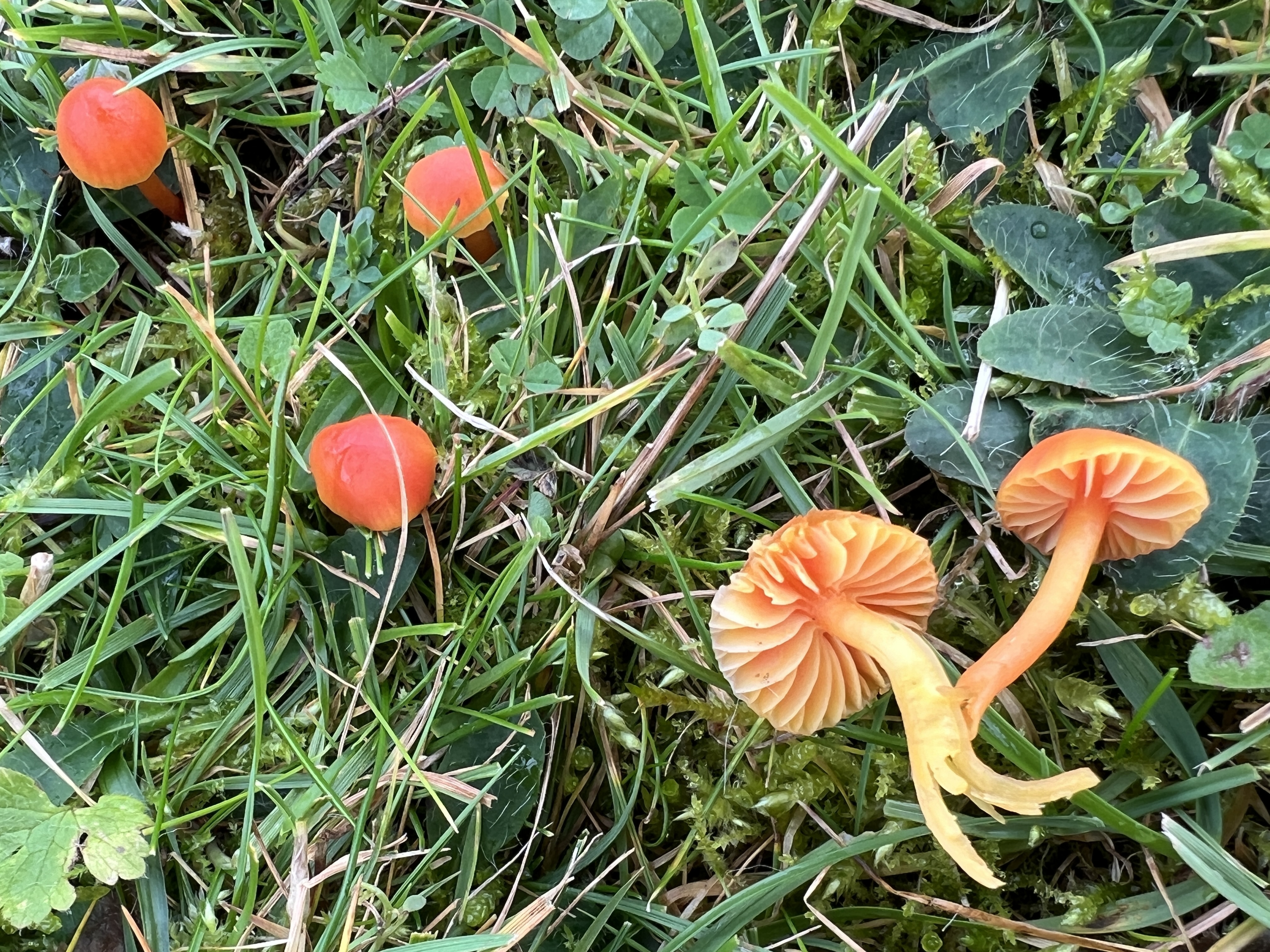
Hygrocybe calciphila, Cotswolds England. Photo Simon Harding
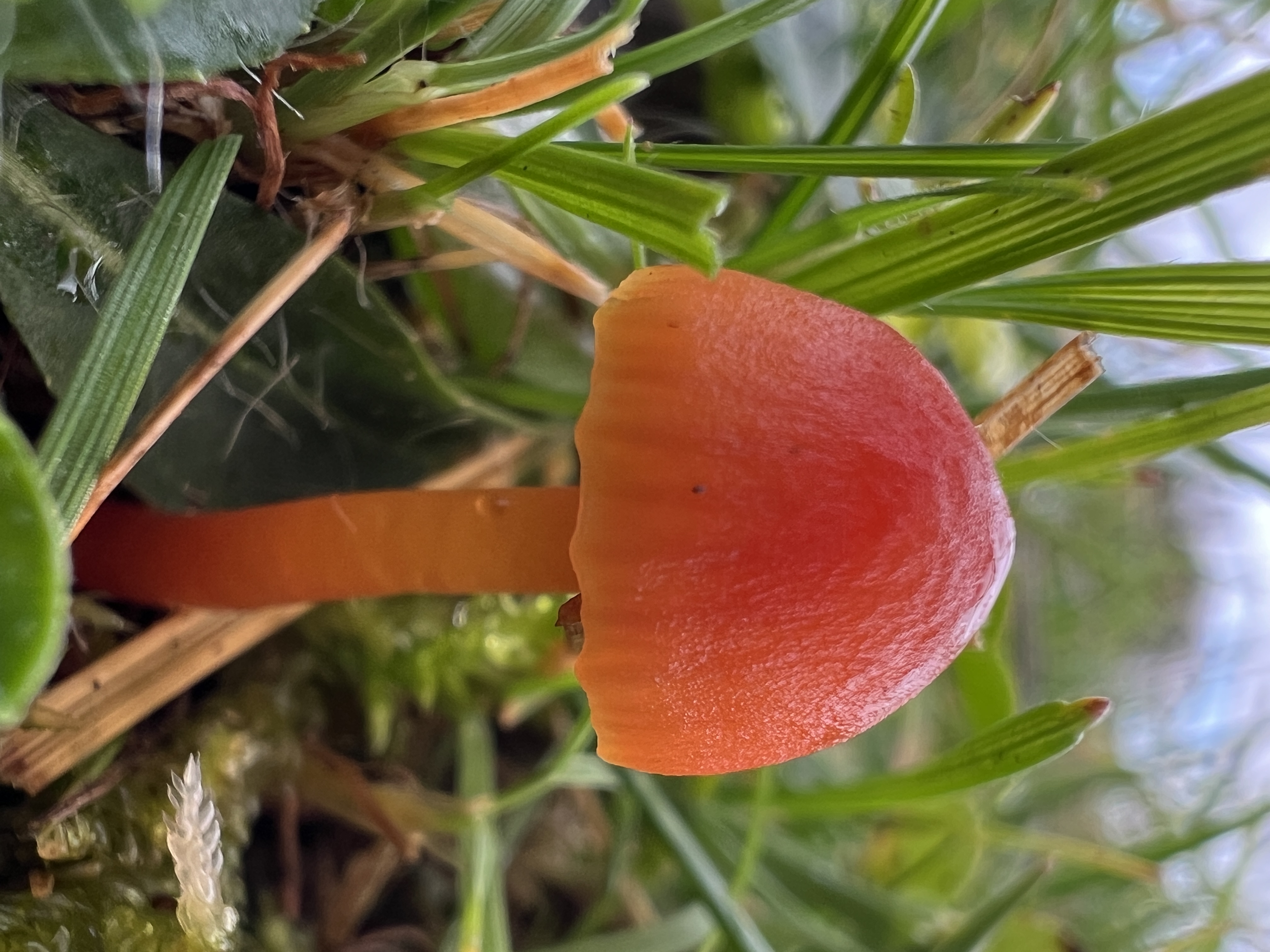
Hygrocybe calciphila, Cotswolds England. Photo Simon Harding
Country occurrence
Regional Population and Trends
| Country | Trend | Redlisted |
|---|