- Proposed
- Under Assessment
- Preliminary Assessed
- Assessed
- ENPublished
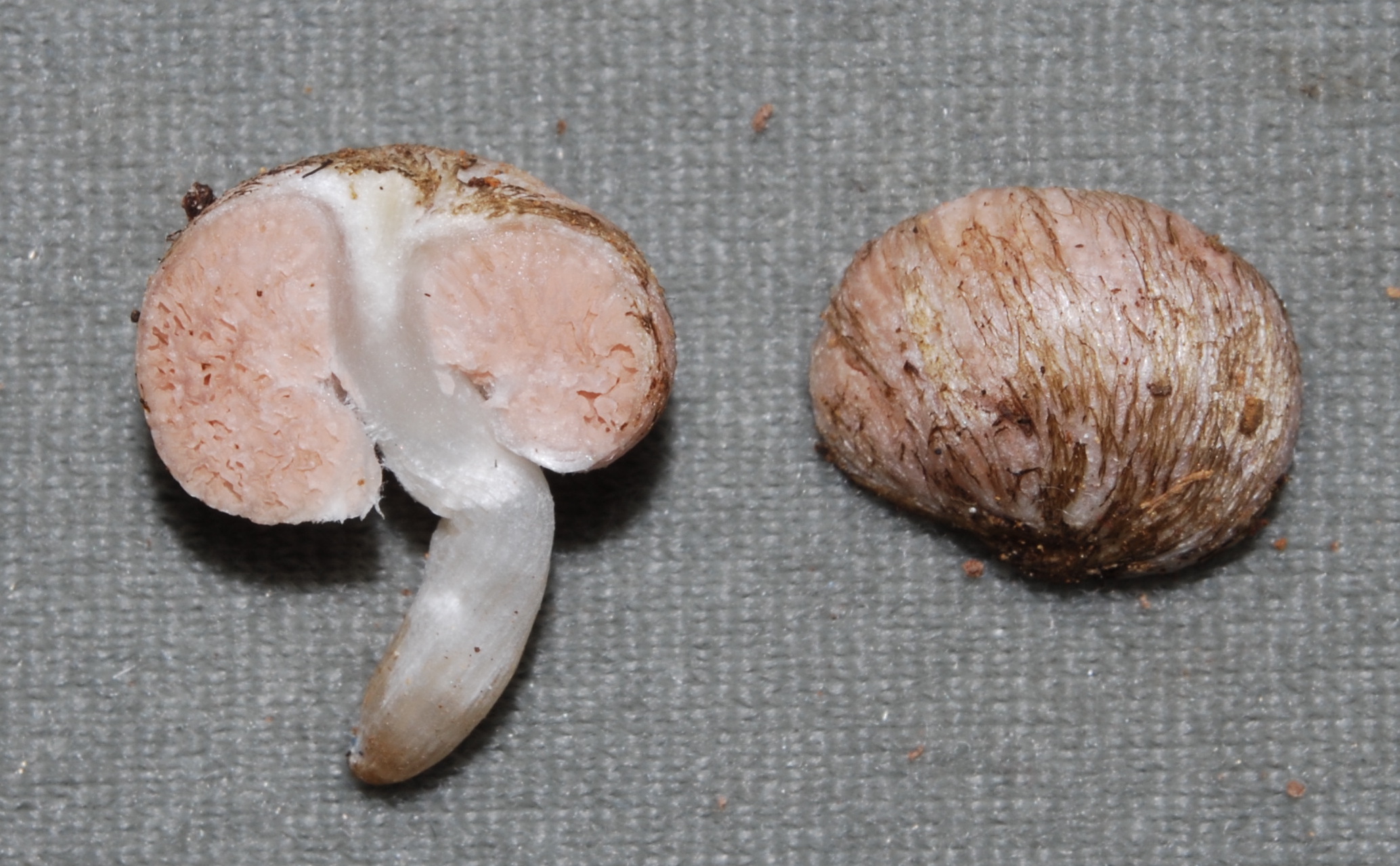
Entoloma chilense (E. Horak) Noordel. & Co-David
Search for another species...
- Scientific name
- Entoloma chilense
- Author
- (E. Horak) Noordel. & Co-David
- Common names
- IUCN Specialist Group
 Mushroom, Bracket and Puffball
- Kingdom
- Fungi
- Phylum
- Basidiomycota
- Class
- Agaricomycetes
- Order
- Agaricales
- Family
- Entolomataceae
- Assessment status
- Published
- Assessment date
- 2020-04-03
- IUCN Red List Category
- EN
- IUCN Red List Criteria
- B1ab(iii,iv,v)
- Assessors
- Giuliana Furci (Fundación Fungi, Chile); Matthew Smith
- Reviewers
- Gregory Mueller (Chicago Botanic Garden / IUCN SSC Mushroom, Bracket and Puffball Specialist Group); Bryn Dentinger (Natural Historla Museum Utah & University of Utah)
Assessment Notes
The content on this page is fetched from The IUCN Red List of Threatened Species: https://www.iucnredlist.org/species/172740223/172861172
Justification
This species is restricted to highly fragmented Valdivian rainforest in Chile's coastal range. It has an extent of occurrence of approximately 2,000 km2 and the population is severely fragmented. A continuing decline is expected in the extent of suitable habitat, the number of locations and subpopulations, and the number of mature individuals; as much of the suitable habitat in the area has already been lost and there is a high likelihood of one of the remaining two known sites (neither of which is protected) being lost due to highway construction. It is therefore, assessed as Endangered.Taxonomic notes
The basionym of this species is Rhodogaster chilensis (E. Horak). The genus Rhodogaster is nested within the Entoloma sensu lato and was transferred to Entoloma by Co-David et al. (2009).Geographic range
This species is rare and has been documented only from two sites in the Valdivian forests of Chile's coastal range. The type was collected in Valdivian forests very close to the Pacific Ocean near Pucatrihue, Chile (as Fucatrihue in Horak 1964). There are newer collections by Smith, Furci and Sandoval near the Monumento Natural Alerce Costero, Chile. Its extent of occurrence is difficult to estimate as there are only two known sites, but taking into account other likely projected areas, it is likely to be in the region of 2,000 km2.Population and Trends
This species is endemic to the Valdivian rainforest in Chile's coastal range and has only been documented at two sites. There are very few collections, but it is difficult to detect as has a truffle-like basidioma and, therefore, it is difficult to estimate its population size with any degree of certainty. However, the population is likely to be in decline, because the coastal Valdivian forests of Chile are a unique ecosystem that is under threat due to logging, burning, grazing, road-building and the expansion of pine plantations. The population is also severely fragmented as its suitable habitat is now restricted to tiny patches.
Population Trend: Decreasing